
Why is the Engineering Plastics Reshaping Modern Manufacturing ?
From lightweight vehicles to smarter electronics, discover how engineering plastics are quietly transforming the products we rely on every day.
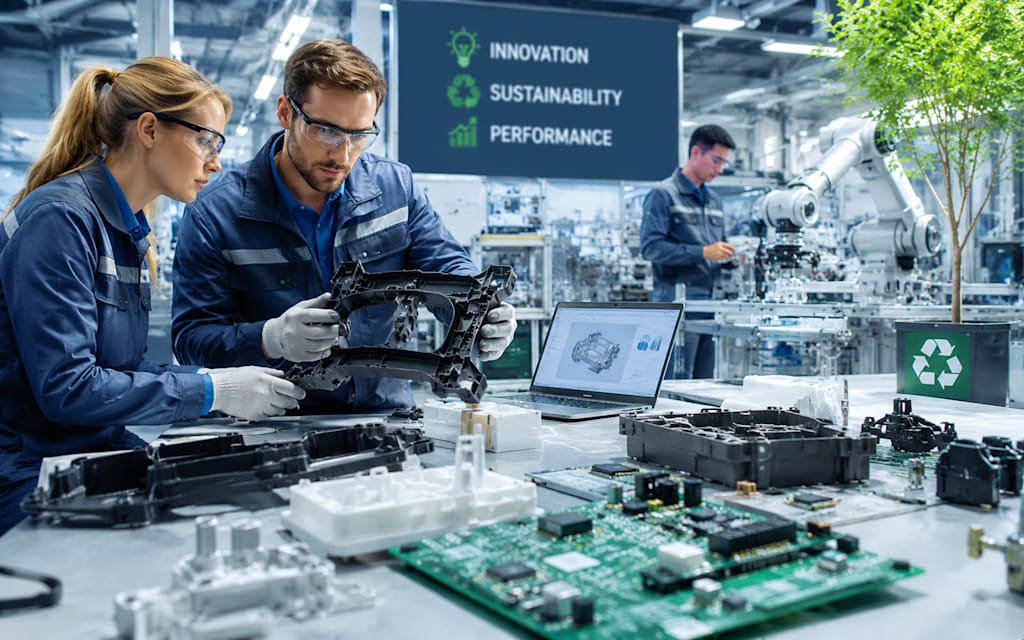
The next time you hold your smartphone, drive your car, or switch on a household appliance, you're interacting with a material that rarely gets the spotlight but powers countless innovations behind the scenes. Engineering plastics have become an essential part of modern manufacturing because they combine strength, durability, and design flexibility in ways that traditional materials often cannot.
For decades, manufacturers depended heavily on metals to build products that needed to withstand heat, impact, and continuous use. Today, the story is changing. Companies across automotive, electrical, electronics, healthcare, industrial equipment, and consumer goods are increasingly replacing heavier materials with high-performance engineering plastics. The result is lighter products, improved efficiency, and more sustainable manufacturing practices.
The global engineering plastics market is projected to grow at a CAGR of 7.24%, highlighting the expanding demand for advanced polymer materials across industries.
The Material Revolution Happening Behind Everyday Products
Walk through any modern factory and you'll notice something fascinating. Components that were once made from steel or aluminum are now being manufactured using engineered polymers. This isn't simply about reducing costs - it's about improving overall product performance.
Engineering plastics are designed to perform under demanding conditions. They resist chemicals, tolerate high temperatures, offer excellent dimensional stability, and provide impressive mechanical strength. These qualities make them suitable for products that require long service life and consistent reliability.
One of the biggest reasons for this transition is the global push toward lightweight manufacturing. Automakers, for example, continuously seek materials that reduce vehicle weight without compromising safety. Every kilogram saved contributes to improved fuel efficiency or longer battery range in electric vehicles.
Similarly, electronics manufacturers prefer engineering plastics because they provide electrical insulation while allowing increasingly compact product designs. Medical equipment manufacturers also rely on these materials due to their durability, sterilization compatibility, and precision molding capabilities.
As innovation accelerates, engineering plastics have become far more than simple substitutes for metal—they are enabling entirely new product designs that were once impossible.
Why Manufacturers Are Investing in Advanced Engineering Plastics
Global manufacturing is becoming smarter, faster, and more resource-efficient. Every production decision now balances performance, sustainability, and long-term operating costs.
Engineering plastics align remarkably well with these objectives.
Their excellent strength-to-weight ratio helps manufacturers produce components that consume fewer raw materials while maintaining structural integrity. Many engineering plastics also reduce corrosion issues, minimizing maintenance requirements over a product's lifespan.
Another major advantage lies in manufacturing flexibility. Injection molding allows complex components to be produced with high precision and repeatability, reducing assembly time and lowering production waste.
Industrial automation is further accelerating demand. Modern factories require durable gears, bearings, connectors, housings, and machine components capable of operating under continuous mechanical stress. Engineering plastics often outperform conventional materials in these specialized applications.
Growing investments in electric vehicles have also expanded opportunities. Battery systems, charging infrastructure, lightweight structural components, and electrical connectors increasingly rely on advanced polymers to improve both performance and safety.
Meanwhile, consumer expectations continue evolving. Today's buyers want products that are lighter, more energy efficient, longer lasting, and aesthetically appealing. Engineering plastics help manufacturers achieve all of these goals simultaneously.
Engineering Plastics Market Size Reflects a Changing Industrial Landscape
When analysts discuss the Engineering Plastics market size, they're really describing something much larger than material demand. The market reflects broader economic shifts toward advanced manufacturing, electrification, digital infrastructure, and sustainable production.
Rapid industrialization across developing economies has increased demand for durable machinery, transportation systems, and electrical equipment—all of which rely heavily on engineering plastics.
The expansion of renewable energy infrastructure also contributes to market growth. Wind turbines, solar installations, electrical distribution equipment, and energy storage systems require materials capable of delivering long-term performance under challenging environmental conditions.
Healthcare continues to emerge as another important growth sector. From diagnostic equipment and surgical instruments to drug delivery devices, engineering plastics provide the precision and reliability required by modern medical technology.
Understanding Engineering Plastics Market Share Across Industries
Examining the Engineering Plastics market share reveals just how diverse the industry's applications have become. The automotive industry remains one of the largest consumers, driven by the ongoing need for lightweight components that improve fuel economy and support electric vehicle development.
Electrical and electronics manufacturers represent another significant segment. The continued expansion of smart devices, connected appliances, telecommunications equipment, and data infrastructure increases demand for materials offering excellent electrical insulation and thermal performance. Industrial machinery manufacturers also contribute substantially as automation technologies spread across factories worldwide. Durable engineering plastics improve machine reliability while reducing maintenance costs.
Construction, aerospace, healthcare, packaging, and consumer products further diversify market demand, making engineering plastics one of the most versatile advanced material categories available today.
Rather than depending on a single industry, the market benefits from multiple sectors experiencing simultaneous technological advancement.
Innovation Will Continue Driving the Next Chapter
One of the most exciting aspects of engineering plastics is that innovation never stands still.
Researchers continue developing materials with improved heat resistance, chemical stability, flame retardancy, recyclability, and environmental performance. Manufacturers are also investing in bio-based materials and circular economy initiatives to reduce environmental impact without sacrificing performance.
Digital manufacturing technologies, including automation and precision molding, are making advanced engineering plastics more accessible across industries of every size.
As global manufacturers pursue greater efficiency, sustainability, and product innovation, engineering plastics will remain central to future industrial development.
The next breakthrough vehicle, medical device, renewable energy system, or smart electronic product may owe much of its performance not to a revolutionary machine, but to the remarkable materials quietly working behind the scenes.
What everyday product do you think has benefited the most from engineering plastics—and would you be surprised to learn how many of its components now rely on these advanced materials?
About the Creator
efingutthomas
My expertise is custom research across industries such as aerospace & defense, agriculture, animal wellness, automation, automotive, chemicals, consumer goods, electronics, energy, finance, food & beverages, healthcare, hospitality and ICT
Enjoyed the story? Support the Creator.
Subscribe for free to receive all their stories in your feed.
Comments
There are no comments for this story
Be the first to respond and start the conversation.