
Why Fake TV Doctors Keep Coming Back
Fake experts, cheap fines, and an aging audience keep the machine running.
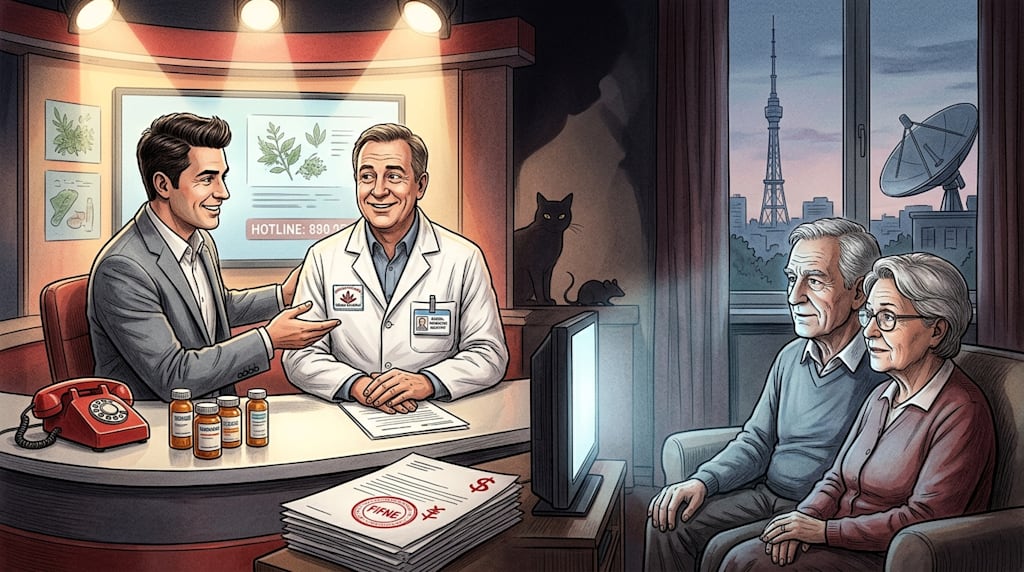
In 2017, a woman named Liu Hongbin appeared on multiple provincial satellite channels as a “Tibetan medicine inheritor,” a “Miao medicine descendant,” and a “disciple of a national master of Chinese medicine.” She was an actor. The State Administration for Industry and Commerce later named her case in a public notice on false advertising. The meme that followed—“I made a decision that goes against my ancestors”—captured the absurdity, but not the mechanics. The mechanics are boring, documented, and still running.
The scam is not a few rogue actors. It is a supply chain: advertisers source products, production companies write scripts, actors play experts, TV stations sell airtime, and hotlines and off-line sales meetings do the harvesting. The gains go to merchants and platforms. The costs land on elderly viewers and their families. The fine, when it comes, is small enough to treat as a business expense. This is why the same show returns after every campaign-style cleanup.
The review has procedures. They are easy to formalize.
A medical advertisement needs a drug advertisement approval document from drug regulators or a medical advertisement review certificate from health authorities. The TV station’s advertising department and chief editor’s office then review the content again. Double insurance, on paper.
The loophole is documented in enforcement notices: the approved script says “supportive conditioning” and “relieves symptoms.” The broadcast version says “cures,” “no recurrence,” “no need for hospital.” Hosts ask follow-up questions. Actors improvise. A few sentences beyond the script do the selling. No one compares the approved script word for word with the broadcast. At many prefecture- and county-level stations, the advertising review job is one person with several other duties, expected to know both law and basic medicine, at a salary that does not attract either.
China’s Advertising Law is explicit. Article 16 prohibits drug advertisements from asserting or guaranteeing efficacy and from using experts, patients, or their images as testimonials. Article 18 applies similar limits to health food advertising. Medical and health programs are also barred from disguised medical advertising. The problem is not the text of the law. It is evidence, jurisdiction, and speed. An ad airs once and is gone. Converged-media livestreams get cut into clips and reposted. By the time a regulator opens a file, the hotline has rung out and the inventory has moved.
The fine is smaller than the ad buy.
The Measures for the Administration of Radio and Television Advertisement Broadcasting set a penalty ceiling that critics have cited for years: violations can be capped at 30,000 yuan, with license revocation reserved for serious cases. Against a title sponsorship for a health product program, 30,000 yuan is not a deterrent. It is a line item.
The Advertising Law allows higher penalties: three to five times the advertising expenses, or 200,000 to 1 million yuan when expenses cannot be calculated, plus license revocation after three violations in two years. The practical questions are which provision applies, who imposes the fine, whether the advertiser can be found, and whether the platform is only lightly touched. When enforcement stops at the broadcast end, the outcome is predictable: the platform pays a toll, the merchant keeps the margin.
Jurisdiction is split. Radio and television authorities regulate broadcasting. Market regulation authorities regulate advertising and market order. Drug regulators regulate drugs and health foods. Health authorities regulate medical institutions and personnel. When a case breaks, each can point to the others. The supply chain also produces local advertising revenue and tax revenue. Local officials have little incentive to dismantle it.
Local stations need the money.
Before mobile internet, local stations could rely on the channel to collect advertising fees. After short video took off, younger audiences left television, and advertisers followed. The remaining big spenders in local TV advertising are concentrated in health products and medicine. Some products carry gross margins and marketing budgets high enough to support full-program title sponsorship and touring promotion. For many local stations, this is not a moral choice. It is a survival line. The industry phrase is “medicine ads keep the station alive.”
Making a platform cut that line on its own is hard. The station knows the rules are being broken. Under revenue pressure, it treats the violation as a calculable cost. Fines are capped. Licenses are rarely revoked. Responsible persons are rarely held accountable. After the attention passes, the show returns.
The “hit-and-run across channels” model makes it harder. The same actor plays a Tibetan medicine expert on one station and a Miao medicine expert on another. There is no nationwide blacklist of on-screen “experts” and no public qualification verification database for the people who play them. Production companies, advertisers, actors, and platforms can cut responsibility into layers. When a case breaks, finding the responsible party is often impossible.
The elderly are not stupid. Their trust is being used.
The most stable audience for this advertising is older viewers. Children are away. Health anxiety is high. Information channels are narrow. The TV station logo functions as a credibility endorsement. The sales script also sells companionship: someone calls them “uncle” and “auntie,” someone delivers eggs, someone organizes a free health check. They buy medicine, and they buy the feeling of being cared about.
Younger viewers who see an “expert lecture” search for qualifications, approval numbers, and company records. Older viewers are more likely to believe: “It is on TV, so it must be real.” When a local station sells airtime to a health product merchant, the logo becomes part of the scam. Reminding people “don’t believe it” is not a policy. Community reporting rewards, warnings to adult children, media literacy education for older adults, and coordinated crackdowns on off-line “expert lecture” sales meetings are policy. If enforcement hits only TV ads, the audience is pulled into WeChat groups and hotel conference rooms the next day.
Campaign-style cleanup rebounds because the incentive survives.
Regulators have run repeated campaigns. One official announcement stated that television channels nationwide had fully cleared false medical advertisements by a set date. Not long after, a provincial station was exposed again and trended online. When attention comes, ads are pulled. When attention passes, the show resumes. It is a cat-and-mouse game, and the mouse knows the schedule.
Routine monitoring is the missing piece. Ad broadcasts need to be archived for word-for-word comparison. AI voice and subtitle monitoring need to flag high-risk claims such as “cure” and “no recurrence.” Converged-media livestreams need synchronized inspection. Reports need rapid response. Penalties need to be linked to title sponsorship fees, so that illegal gains are reduced to zero rather than treated as operating costs.
What would actually change the math
Four changes would move the needle. None requires a new law.
First, pursue the advertiser. The source of false advertising is the seller. Apply the Advertising Law at the top of its range, trace liability to the company’s actual controller, and build a cross-department blacklist that follows the company across provinces.
Second, build a verification database for on-screen “experts.” Physician practice registration, drug advertisement review approvals, and disclosure of the actor-role relationship should be checkable before a program airs. A verified fake expert, fake inheritor, or fake patient should be barred for a set period from radio, television, and converged-media advertising.
Third, make the platform carry the cost. A 30,000-yuan fine is not accountability. Advertising revenue structure audits, channel assessments, license downgrades, and personal accountability for responsible editors and managers are. If a platform eats from the supply chain, it should be liable for the supply chain.
Fourth, give local stations a replacement revenue path. Blocking without channeling pushes stations toward other loopholes. Fiscal support, public cultural service procurement, and matching with compliant advertising resources are the unglamorous part of the fix. Without them, “medicine ads keep the station alive” will survive every campaign.
Closing
TV false medical advertising persists because too many people know about it and quite a few benefit. Review has procedures, but the procedures become formalistic. Regulation has division of labor, but the division becomes diluted responsibility. Penalties have rules, but illegal gains far exceed illegal costs. Local stations face survival pressure, older viewers face an information gap, and merchants enjoy high gross margins. Each link feels it is only “cooperating a little.” Together they form a harvesting machine.
To root it out, it is not enough to hit the TV station advertising department. Advertisers, producers, broadcast platforms, review accountability, alternative revenue, and the information environment for older viewers must all move at the same time. Otherwise, once the attention passes, someone on TV will still make “a decision that goes against my ancestors.” And the audience outside the screen will still believe that station logo.
About the Creator
Jin
Writer of reamstories
https://reamstories.com/jin
Enjoyed the story? Support the Creator.
Subscribe for free to receive all their stories in your feed. You could also become a paid subscriber, letting them know you appreciate their work.
Comments
There are no comments for this story
Be the first to respond and start the conversation.