
Why Every App You Use Now Talks to Another
How the Integration Platform-as-a-Service Industry Is Quietly Reshaping Digital Business
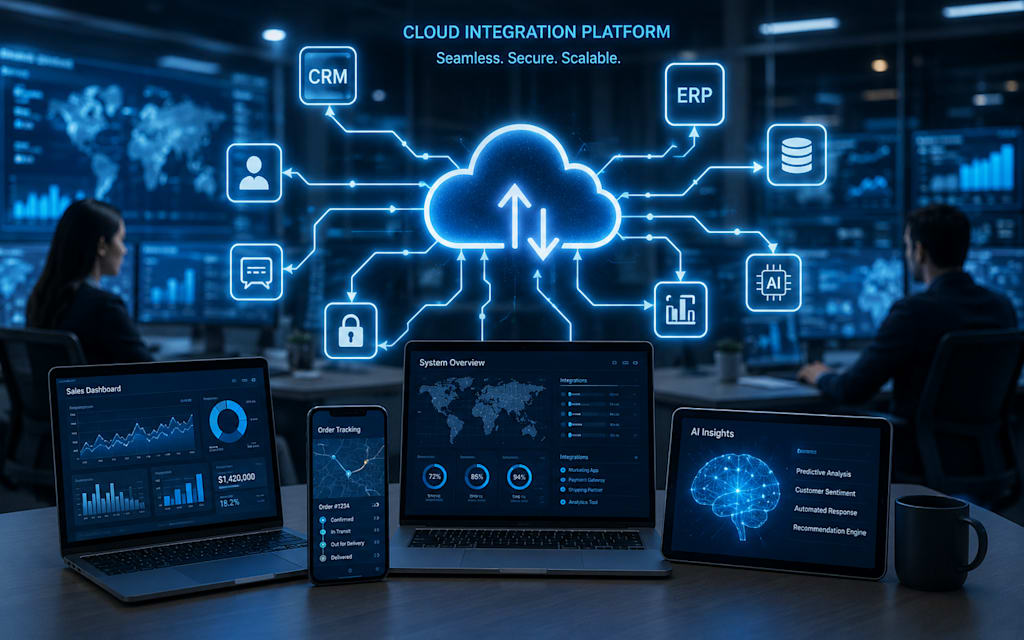
The notification appeared in seconds.
A customer placed an online order. Instantly, inventory updated, payment systems synced, delivery software activated, and a support chatbot sent confirmation — all without a single employee touching a spreadsheet.
To most people, it looked ordinary.
But behind that smooth digital experience sits a hidden layer of technology quietly transforming how modern businesses operate: the integration platform-as-a-service market.
For years, companies struggled with disconnected software. Sales teams used one platform, finance used another, customer support worked elsewhere, and data rarely moved cleanly between them. Employees wasted hours copying information manually while businesses lost visibility across operations.
Now, organizations are racing toward connected ecosystems where applications communicate in real time. That shift is changing how enterprises scale, automate, and compete in the AI-driven economy.
According to Mordor Intelligence, the integration platform-as-a-service market size is expected to grow from USD 9.24 billion in 2026 to USD 20.93 billion by 2031, advancing at a CAGR of 17.75% during 2026-2031. That projection reflects how critical integration has become for digital transformation strategies worldwide.
Why Businesses Can No Longer Afford Disconnected Systems
The modern workplace no longer operates from a single office, platform, or cloud environment.
A marketing manager might work from a CRM dashboard, while finance teams rely on cloud accounting software. Human resources may use separate workforce tools, while operations depend on logistics platforms powered by AI analytics.
Without integration, every department becomes an isolated island.
That fragmentation creates more than inconvenience. It slows decisions, increases operational risk, and weakens customer experiences. In industries where consumers expect instant service, disconnected systems can quietly damage trust.
This is where the integration platform-as-a-service Industry becomes essential.
These platforms allow businesses to connect applications, automate workflows, and move data securely across systems without building every integration manually. Instead of spending months developing custom connections, organizations can deploy integrations faster and scale operations more efficiently.
The rise of AI is also accelerating demand.
AI systems rely heavily on clean, connected, real-time data. A disconnected organization cannot fully leverage predictive analytics, automation, or intelligent customer experiences. As companies invest more aggressively in AI adoption, integration infrastructure becomes a foundational requirement rather than an optional IT upgrade.
That reality is influencing several important integration platform-as-a-service market trends:
Growing adoption of hybrid and multi-cloud environments
Rising enterprise demand for workflow automation
Expansion of AI-powered business operations
Increased focus on real-time analytics and data synchronization
Higher demand for low-code integration tools
These changes are affecting companies of every size — not just global enterprises.
Small businesses now operate across payment gateways, ecommerce systems, inventory tools, and social platforms simultaneously. Even creators and freelancers depend on connected ecosystems to manage audiences, subscriptions, analytics, and customer communication.
The invisible infrastructure behind digital convenience is becoming one of the most valuable assets in business technology.
The Quiet Technology Powering the AI Economy
One reason the integration platform-as-a-service market growth story matters is because most users never see it directly.
People notice fast deliveries, personalized recommendations, accurate notifications, and seamless customer support. They rarely think about the complex integrations making those experiences possible.
Yet businesses increasingly understand that digital success depends on invisible operational efficiency.
Imagine a healthcare provider attempting to synchronize patient scheduling, billing, insurance verification, and telemedicine platforms manually. Or a retailer trying to manage ecommerce, warehouse logistics, payment processing, and customer engagement without integrated systems.
The result would be chaos.
As industries digitize further, connected infrastructure becomes a competitive advantage. Organizations with faster integrations can launch services quicker, adapt to market changes faster, and improve customer experiences more consistently.
This momentum is also shaping the integration platform-as-a-service market forecast over the next several years.
Companies are no longer asking whether integration matters. They are asking how quickly they can modernize their architecture before falling behind.
Another major factor influencing the market is the growing conversation around data visibility and decision-making. Leaders increasingly want unified dashboards that combine insights from sales, operations, customer service, cybersecurity, and AI analytics into one ecosystem.
That requires reliable integration layers.
At the same time, businesses are paying closer attention to the evolving integration platform-as-a-service market share landscape as providers compete to deliver more scalable automation, stronger security frameworks, and easier deployment capabilities.
The technology may sound technical, but its impact is deeply human.
Employees spend less time handling repetitive manual tasks. Customers receive faster support. Teams collaborate more effectively. Businesses react faster during disruptions. Data becomes more useful instead of overwhelming.
And in an economy increasingly shaped by AI assistants, automation, and real-time decision systems, those advantages matter more every year.
The next time an app updates instantly, a package arrives on schedule, or customer support already knows your issue before you explain it, there is a strong chance integrated cloud platforms are working silently in the background.
The question is no longer whether connected ecosystems will define the future of business.
The question is: Which industries will transform fastest as integration becomes the backbone of the digital economy?
What do you think — are connected digital ecosystems improving everyday life, or are businesses becoming too dependent on automated platforms?
About the Creator
Enjoyed the story? Support the Creator.
Subscribe for free to receive all their stories in your feed.
Comments
There are no comments for this story
Be the first to respond and start the conversation.