
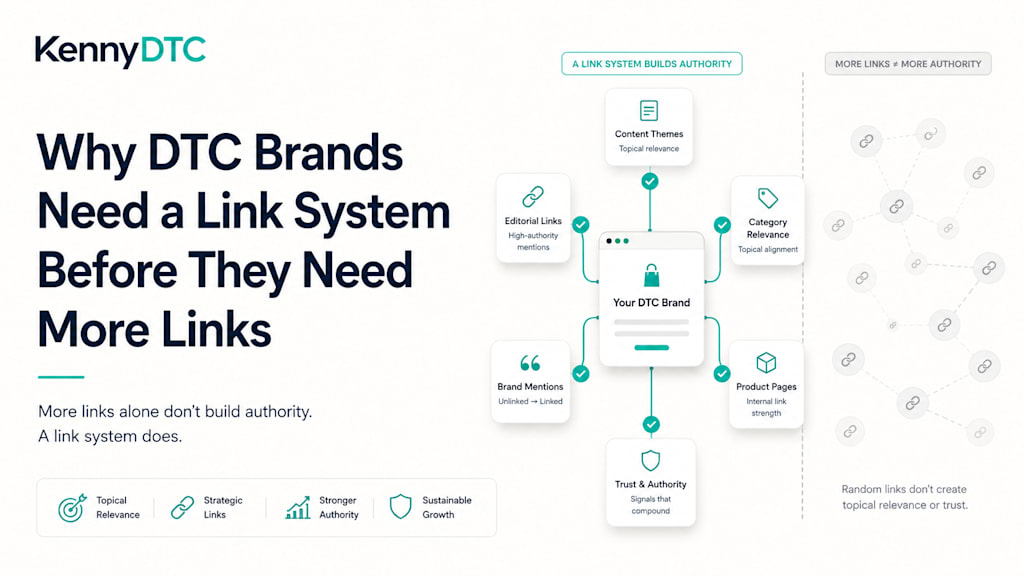
Why DTC Brands Need a Link System Before They Need More Links
Most DTC founders understand traffic.

They know how to test ads, build landing pages, work with creators, refresh product images, and adjust offers when conversion rates start to move. But when the conversation turns to SEO and backlinks, things often become less clear.
Some brands treat backlinks as a numbers game. They ask how many links they need, what domain rating is enough, or whether a dofollow link from a high-authority site will move rankings. These questions are not wrong, but they usually skip the bigger issue.
A DTC brand does not just need more links.
It needs a link system.
That system should help search engines understand what the brand is about, help users see the brand in more trusted places, and help AI search tools connect the brand with the right topics. A random backlink can sometimes create movement. A structured external authority plan is what builds long-term visibility.
This is especially important for smaller DTC brands. They may not have years of brand search volume, media coverage, reviews, or organic mentions. When a potential customer searches the brand name and finds very little outside the website itself, trust becomes thin.
Backlinks are not only about rankings. They are also part of the public evidence that a brand exists in a real category.
The mistake: starting with authority before building relevance
Many brands want authority links first.
That is understandable. A link from a strong site looks impressive. It feels safer to report. It may even create a short-term ranking signal. But if a young DTC site has no clear topical footprint yet, authority alone can feel disconnected.
For example, a jewelry brand needs to be associated with gift ideas, relationships, fashion, personal style, or emotional connection. A skincare brand needs to be connected with ingredients, routines, skin concerns, beauty education, and product comparisons. A pet brand needs to appear around pet care, home living, cleaning, training, or animal wellness.
Before chasing the biggest domain, the brand needs to answer a simpler question:
Where should this brand naturally be mentioned?
This is where many backlink campaigns go wrong. They build links that look strong in a spreadsheet but feel unnatural in the real world. A search engine can see the link, but it may not clearly understand why that link belongs there. A user can click the article, but the mention may feel inserted instead of earned.
Good backlink work starts with relevance.
Layer one: the cold-start foundation
Every DTC brand has a cold-start phase.
At this stage, the site may have decent product pages, a few blog posts, and some paid traffic, but very little external authority. The goal is not to chase the hardest keywords immediately. The goal is to help the brand stop looking isolated.
A cold-start backlink foundation should focus on basic trust signals.
That usually means creating relevant external mentions, clean anchor text distribution, branded links, homepage links, and a few category-level links where appropriate. The purpose is not to manipulate rankings aggressively. It is to create a more natural external footprint.
For a new or underdeveloped DTC site, this stage matters a lot. Search engines need context. AI search tools need sources. Users need reassurance.
A brand with no external references is harder to trust than a brand that appears across relevant articles, niche blogs, creator discussions, interviews, and topical resources.
This is why I usually see the first backlink layer as a foundation, not a shortcut.
Layer two: cost-efficient vertical relevance
Once a brand has a basic external footprint, the next step is vertical relevance.
This is where the work becomes more specific. A DTC brand should not build links from random marketing sites just because they are available. It should appear in content environments that match the product category and customer mindset.
A home decor brand should not only be linked from generic SEO articles. It should have mentions in lifestyle, interior design, small-space living, material selection, and home improvement content.
A wellness brand should appear around routines, daily habits, ingredient education, and personal care.
A DTC accessory brand should show up in fashion, gifting, couple lifestyle, personal expression, and trend-related content.
This kind of vertical link building is often more cost-efficient than chasing expensive authority placements too early. It helps the brand build topic consistency. It also makes anchors and surrounding text feel more natural.
In my view, this is one of the most practical stages for growing DTC brands. It keeps cost under control while still building a stronger connection between the brand and its category.
Layer three: competitor backlink mapping
At some point, the brand needs to stop guessing.
This is where competitor backlink research becomes useful.
The goal is not to copy competitors blindly. Many competitors have messy link profiles. Some links may be irrelevant, paid, outdated, or low quality. But competitor research can reveal useful patterns.
It can show which sites mention similar products.
It can show which content types attract links in the category.
It can show whether competitors rely on reviews, roundups, interviews, resource pages, media coverage, guest articles, or affiliate-style content.
It can also show gaps.
The best competitor backlink strategy is not “copy every link they have.”
It is to ask:
Which links explain why they rank?
Which links strengthen their category authority?
Which links are realistic for my brand to earn or place?
Which links are not worth chasing?
Which gaps can my brand fill better?
For DTC brands, this step is often the bridge between basic SEO work and a more serious growth system. It brings strategy into link building instead of treating backlinks like inventory.
Layer four: authority in the right verticals
Authority links still matter.
But they matter more when they sit on top of relevance, not instead of it.
An authority placement is most useful when it reinforces the brand’s category position. If a DTC skincare brand earns a mention in a trusted beauty or wellness publication, that is much stronger than a random link from an unrelated high-authority website. If a pet product brand appears in a respected pet care or home living context, the signal is clearer.
The same principle applies to AI search and generative discovery.
AI systems do not only look for a website’s own claims. They also look for external confirmation. When a brand is mentioned across relevant, credible sources, it becomes easier for search systems to associate that brand with a product category, use case, or problem.
This is why authority should be layered carefully.
First, establish the brand.
Then build topical relevance.
Then analyze competitor patterns.
Then add stronger authority placements in the right verticals.
That sequence is usually healthier than jumping straight into expensive links without a base.
Backlinks should support brand memory
There is another part of backlinks that people often ignore.
Backlinks help with brand memory.
A user may not buy the first time they visit a DTC site. They may discover the brand through search, leave, see it mentioned in an article later, search the name again, read a comparison, and come back through a paid ad or email campaign.
In analytics, the final conversion may belong to another channel. But the external mentions helped reduce doubt along the way.
That is why I do not separate link building from brand building. For a DTC brand, every external mention should answer one question:
Does this make the brand easier to trust?
If the answer is no, the link may not be as valuable as it looks.
A more practical way to think about DTC link building
For brands that are still building their organic presence, I prefer a layered approach:
Start with a cold-start foundation, so the site is not isolated.
Add cost-efficient vertical relevance, so the brand becomes connected to the right topics.
Use competitor backlink mapping, so decisions are based on market evidence instead of guesswork.
Then pursue authority placements in relevant verticals, so the brand gains stronger trust signals without losing topical focus.
This is the kind of thinking behind the DTC SEO and external authority work I write about at KennyDTC.
Backlinks are not magic. They will not fix a weak product, unclear positioning, thin content, or poor conversion experience.
But when a DTC brand already has a real offer, a clear category, useful content, and a website that can convert, backlinks can become a serious growth layer.
Not because they create shortcuts.
Because they make the brand easier to understand, easier to verify, and easier to trust.
And in DTC, trust is often the difference between traffic that disappears and traffic that eventually turns into customers.
About the Creator
Enjoyed the story? Support the Creator.
Subscribe for free to receive all their stories in your feed.
Comments