
Why China Blocked a Gas Price Hike When Inflation Was Almost Zero
The CPI number looked calm. The cost shock underneath it did not.
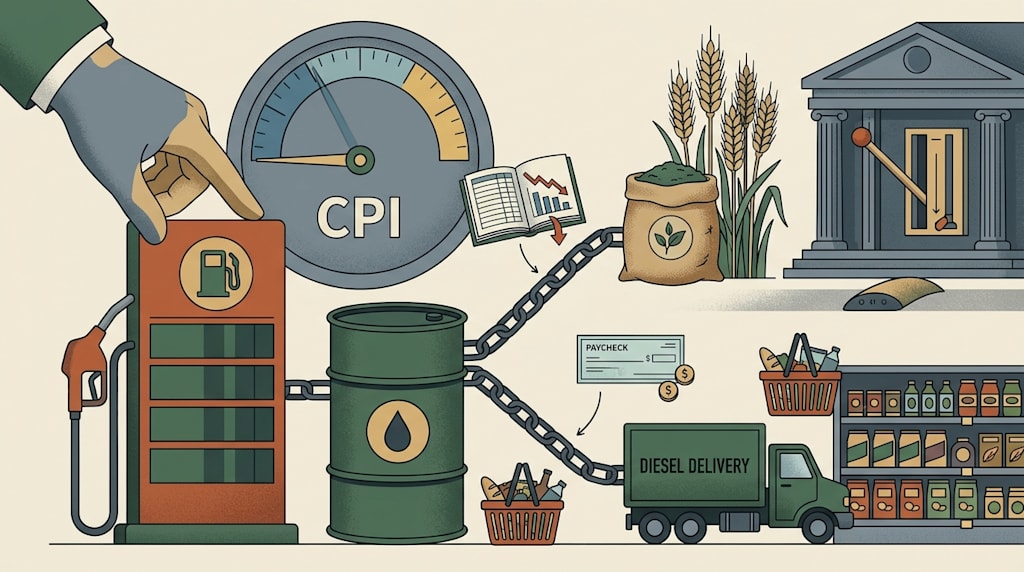
In March 2026, China’s refined oil price adjustment produced an odd result. Under the existing formula, gasoline and diesel should have risen by 2,205 yuan and 2,120 yuan per ton. The actual increases were 1,160 yuan and 1,115 yuan per ton. That is more than 1,000 yuan less per ton, or about 0.85 yuan less per liter. It was the first temporary adjustment since the current pricing mechanism took effect in 2013.
Domestic inflation was low at the same time. From January to September 2026, CPI rose 0.9% year on year. Retail sales grew 1.1%. An economy with almost no price growth and weak consumption should not need to worry about inflation. Yet policymakers chose to hold down fuel prices. The contradiction points to a problem the CPI can hide. An imported cost shock can pass through the price system and hit corporate profits, employment, and household incomes.
Low CPI is part of the problem
The usual view treats inflation as a general rise in prices. Low CPI then means no inflation problem. High CPI means inflation must be suppressed. Cost-push inflation works differently. It enters from the supply side. Higher external energy prices change firms’ costs first. Shelf prices lag.
Firms face harder choices than “raise prices or not.” Keep prices unchanged and profits shrink. Raise prices to protect margins and sales may fall, which also shrinks total profit. Cut other costs and wages, research, or service quality may suffer. Each path carries pressure. The pressure simply does not appear in CPI yet. When demand is weak and mid- and downstream competition is fierce, firms and households absorb the shock. Calm price data can hide erosion in profit statements.
The oil shock was not isolated. In March 2026, Middle East tensions pushed international crude prices sharply higher. Brent briefly broke $100. Crude in some regions rose above $150 per barrel. China imports more than 70% of its crude. Higher international prices raise import and fuel costs directly. Domestic demand management cannot easily offset that.
The shock travels farther than the gas pump
Oil price discussions often stop at retail gasoline and diesel. Petroleum products include solvents, chemical feedstocks, lubricants, paraffin wax, asphalt, and petroleum coke. Each sits inside a longer supply chain. Fertilizer is one of the most important transmission nodes.
A decomposition of global food price drivers from 2000 to 2023 found that global input costs contributed most to food price increases over the long run. Crude oil and fertilizer prices played key roles. Fertilizer price shocks have a significant effect on corn and soybean prices. Energy shocks usually move through upstream costs, chemical and manufacturing sectors, distribution channels, and eventually food prices. Fertilizer sits at a critical point. It absorbs petroleum-derived costs and feeds grain production costs. Expensive fertilizer raises the cost of growing grain. Higher grain costs lift the floor under food prices.
Logistics is another underestimated path. Fuel-powered vehicles still dominate road freight. Diesel heavy trucks are the main force in express delivery, fast freight, and cold chain. At some express companies’ transfer warehouses, diesel heavy trucks account for more than 75% of capacity. Higher diesel prices do not stay on the gas station sign. They move through transport, supply, and sales chains and press on a wider range of goods prices. Many CPI items are sensitive to logistics costs. That sensitivity does not appear at full strength immediately.
Both paths point to one conclusion. Oil prices raise the base layer of prices across many categories. Transmission is gradual, dispersed, and full of friction. Gradual transmission is easy for CPI data to miss early. Dispersed transmission is hard for one aggregate policy to intercept.
The risk is stagnation without inflation
Calling cost increases “bad inflation” can mislead. Inflation is not naturally good or bad. Under some conditions, a cost-push shock can produce a bad outcome. Prices fail to rise, while output and incomes fall first.
The logic is simple. Costs rise. Final demand cannot support matching price increases. Corporate profits shrink. Firms adjust hiring and investment. Wage growth slows. Employment expectations weaken. Consumption falls further. Weaker demand makes cost pass-through harder. Harder pass-through increases pressure on profits and jobs. If this loop reinforces itself, the economy can drift toward stagnation with cost pressure, not textbook demand-pull inflation.
The 2026 data fit the warning zone. CPI is below 1%. Retail sales growth is around 1%. Some months posted negative retail sales growth. Final demand cannot absorb a large cost shock. If higher oil prices passed through quickly and fully, the likely result would be compressed profits, weaker employment and income expectations, and softer consumption. That is not a healthy rebound in CPI. Welcoming the shock as “the inflation we wanted” would misread it.
Huang Yiping, a member of the People’s Bank of China Monetary Policy Committee, offered a policy note in March 2026. He said sharp energy price increases may affect corporate profitability and growth. With domestic inflation below 1%, there is room to digest imported inflation. But if the inflation is imported, the space for monetary policy response may be limited. Monetary policy needs to respond only when the shock becomes broad inflation. The distinction matters. An imported cost shock hurts profits and growth. Broad inflation expectations require a systemic monetary response. The buffer at the refined oil link tries to keep the shock in the first stage.
Why use pricing instead of rate hikes
A natural question follows. If imported inflation is a concern, why not raise interest rates? The tool has to match the shock.
This pressure comes from the external supply side. Domestic demand is not overheated. Rate hikes suppress aggregate demand by raising borrowing costs. They cannot make international oil prices fall. They cannot directly increase crude supply. They can make domestic corporate financing more expensive, household mortgages larger, and government debt costlier. With weak consumption and pressured profits, rate hikes could hit demand and employment before they lower inflation.
Monetary policy still has a role if the shock lasts long enough and becomes large enough. If it changes inflation expectations, triggers wage-price spirals, or causes broad second-round transmission, the central bank must respond. Huang’s line marks that boundary. During cost transmission, the better tools act on the chain itself. These include pricing buffers, targeted fiscal support, reserve adjustments, and temporary relief for vulnerable groups and agricultural transport.
The refined oil pricing mechanism is one of the few workable levers. It places a speed bump between external oil prices and domestic costs. The $130 per barrel upper limit and $40 per barrel lower limit were designed for extreme swings. The March 2026 adjustment did not change the framework. It held down part of the formula-implied increase. The move does not erase the oil shock. It changes how fast the shock reaches corporate balance sheets and household budgets. With weak demand, speed matters. A slower shock gives firms more room to adjust and reduces tail risks for jobs and incomes.
The United States offers a comparison. Higher oil prices pushed up inflation. The Federal Reserve had been inclined to ease. It had to keep a tightening stance and faced pressure to raise rates again. Federal Reserve research shows that a sustained 10% oil price increase typically adds about 40 basis points to headline inflation over the following quarters. Oil above $90 for more than six months could add about 60 basis points to annual U.S. inflation. The Bank of Canada raised rates in October 2026 for a similar reason. It wanted to reduce the risk that high energy prices would spread into broad inflation. When energy shocks last, central banks face painful choices between growth and prices. China’s buffer at the refined oil link buys time. It tries to avoid reaching that fork too early.
Restraint is a judgment
Return to the opening puzzle. CPI is near zero. Why hold down oil prices? The target is the chain that turns a cost shock into profit contraction, job pressure, and weaker consumption under low demand. The CPI reading is not the main threat.
The refined oil pricing mechanism is a buffer, not a cure-all. It cannot replace targeted fiscal support for agriculture, transport, and vulnerable groups. It cannot replace reserve adjustment and expectation management. It cannot repair income expectations. At the steepest point of the shock, it can turn the gap between the formula-implied increase and the actual increase into breathing room for firms.
In an economy with consumption growth near 1% and CPI below 1%, restraint in oil price transmission shows vigilance about stagnation. It does not show fear of inflation. Inflation can be a signal. It can also be an erosion. The difference lies in whose income, profits, and job expectations absorb the shock. Suppressing bad inflation does not require freezing prices. It requires blocking the transmission path that does the most damage to output and incomes.
About the Creator
Jin
Writer of reamstories
https://reamstories.com/jin
Enjoyed the story? Support the Creator.
Subscribe for free to receive all their stories in your feed. You could also become a paid subscriber, letting them know you appreciate their work.
Comments
There are no comments for this story
Be the first to respond and start the conversation.