
Why Cerium Dioxide Matters in Precision Polishing, Catalysis, and Advanced Materials
A simple look at how cerium dioxide supports smoother surfaces, cleaner reactions, and next-generation material performance.

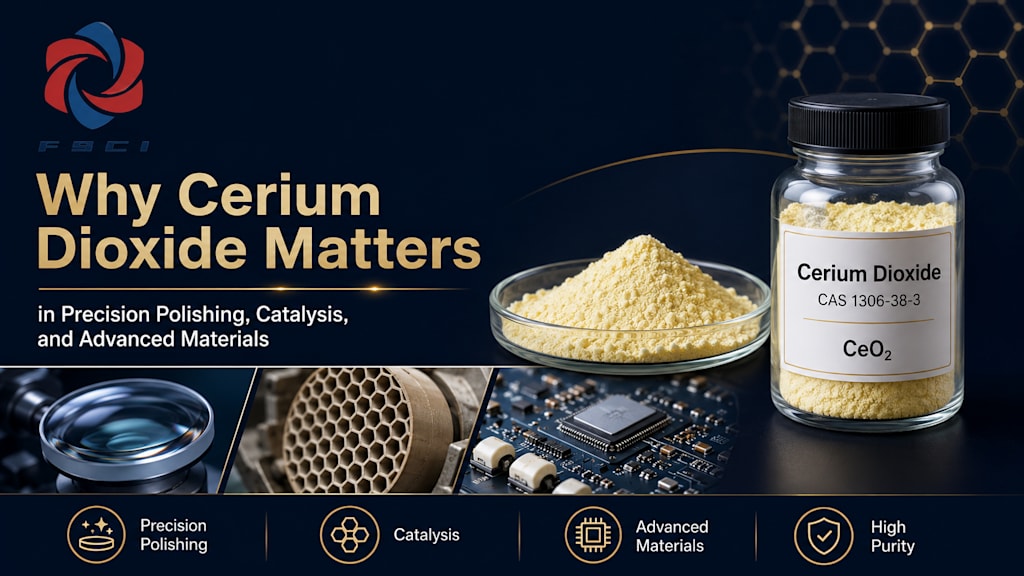
In modern manufacturing, some materials play a critical role even though most people never see them in the final product. Cerium dioxide is one of those materials.
Also known as ceria, cerium oxide, or cerium(IV) oxide, cerium dioxide is a rare earth oxide widely used in precision polishing, glass processing, catalyst systems, ceramics, electronics, and energy-related materials. Its value comes from a combination of chemical stability, polishing performance, oxygen storage behavior, and compatibility with demanding industrial processes.
For manufacturers working with optical glass, display panels, automotive catalysts, semiconductor materials, or advanced ceramics, cerium dioxide is more than a simple inorganic powder. It is a functional material that can influence surface quality, catalytic performance, and long-term product reliability.
A Rare Earth Oxide With Practical Industrial Value
Cerium belongs to the rare earth element family, but cerium-based materials are not limited to niche scientific research. Cerium dioxide has become one of the most commercially important rare earth oxides because it offers practical performance in real manufacturing environments.
The material is typically supplied as a pale yellow to white powder. In industrial use, buyers usually evaluate it based on purity, particle size, particle distribution, surface behavior, impurity levels, and application suitability.
This is especially important because the same chemical compound may be used in very different ways. A cerium dioxide powder for general ceramic use may not meet the same requirements as a high-purity polishing material for optical lenses or semiconductor wafer processing.
Cerium Dioxide in Glass and Optical Polishing
One of the best-known uses of cerium dioxide is as a polishing agent for glass and optical surfaces. In this field, cerium dioxide is valued because it does not work only as a mechanical abrasive. It also interacts chemically with silica-based surfaces, which helps create a smoother and more refined finish.
This chemical-mechanical polishing behavior makes cerium dioxide useful in applications such as optical lenses, display glass, automotive glass, camera lenses, telescope components, and precision glass parts.
For buyers in the polishing industry, particle consistency is critical. If the particle size is too coarse or poorly controlled, it may cause scratches or uneven surface quality. If the material is too fine or unsuitable for the process, it may reduce removal efficiency. This is why polishing-grade cerium dioxide is often selected according to both chemical purity and physical particle characteristics.
Why It Is Important in Catalysis
Cerium dioxide is also widely discussed in catalyst systems because of its ability to store and release oxygen. This oxygen storage behavior allows ceria-based materials to participate in oxidation and reduction reactions.
In automotive three-way catalytic converters, cerium dioxide can help support the treatment of exhaust gases by assisting the conversion of carbon monoxide, nitrogen oxides, and unburned hydrocarbons under changing oxygen conditions. In industrial catalysis, it may also be used as a catalyst support or functional additive.
The catalytic value of cerium dioxide is closely related to the reversible change between cerium oxidation states and the formation of oxygen vacancies. In simple terms, the material can help manage oxygen availability at the catalyst surface, which is why it remains important in emission-control and chemical-processing technologies.
Applications in Ceramics, Electronics, and Energy Materials
Beyond polishing and catalysis, cerium dioxide is also used in advanced materials. Depending on grade and specification, it may appear in electronic ceramics, phosphors, refractory oxides, solid oxide fuel cell materials, and functional coatings.
In these areas, impurity control becomes especially important. Trace elements that may be acceptable in general industrial use can affect electrical, optical, or thermal performance in advanced applications. For high-end ceramic or energy-related materials, buyers may require higher purity grades and more detailed documentation.
This is one reason cerium dioxide sourcing is often specification-driven. Industrial buyers are not simply searching for a product name. They are searching for a grade that matches a process.
What Buyers Should Check Before Sourcing Cerium Dioxide
For a material such as cerium dioxide, purchasing decisions should be based on more than price. The right grade depends on the final application.
First, buyers should confirm the chemical identity. Cerium dioxide may be listed as ceria, cerium oxide, cerium(IV) oxide, ceric oxide, or CeO2. The CAS number 1306-38-3 helps avoid confusion during procurement.
Second, purity should be matched to the application. General industrial use may not require the same purity as optical polishing, semiconductor-related polishing, electronic ceramics, or fuel cell materials.
Third, particle size and distribution are important, especially for polishing applications. Surface finish quality often depends on how consistently the powder behaves during processing.
Fourth, documentation should be checked. COA, MSDS, product specification, packaging details, and batch information help technical and purchasing teams evaluate whether a material is suitable.
Fifth, packaging and storage matter. Cerium dioxide powder should be stored in dry, well-ventilated conditions and protected from moisture and contamination.
Why Supplier Experience Matters
In fine chemicals and specialty inorganic materials, a supplier’s value is not limited to having the product in stock. For industrial buyers, the supplier should understand specification matching, documentation, packaging, export logistics, and application requirements.
This is where companies such as Foconsci Chemical become relevant to global buyers. As a specialty chemical supplier, the company lists materials across additives, catalysts, industrial chemicals, pharmaceutical intermediates, and high-purity chemical categories.
For buyers searching by exact product identity, Cerium Dioxide CAS 1306-38-3 provides a direct reference point for reviewing cerium dioxide specifications, purity grades, packaging, and industrial application information.
The Bigger Trend Behind Cerium Dioxide Demand
The demand for cerium dioxide reflects several larger industrial trends. Glass and optics manufacturers want better surface quality. Automotive and environmental industries need more effective catalyst materials. Electronics and advanced ceramic manufacturers require high-purity oxides with controlled performance. Energy-related technologies continue to explore materials with oxygen storage and ionic conductivity properties.
In all of these fields, small material differences can have large process consequences. A change in purity, particle size, or impurity profile may affect polishing speed, surface finish, catalyst behavior, or ceramic performance.
For this reason, cerium dioxide should not be treated as a generic powder. It should be evaluated as a functional industrial material.
As manufacturing becomes more precise, materials like cerium dioxide will continue to play an important role in the background of high-value industries. It may not be visible in the final product, but it can help shape the quality, efficiency, and reliability of the production process.
About the Creator
Enjoyed the story? Support the Creator.
Subscribe for free to receive all their stories in your feed.
Comments
There are no comments for this story
Be the first to respond and start the conversation.