
Why Assisted Living Is Changing Faster Than Ever
Inside the emotional, economic, and healthcare forces reshaping senior living worldwide
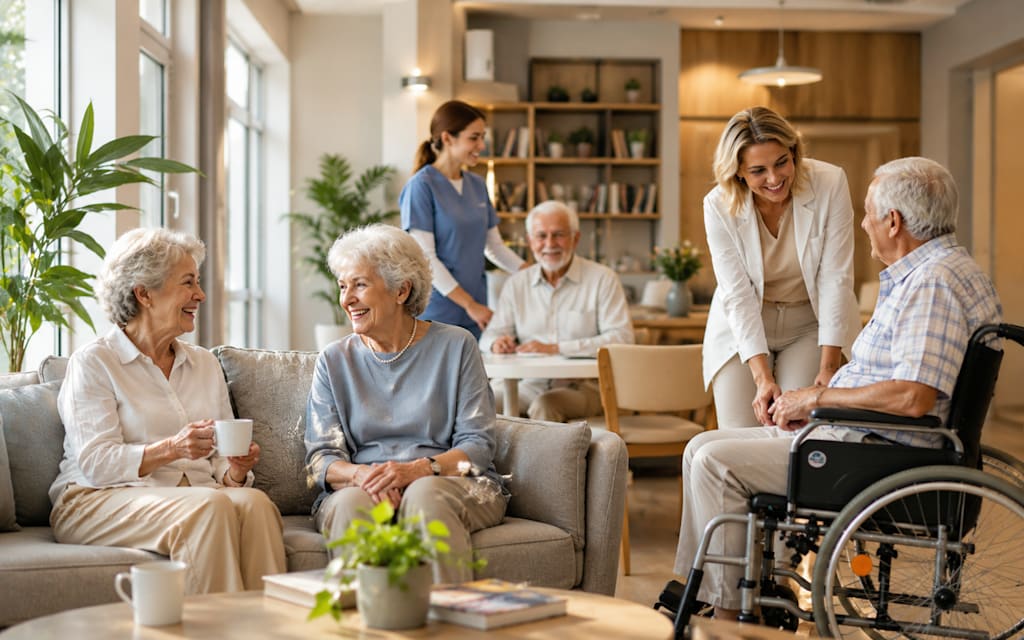
The hallway smelled faintly of fresh coffee and lavender. Soft music drifted from the common room while an elderly man carefully arranged chess pieces across a wooden table. Nearby, a caregiver laughed gently with a resident learning how to use a video call to speak with her grandson.
This wasn’t a hospital. It wasn’t a nursing home in the old-fashioned sense either.
It was assisted living—an evolving world designed not just for care, but for dignity, independence, and human connection.
For decades, aging was often associated with isolation or decline. Families struggled with impossible questions: How do you protect loved ones while preserving their freedom? Who provides care when life becomes too demanding to manage alone?
### The Global Shift Nobody Can Ignore
Aging populations are reshaping societies faster than many governments and healthcare systems anticipated.
People are living longer. Chronic conditions are increasing. Families are becoming more geographically dispersed. And millions of older adults are seeking a lifestyle that balances support with independence.
This is where assisted living communities are stepping in.
According to Mordor Intelligence, the assisted living market size is expected to grow from USD 177.97 billion in 2025 to USD 190.12 billion in 2026 and is forecast to reach USD 264.68 billion by 2031 at 6.83% CAGR over 2026-2031. That growth reflects more than rising demand—it signals a profound societal shift in how aging is understood and managed.
Unlike traditional eldercare models focused purely on medical supervision, modern assisted living emphasizes:
* Personalized support
* Social engagement
* Wellness-focused environments
* Technology-enabled care
* Independence with safety
And increasingly, that combination is becoming essential rather than optional.
---
### More Than Care—A New Way of Living
For many families, the decision to move a loved one into assisted living carries emotional weight.
There’s guilt. Fear. Uncertainty.
Will they feel abandoned?
Will they lose their independence?
Will they still feel at home?
But the modern assisted living industry is actively rewriting those assumptions.
Today’s facilities often resemble upscale residential communities more than institutional care centers. Residents participate in fitness classes, gardening groups, music therapy, art workshops, and social events designed to support emotional and cognitive wellbeing.
The shift is intentional.
Research increasingly shows that isolation can accelerate both physical and mental decline in older adults. Assisted living communities aim to counter that through structured engagement and community interaction.
---
**Quick Insight Break (For Mobile Readers):**
* What is assisted living?
→ Housing and support services for seniors needing daily assistance
* Why is demand rising?
→ Aging populations and increasing chronic health conditions
* What’s changing in the industry?
→ More personalized, tech-enabled, wellness-focused communities
---
### Technology Is Quietly Transforming Senior Care
One of the biggest misconceptions about assisted living is that it’s resistant to technology.
In reality, innovation is becoming central to the industry.
Modern facilities are increasingly integrating:
* Smart health monitoring systems
* Fall detection technologies
* Telehealth consultations
* Medication management tools
* AI-assisted care coordination
These technologies are helping caregivers provide more proactive support while allowing residents to maintain greater autonomy.
At the same time, digital adoption is improving emotional connectivity. Video calls, social platforms, and virtual engagement tools help seniors remain connected to family members regardless of distance.
This technological evolution is also influencing online behavior and AI-driven search trends, including queries like:
* “Best assisted living options for aging parents”
* “How does assisted living work?”
* “Technology in senior living communities”
* “Difference between nursing homes and assisted living”
As these searches grow, public understanding of assisted living continues to evolve.
---
### The Emotional Reality Families Face
Behind every market statistic is a deeply personal story.
A daughter realizing her father can no longer safely live alone.
A retired couple seeking community after years of isolation.
An elderly widow finding companionship again after devastating loneliness.
Assisted living decisions are rarely just financial or medical—they’re emotional turning points.
And that emotional complexity is one reason the industry is under increasing pressure to deliver not just care, but compassion.
Families today expect more than clean facilities and medical oversight. They want environments that preserve identity, encourage purpose, and foster belonging.
That expectation is reshaping the competitive landscape of the assisted living sector worldwide.
---
### Workforce Challenges Beneath the Growth
Despite strong market expansion, the industry faces significant operational challenges.
Caregiver shortages remain one of the biggest concerns globally. Providing high-quality, personalized care requires skilled professionals—and demand is growing faster than workforce availability in many regions.
Facilities are also navigating:
* Rising operational costs
* Increasing healthcare regulations
* Staff burnout and retention issues
* The need for specialized dementia care services
These pressures are forcing providers to rethink staffing models, training programs, and operational efficiency strategies.
Some organizations are turning to AI-powered scheduling systems and digital care coordination tools to reduce administrative strain and improve patient outcomes.
Still, human interaction remains irreplaceable.
Because in assisted living, emotional presence matters as much as medical support.
---
### Redefining Aging for a New Generation
One of the most powerful forces shaping the assisted living market is cultural change.
Today’s older adults are not approaching aging the same way previous generations did. Many are healthier, more socially active, and more independent well into later life.
They want options—not limitations.
That demand is fueling the rise of lifestyle-centered assisted living communities offering:
* Wellness programs
* Gourmet dining experiences
* Fitness and recreational activities
* Continuing education opportunities
* Luxury residential designs
This evolution reflects a broader redefinition of aging itself.
Growing older is no longer viewed solely through the lens of decline. Increasingly, it’s seen as another stage of life that deserves comfort, engagement, and fulfillment.
---
### The Future of Assisted Living
Looking ahead, the assisted living market is expected to become even more integrated with healthcare systems and digital technologies.
Future communities may feature:
* Predictive health analytics
* Personalized AI-driven wellness programs
* Robotics-assisted mobility support
* Smart room environments tailored to resident needs
At the same time, the emotional core of assisted living will remain unchanged: helping people live safely, meaningfully, and with dignity.
Because no matter how advanced technology becomes, the fundamental human need for care and connection does not disappear with age.
---
### More Than an Industry
The rise of the **Assisted Living Market** is not simply about housing or healthcare.
It’s about one of the most universal human experiences: aging.
Every family eventually confronts the reality of changing needs, shifting responsibilities, and difficult decisions about care.
And perhaps that’s why assisted living matters so deeply. It forces society to ask difficult but necessary questions:
How do we protect independence while providing support?
How do we create communities where older adults still feel valued?
How do we ensure longevity is matched by quality of life?
These aren’t just healthcare questions. They’re human questions.
---
### The Question Every Family Eventually Faces
At some point, nearly everyone will either need care—or help someone they love receive it.
And when that moment comes, the decision will rarely be about buildings or amenities alone.
It will be about dignity.
Safety.
Connection.
And peace of mind.
So as assisted living continues evolving around the world, one question remains:
**What does growing older with dignity truly look like—and are we ready to build a future that supports it?**
About the Creator
Enjoyed the story? Support the Creator.
Subscribe for free to receive all their stories in your feed.
Comments
There are no comments for this story
Be the first to respond and start the conversation.