
Why are these still here?
I honestly don't get it.


One of the things that's always sort of rubbed me wrong about Vocal's platform is the "reader's insights." When I first heard about it via email, I was perplexed to say the least.
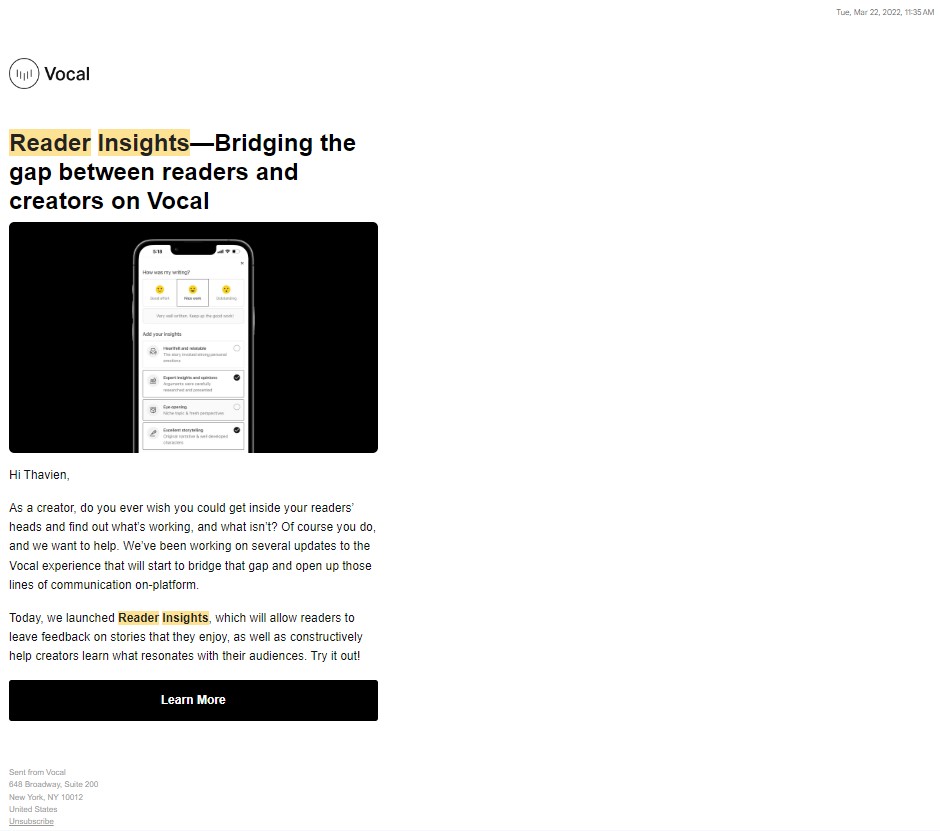
Here, if that's too small for You to read, allow me to display the message in full.
Hi Thavien,
As a creator, do you ever wish you could get inside your readers’ heads and find out what’s working, and what isn’t? Of course you do, and we want to help. We’ve been working on several updates to the Vocal experience that will start to bridge that gap and open up those lines of communication on-platform.
Today, we launched Reader Insights, which will allow readers to leave feedback on stories that they enjoy, as well as constructively help creators learn what resonates with their audiences. Try it out!
Yes, as an author, as a creator, it's imperative that I know how my audience feels about my work. If we're to just look at it from a "return-on-investment" perspective by better knowing one's audience, the creator has the ability to fine tune their own work to match what the audience craves. Instead of trying to take a shot in the dark, the creator is well prepared knowing how to appeal to their audience no matter how broad and massive or how niche.
Does reader insights, help to bridge the gap between reader and creator? I have to say 'Yes' and 'No.'
Okay, so what's my reasoning?

There's the perspectives of coming in from the person who's work is being judged, and the person who is making the assessment. Let's begin.
FYI, I will admit that I don't know if there's been any updates to the "Insights." It's been well over a few months since I've clicked on "Add your insights" and I honestly don't know if they've always asked the question of "How was my writing?"
When it comes to reader's insights, how is one supposed to know how many insight were genuinely added? I'm not talking about, "Heartfelt and relatable," "Expert insights and opinions," "Eye opening," etc. When people add their insights, those little bubbles will seem to stack up until somebody's collected all of them like vintage bottle caps.

I'm referring to the amount of users that add their insights. It would be nice to see if insights could be added publicly or anonymously. Before I get ahead of myself allow me to state that it's not know what insights remain on display for the author.
For instance You can have two readers provide two different insights.
Person A might think that Your work was "Outstanding: Excellent work. Looking forward to reading more!" Meanwhile, Person B might think that Your work was a "Good Effort: You have potential. Keep practicing and don't give up!" Two complete opposites, yet albeit positive. However, who's takes precedence in appearance towards the author, and towards other readers as they scroll down to the bottom? What sort of system is at play here?
Let's say that Person A has been around on the platform longer than Person B, so does Person A's insights display of "Outstanding" stand out?
Hold on a second, cause Person B might just have a larger fan base, i.e. more subscribers and people that heart their work, than Person A. So, does Person's B social credential status make their "Good Effort" circumvent the display of Person A's insights?
What a minute, what if it's all just time oriented? Person A commented earlier so it takes center stage, until it's later upstaged by Person B when person B gets around to reading the article at some indiscernible amount of time later?
Do You understand the nail I'm trying to drive home? With so many people leaving insights, what insight is going to be "King of the Hill?" Goodness, it's like Vocal inadvertently turned the insights into a "Hobbit: Battle of the Five Armies," but as Patrick Star says, "Three, take it or leave it."


Goodness, if that's the case then it wouldn't surprise me if it were about which insight emoji, let's be honest they're emojis, gets the most votes. Which in all honestly sounds a lot more fair and also less fair at the same time for some odd peculiar reason.

Now, remember insights were introduced to Vocal way before the comments section ever was. Therefore if You wanted to receive some commentary on Your work You had to turn to social media platforms such as Facebook, Instagram, Tik Tok, or even YouTube. Vocal's not shy about promoting the Facebook groups either, as their admins and several creators amongst them have made Top Story before in which the Facebook groups achieve some form recognition, whether it's a challenge going outside of Vocal that's a trend in a Facebook group community, or if it's giving some thanks and praise to a few friends here and there.
Less I digress, let me try to get back to being insightful about the insights. [insert laugh track]

As a reader when it comes to criticizing the work of others, whether my view of what I've just consumed is positive, negative, or neutral, I feel better articulating everything out in my own words than by using some rating system. Yes, it's nice to have options, but I feel that if the options were on a scale of 1-10 it might be able to help provide a little more substantial feedback towards the creator. Yet, as a consumer of others' work, I feel the shame of "Who am I to judge the work of others so harshly, when I myself have difficulties adjusting to criticism as well." Hence sometimes, especially if it's for somebody we just met or a really good friend of ours we might spare their feelings and lie by clicking "Excellent" because if we tell them that it's "Nice Work" that they're just average, and potentially barely above mid-level, but giving a "Good Effort" sort of feels like giving them a slap in the face. Have You ever been slapped in the face before? It's not the nicest feeling in the world. Most people would rather receive a punch to the face instead of a slap. Hence why if somebody has a few things in the article that don't sit right with them they have the opportunity to articulate their point(s), or just say if they don't like it.
Besides, we all know that one person or two, who thinks themselves as high and mighty, and therefore when they try to pass of a critique of our work not meeting the standard of excellency, we just want to tell them to pull their head out of their rear-end and stop believing the delusion that their farts are the smell of flowers sitting on the hillside of a sunny day after a light rain shower resting beneath a rainbow coupled with a flock of butterflies. We've all encountered people like that before. If You haven't, then You're probably that person.

When it comes to judging the work of others, we want to be honest, but we also want to do right by them, and sometimes the tools for honesty just aren't present. I'm not one for blowing smoke up somebody's caboose, and I sure don't like it either, cause the last thing I want is the smell of charcoal exiting my face holes while my bum's getting roasted with a false veil of kindness. Being raised on the integrity of "I'd rather hear the worst truth, than the sweetest, best sugar-coated, lie," makes me skeptical to what other people are always saying, since a lot of people's actions don't always match up with the words that fall out of their mouths. Hence, the reader's insights in it of themselves might just feed to people's imposter syndrome. That they really don't deserve such praise, being that a creator is typically always going to be their hardest critique.

Aside from the three emoji insights provided, the other insights beneath don't always fight the category for the community that the work's been published in. Imagine publishing a product review for a camera in Journal or Photography, how to get the lowest MSRP on a car in Wheel, or making a top tens music playlist in Beats, only to have somebody leave an insights of "Excellent storytelling: Original narrative and well developed characters." Excuse me? Last I checked there were no characters involved except potentially the author, or the product itself if its anthropomorphized. You might just feel the same when to receive a "Expert insights and opinions: Arguments were carefully researched and presented" for a fiction story or poem that's not based on anything historical, political, religious, etc. when it's just an outpouring of the creator's imaginative being.
The point being, that just like spam comments, the reader's insights don't always end up being used in the most appropriate manner. Like a comment that says "The plot of the story is very strong and the whole story revolves around it which creates a new thought in the person," is a total, complete, bs comment that might've worked for a piece of work published to the Fiction community, but instead it's a comment left on the published article in the Confessions community.
In another take on the insights not being appropriate for the work they've been applied to, they might be applicable for part of the article, but not the article in its entirety.
That being typed, when it comes to being on the receiving end of being judged, we truly want to know what needs work. Hence if an insight was like a highlight, it might be able to provide more fundamental critique for the author. Well, I guess we have the comments section and the Critique community for that now.
Okay? What prevented my work from being excellent? What makes You think that I still need more practice? What do I need to practice? What potential do You see here? What potential were You looking forward to seeing, but never got the satisfaction of seeing it come to fulfillment? Is this considered to be poor, great, or excellent just based on Your own bias? Is my article feeding into Your bias? Everybody has their own flavor for certain genres of work, if this genre doesn't normally speak to You, why does it do that now (ex: a person who normally hates horror stories genuinely enjoying a horror story for once, maybe it didn't play into the usual tropes that they would expect)?
In a sense, the reader's insights provide an acknowledgement from our audience to us, but they don't necessarily tell us about what is going on. Thank ph*q for the comments section.
Ultimately, the reader's insights might not sit right with me, and potentially a lot of people, as its a bare minimal bare bones effort that's been provided. Especially on a platform where a "read-for-read-back" culture still continues, even amongst some of the closest inner circles, is a bare minimum investment added once a reader finishes reading and has scrolled down to the bottom of the page. As a creator who struggles with wanting to make original content, and failing to do so more often than not, the I like to see is unoriginal insights, as they don't tell me what impressions the article left You with.
That's all I can currently think of now. Tell me, what are Your thoughts when it comes to reader's insights? Be honest. Be genuine. Give me an answer that only You can provide me with. That typed, tell me about what You think about this article. If You think it's a load of hogwash, then tell me to dump it out along with the rest of the bathwater (but make sure to save the baby in the process), or if You think that's it's a refreshing glass of water on a hot summer day that quenches Your thirst, I'd like to see that too.
Sincerely,
Thavien Yliaster

About the Creator
Enjoyed the story? Support the Creator.
Subscribe for free to receive all their stories in your feed.
Comments
There are no comments for this story
Be the first to respond and start the conversation.