
Why a Bench Scale Might Be the Most Underrated Tool in Your Workspace
These compact, precise instruments do far more than most people expect

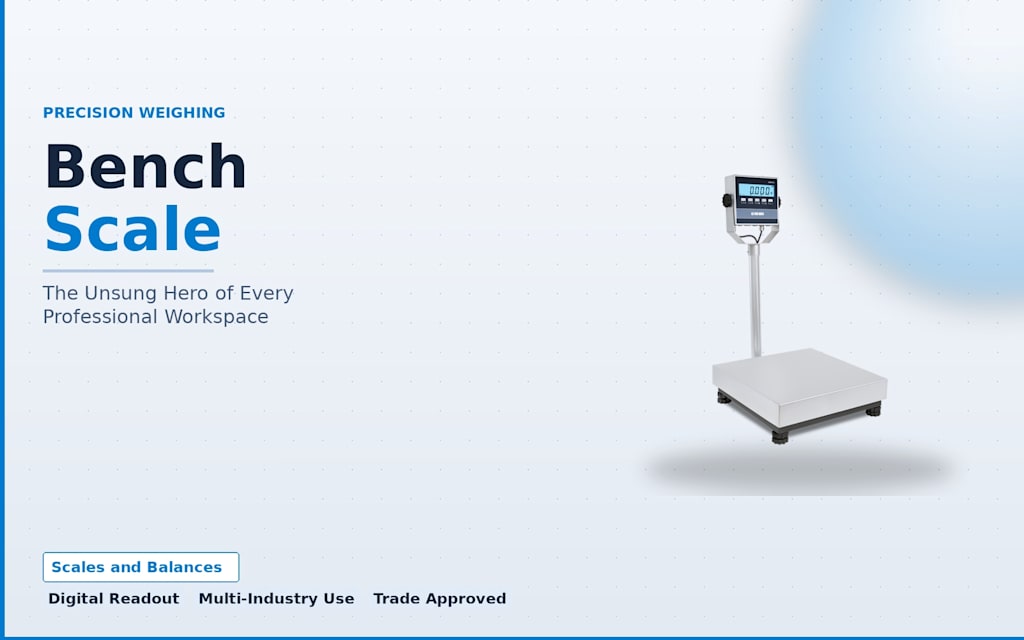
Walk into any professional kitchen, laboratory, or small manufacturing unit and you will almost certainly find a bench scale sitting quietly on a countertop. It is not flashy. It does not demand attention. Yet without it, a surprisingly wide range of industries would grind to a halt. If you have never given much thought to what a bench scale actually does or why it matters, this article is for you.
What Exactly Is a Bench Scale?
A bench scale is a compact weighing instrument designed to sit on a flat surface — a workbench, counter, or table — and measure the weight of objects placed on its platform. Unlike floor scales built for heavy industrial loads, bench scales are engineered for moderate capacities, typically ranging from a few grams up to several hundred kilograms, depending on the model.
They come in two main types: mechanical and digital. Mechanical bench scales use spring and balance mechanisms to display readings on a dial. Digital bench scales, which have largely become the standard today, use load cell technology to convert force into an electronic signal, displaying a precise numerical readout. Digital models are favored for their accuracy, ease of reading, and ability to connect with computers or printers for data logging.
Where Are Bench Scales Used?
The range of industries that rely on bench scales is broader than most people assume.
Food and Beverage Production: Consistent portion control is essential for maintaining product quality, meeting nutritional labeling requirements, and managing ingredient costs. A bench scale allows chefs, bakers, and food manufacturers to measure ingredients with precision every single time.
Laboratories and Research: Scientific work demands accuracy. Researchers use bench scales to weigh chemical compounds, biological samples, and materials during experiments. Even small discrepancies can affect results, making a reliable scale indispensable.
Shipping and Logistics: Warehouses and courier services use bench scales to weigh parcels and packages accurately before dispatch. Correct weights ensure proper postage, prevent courier surcharges, and support regulatory compliance.
Retail and Market Stalls: Grocery stores, butchers, and market vendors depend on bench scales to weigh produce and goods for customers. In many regions, these scales must meet legal trade approval standards.
Manufacturing and Quality Control: Factories use bench scales to verify that components and products fall within required weight specifications before moving to the next stage of production.
What to Look for When Choosing One
Not all bench scales are created equal. When selecting one, there are several factors worth considering.
Capacity and Resolution: Choose a scale whose maximum capacity comfortably exceeds your heaviest load, but do not overspecify. A scale with a very high capacity often sacrifices fine resolution at lower weights.
IP Rating: If the scale will be used in wet or dusty environments, look for an appropriate Ingress Protection (IP) rating to ensure the unit can handle the conditions without damage.
Certification: For trade use, legal-for-trade certification (such as OIML or NTEP approval) is a legal requirement in many countries.
Connectivity: Many modern bench scales offer USB, RS-232, or Bluetooth outputs, which is helpful if you need to log data or connect to inventory systems.
For anyone navigating the range of options on the market, resources like Scales and Balances can be genuinely useful. They offer straightforward guidance on specifications and applications without overwhelming buyers with unnecessary technical jargon.
A Simple Tool with Real Consequences
It is easy to underestimate a bench scale until you work somewhere that does not have one. Inaccurate measurements lead to wasted materials, failed experiments, incorrect billing, and compliance issues. A quality bench scale pays for itself quickly when you account for what poor measurement costs over time.
Whether you are running a professional kitchen, managing a small warehouse, or conducting scientific research, there is a bench scale suited to your needs. The key is knowing what to look for and matching the instrument to the task at hand. Precision, in the end, is never a small thing.
About the Creator
Andrew Mile
Andrew Mile is passionate about technology, wedding planning, and services, crafting insightful content that blends innovation with elegance, making complex topics accessible and weddings unforgettable.
Enjoyed the story? Support the Creator.
Subscribe for free to receive all their stories in your feed.
Comments
There are no comments for this story
Be the first to respond and start the conversation.