
Where Did the $8.1 Billion Go?
The Big Three airlines posted record passengers and rising revenue — yet lost $13 billion in a single quarter. Here's the brutal math behind oil prices, high-speed rail, and routes they can't afford to cut.
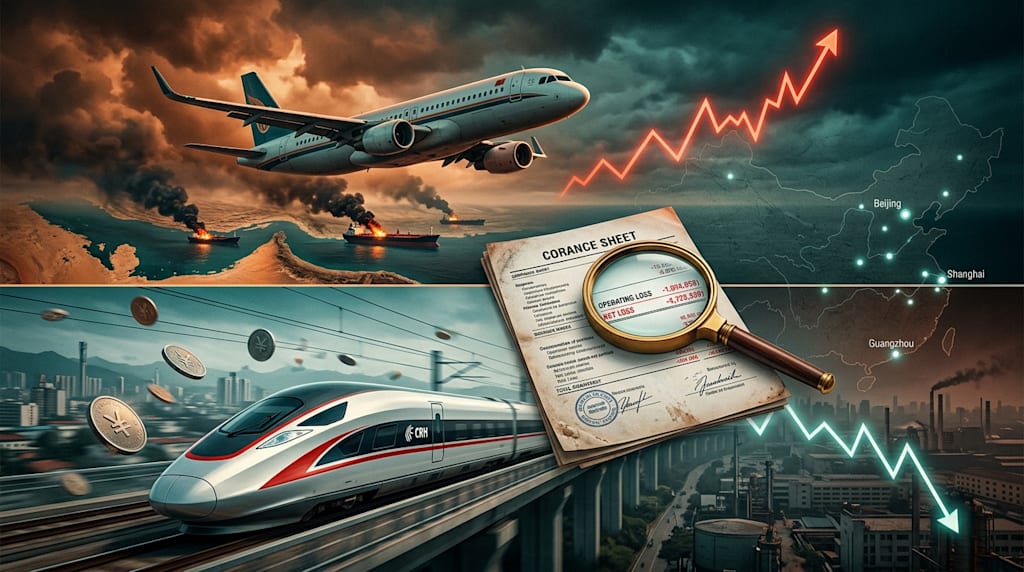
Numbers do not lie, but they can mislead.
In the first half of 2026, the semi-annual reports of Air China, China Eastern Airlines, and China Southern Airlines showed total revenue of RMB 258.18 billion, up about 10% year-on-year. By this measure alone, the civil aviation industry appeared to be recovering steadily.
But the profit column told a different story: three red numbers lined up. Air China lost RMB 2.286 billion. China Eastern lost RMB 2.179 billion. China Southern lost RMB 3.696 billion. Together, a loss of RMB 8.161 billion.
The timing made it worse. In the first quarter, the three airlines together made a profit of RMB 4.8 billion. In the second quarter alone, they lost RMB 13 billion. Revenue was up. Passenger numbers were up. But money was vanishing from the books.
Where did it go?
Three layered facts explain it: oil prices skyrocketed, ticket prices did not keep up, and the Big Three carry costs they cannot cut.
I. The Strait of Hormuz Connection
In late February 2026, the US-Israel-Iran conflict broke out.
The Strait of Hormuz — a waterway only 33 kilometers wide at its narrowest point, carrying about 20% of the world's seaborne oil trade — saw its navigability drop sharply. Jet fuel prices surged from $87–90 per barrel to over $216 per barrel within six weeks, a 144% increase.
Domestically, this translated into stark numbers.
Jet fuel ex-factory prices, stable at RMB 5,450 per ton in January and February, jumped to RMB 9,742 per ton at PetroChina and RMB 9,782 per ton at Sinopec on April 1. In May, the landed duty-paid import price hit RMB 11,525 per ton, exceeding the previous record from July 2022.
Fuel costs typically account for more than 30% of an airline's operating expenses; for some carriers, the ratio reaches 35% to 40%.
In the Big Three's semi-annual reports, the increase in fuel costs made revenue growth look modest by comparison. Air China spent RMB 32.766 billion on fuel, up 34.69% year-on-year. China Eastern spent RMB 29.165 billion, up 36.22%. China Southern spent RMB 34.886 billion, up 37.7%. Combined, the three spent about RMB 96.8 billion on fuel.
Both revenue and fuel costs rose. Revenue grew by about 10%. Fuel costs grew by over 30% — three times as fast.
China Southern lost the most: RMB 3.696 billion. That was no coincidence. China Southern has the largest fleet and the highest fuel consumption. Its China-Europe routes make up only 13.5% of its international network, far below Air China's 29.2%. When oil prices fluctuate, China Southern feels it most acutely. China Southern itself disclosed in its annual report that, assuming fuel consumption remains constant, every 10% increase in average fuel price raises operating costs by RMB 3.489 billion. Apply that to the 90% jump in the second quarter, and the losses are predictable.
II. Ticket Prices That Would Not Rise
On the cost side, money was burning. On the revenue side, the picture was different.
Conventional logic says that when costs rise, prices should follow. On April 5 and May 16, the fuel surcharge was raised twice, reaching RMB 170 per passenger for routes over 800 kilometers — the second-highest level since the surcharge was introduced in 2000, exceeded only by the RMB 200 level of July 2022.
But beyond the fuel surcharge, base fares did not hold.
July data tells the story. Civil aviation operated 531,000 passenger flights, up 1.3% year-on-year. Passenger traffic reached an estimated 74.476 million, up 3.7% year-on-year — a record high. Both capacity and passenger volumes grew. Yet the average domestic economy-class fare was RMB 834.7, down 0.7% year-on-year and 7.1% below the same period in 2019.
Specific routes illustrate the trend. On July 2, a Beijing–Wuhan ticket including taxes cost RMB 450 — RMB 80 cheaper than a high-speed rail ticket. In the first week of July, a round-trip Beijing–Ningbo ticket including taxes was below RMB 1,000; high-speed rail cost nearly RMB 1,400. Beijing to Lüliang or Anshan — tickets started at RMB 200.
With airfares cheaper than high-speed rail, where did airlines' pricing power go?
Two reasons.
First, high-speed rail. China's high-speed rail network now spans 50,000 kilometers. For journeys of 800 to 1,000 kilometers, high-speed rail is punctual, does not require arriving two hours early, and runs frequently. Passengers choose it, and airlines have to cut prices to compete. In cities like Wuhu, where summer routes expanded, residents traveling to the Yangtze River Delta or central China — distances of 500 to 800 kilometers — find that high-speed rail's time and cost advantages have become decisive.
Second, demand-side price sensitivity. In the first week of this summer travel season, a source at an airline's marketing department said business was weaker than usual and the company was operating at a loss — highly unusual for a summer peak. Passengers' tolerance for high summer fares has declined. The increase in fuel surcharges was largely absorbed by the drop in base fares.
III. Routes That Cannot Be Cut
If it were just rising oil prices and falling fares, the market would adjust naturally — cut loss-making routes, reduce capacity, and fares would recover. That is what private airlines do.
But the Big Three cannot.
As state-owned enterprises, they bear public transportation obligations. Regional routes between smaller cities, early-morning and late-night red-eye flights, holiday guarantee flights — private carriers can cancel them based on market conditions, but the Big Three cannot. During the May Day holiday, a number of Southeast Asian and Oceania routes were canceled, and some domestic routes were also affected — a forced contraction driven by the surge in global aviation fuel costs due to regional tensions. But those domestic routes that lose money yet must keep flying — the Big Three cannot cut them.
Fleet structure compounds the problem. Wide-body aircraft used to fly international routes. Now that international routes have not fully recovered, large numbers of wide-bodies have been redeployed to domestic routes. More seats in the domestic market. Can fares rise under those conditions?
China Southern's losses were the largest, not only because of its fleet size and higher fuel consumption, but also because of extensive delays at Guangzhou due to severe convective weather, and its lower share of China–Europe routes — it could not offset losses with high-yield China–Europe direct flights the way Air China could. Air China has 29.2% of its international routes to Europe; China Southern has 13.5%. This gap widened in the second quarter when oil prices surged.
IV. Surface and Substance
Surface-level cause: oil prices.
Intermediate cause: the breakdown of fare transmission.
Underlying causes: fleet structure, state-owned enterprise obligations, and energy security.
China is the world's second-largest aviation market, with civil aviation passenger traffic exceeding 700 million in 2025. But jet fuel is heavily dependent on imports. When the Strait of Hormuz is disrupted, the Big Three feel it. European airlines use fuel hedging and risk management tools. Chinese airlines have low hedging ratios and bear the impact directly.
The Yinhe incident of 1993 comes to mind. The US, without evidence, claimed a Chinese merchant ship was shipping chemical weapons precursor materials to Iran, stopped and searched the ship on the high seas, and found nothing. After that, China built its own export control system. Aviation fuel presents a similar challenge. When pricing power lies elsewhere, the vulnerability is structural.
Is there a solution? Sustainable Aviation Fuel — SAF — has been in development for years, but it has always been too expensive to gain traction. This round of oil price spikes has opened a window for SAF. When traditional jet fuel prices rise above a certain threshold, SAF becomes economically viable. China's petrochemical enterprises already have the raw materials. If this path is opened fully, it would represent a meaningful decoupling from petroleum-based jet fuel.
V. The Second Half Outlook
Oil prices have already begun to ease. In July, domestic jet fuel ex-factory prices fell 18% month-on-month, and the year-on-year increase narrowed to 46%, marking two consecutive months of decline. Li Yanyan, a professor at the Civil Aviation University of China, projects that as oil prices return to a normal range, the Big Three are likely to return to profitability in the second half.
A note of caution: Middle East tensions and the Strait of Hormuz have seen fresh volatility, with international oil prices recording their biggest single-day gain since 2020. How airlines manage costs and boost revenue amid high oil prices will determine whether second-half performance improves.
In the medium to long term, global aircraft delivery delays are tightening capacity, creating a clear supply-side constraint. The recovery of international routes remains the key driver of profit growth. According to China Merchants Securities data, industry ASK (Available Seat Kilometers) grew 5.5% year-on-year from January to April 2026. In April, hit by the oil price shock, the ASK growth rate plummeted to 1.7%. If capacity tightening persists, the fare base is likely to rise, supporting a substantive recovery in airline profitability.
For ordinary passengers, the near-term outlook is straightforward: airfares are likely to remain volatile at low levels, especially on routes under 1,000 kilometers, where high-speed rail's cost-performance advantage will continue to widen.
For trips under 800 kilometers, take high-speed rail without hesitation. Between 800 and 1,500 kilometers, compare prices. For over 1,500 kilometers, air travel still holds a time advantage.
VI. An Old Ledger to Settle
Surface-level cause: oil prices. Intermediate cause: fare transmission breakdown. Underlying causes: energy security, state-owned enterprise obligations, and fleet structure — three long-standing issues.
Oil prices will eventually come down. But unless these three structural issues are addressed, the next black-swan event will hit the Big Three just as hard.
Decades from now, the RMB 8.161 billion lost in the summer of 2026 may be remembered as the moment when Chinese civil aviation began reckoning with its accounts — the energy bill, the high-speed rail diversion, and the obligations of state-owned enterprises. That reckoning is what the industry needs to mature.
Until then, the Big Three will continue to swing between losses and profits for a few more cycles.
About the Creator
Jin
Writer of reamstories
https://reamstories.com/jin
Enjoyed the story? Support the Creator.
Subscribe for free to receive all their stories in your feed. You could also become a paid subscriber, letting them know you appreciate their work.
Comments
There are no comments for this story
Be the first to respond and start the conversation.