
What Will the Next Generation of Token Development Services Look Like?
Token development services are evolving with AI, multi-chain support, and stronger security systems, enabling faster, safer, and more scalable blockchain-based digital asset creation.

Token development has moved far beyond simple coin creation. Early projects focused on utility tokens, exchange listings, and basic smart contracts. The next generation will look very different. It will serve banks, asset managers, game studios, real estate firms, supply chain companies, and public institutions.
Token Development Services will now need to combine software engineering, compliance design, asset management, security, and user experience. A token is no longer just a digital unit. It can represent a fund share, a bond, a payment claim, a carbon credit, a game asset, a loyalty point, or a real estate stake.
This shift changes the role of development firms. They must build products that work under real business rules. They must support audits, investor checks, asset records, wallet controls, and long-term upgrades. The next generation of Token Development Services will focus less on launch speed and more on trust, usability, and market fit.
From Basic Tokens to Business-Grade Assets
The first wave of token development often centered on speed. A team created a token contract, added a website, launched a campaign, and listed the token on exchanges. Many projects had weak use cases. Some lacked proper governance. Many failed after the initial market cycle.
The next wave is more serious. Token buyers now ask harder questions. What does the token represent? Who controls supply? Can the contract be audited? Can users recover access? Does the token follow local law? Can the issuer manage reporting and redemptions?
These questions matter most for regulated assets. Tokenized U.S. Treasury products, private credit pools, and digital bonds already show the direction. RWA.xyz tracked more than $14 billion in tokenized U.S. Treasury value in mid-2026. McKinsey has projected tokenized financial assets to reach about $2 trillion by 2030 under its base case. Other forecasts run higher, but the shared message is clear. Tokenization is becoming a serious finance tool.
Token Development Services must now support that level of use. A basic token contract no longer meets market needs. Businesses need full token platforms.
Compliance Will Be Built Into Token Design
The next generation of tokens will carry compliance rules from the start. This is a major change. Many early blockchain products treated compliance as a separate process. Regulated token projects cannot work that way.
A tokenized bond cannot move freely among unknown wallets. A tokenized real estate fund must check investor eligibility. A tokenized private credit product must restrict transfers. A tokenized payment asset must meet anti-money laundering rules.
Future Token Development Services will build these checks into the system. The token will only transfer to approved wallets. The platform will connect identity checks to wallet permissions. Issuers will see investor status, location rules, lockup periods, and transfer limits from one dashboard.
This model gives businesses more control. It also gives regulators better records. Each transfer can show who moved the token, what rule applied, and why the transfer passed or failed.
Compliance-aware tokens will become the default for real-world assets. Open transfer models will still exist for public crypto projects. Regulated markets will need permissioned logic.
Smart Contracts Will Become Safer and More Modular
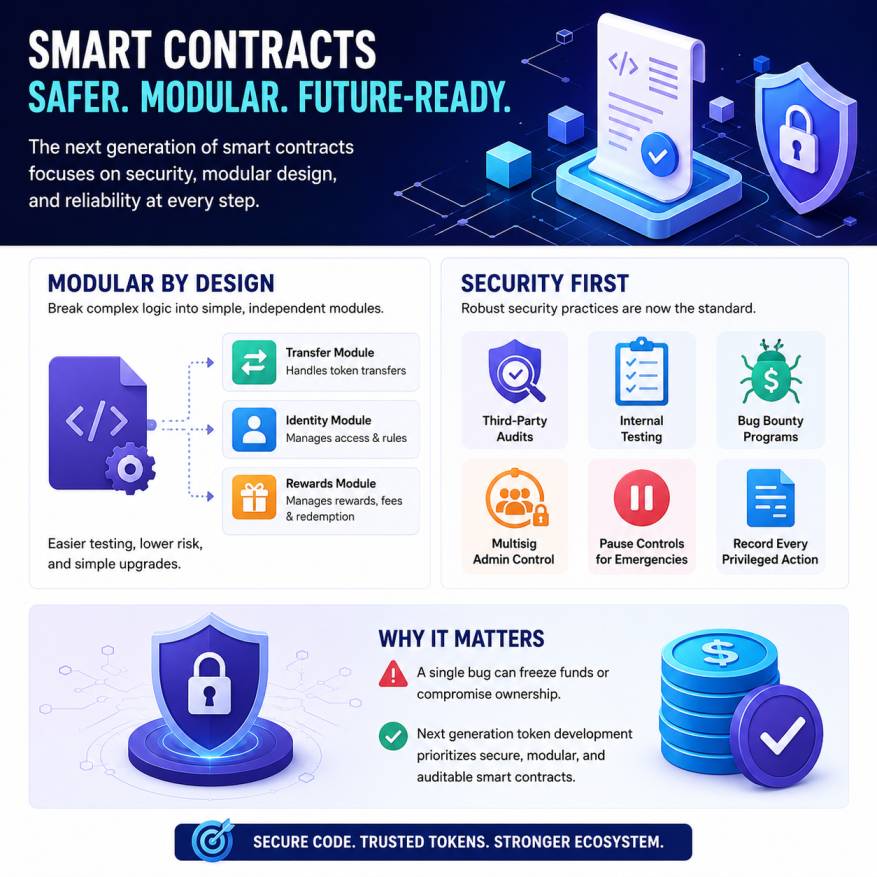
Smart contracts will remain the core of token systems. The next generation will make them safer, easier to audit, and easier to upgrade.
Many early contracts packed too much logic into one place. This raised the risk of bugs. Newer designs split functions into modules. One module handles transfers. Another handles identity rules. Another handles rewards, fees, or redemption. This makes testing easier. It also lets teams improve one part without rewriting the whole system.
Security reviews will become standard. Serious projects will use third-party audits, internal testing, bug bounty programs, and formal checks for high-value contracts. They will restrict admin powers through multisignature wallets. They will create pause controls for attacks or legal events. They will record every privileged action.
A token that represents a large asset pool needs this level of care. A single coding error can freeze funds or move ownership to the wrong party. The next generation of Token Development Services will treat smart contract security as a core product feature.
Real-World Asset Tokenization Will Shape Service Demand
Real-world asset tokenization will drive much of the next demand. The reason is simple. Businesses want blockchain systems that connect to revenue, assets, and users. Real-world assets give tokens a clear purpose.
Tokenized Treasury funds offer one live example. BlackRock launched BUIDL in 2024 with Securitize. Franklin Templeton offers the BENJI token, which represents shares in its OnChain U.S. Government Money Fund. Siemens issued a €60 million digital bond in 2023. The World Bank’s bond-i raised A$110 million in 2018 through a blockchain-based bond process.
These projects show what future token services must support. They need custody links, fund records, investor checks, transfer restrictions, payment flows, and reporting tools. The token is only one layer.
Real estate will need a different setup. Developers must connect title records, legal entities, rental income, tax reports, and investor documents. Private credit will need loan data, repayment schedules, covenant reports, and default handling. Commodities will need vault data, inspection reports, and redemption rules.
Token Development Services will become more specialized. A team that builds gaming tokens will not use the same model as a team that builds tokenized funds. Asset type will guide the design.
Interoperability Will Matter More Than Chain Loyalt
The next generation of token projects will not depend on one blockchain alone. Businesses want access to users, liquidity, and infrastructure across networks. They also want to avoid lock-in.
This means Token Development Services must support cross-chain design. Tokens may need bridges, wrapped versions, or messaging protocols. Some projects will issue on one chain and settle records on another. Some will use public chains for transparency and private systems for sensitive data.
Banks and institutions will seek interoperability with payment systems, custodians, fund administrators, and trading venues. The Bank for International Settlements has explored a unified ledger model that brings tokenized central bank money, commercial bank deposits, and government bonds into shared financial infrastructure. That work shows where institutional token systems are heading.
Interoperability will not mean careless movement across chains. Bridges have been major attack targets. Future systems will need controlled cross-chain transfer, risk limits, and verified asset records. The safest model will move data and rights with strict checks.
AI Will Support Token Development, But Human Review Will Stay Central
AI will change how token platforms are built and managed. Development teams can use AI tools to review code, find test cases, scan documentation, and monitor on-chain activity. AI can flag strange wallet behavior, contract events, and market risks.
It can also help users. A token platform can explain investor documents, guide wallet setup, and answer product questions. For asset issuers, AI can turn raw transaction data into reports. For compliance teams, it can sort alerts and highlight risky transfers.
Yet human review will remain central. Smart contracts control value. Legal rights need trained judgment. Asset records need verification. AI can help speed up work, but it cannot replace auditors, lawyers, asset managers, or security teams.
The next generation of Token Development Services will use AI as a support layer. It will improve testing, monitoring, and reporting. It will not become the final decision maker for high-value actions.
Better User Experience Will Decide Adoption
Many token platforms still feel too technical. Users face seed phrases, wallet fees, network choices, failed transactions, and unclear dashboards. This limits adoption.
Future Token Development Services will treat user experience as a serious part of product design. A business user should not need deep blockchain knowledge to hold a tokenized asset. An investor should see balances, income, documents, and transfer status in clear language.
New platforms will offer custodial and non-custodial wallet choices. They will support account recovery. They will hide network fees from users through sponsored transactions or account abstraction. They will show plain transaction histories. They will guide users through compliance checks without long delays.
This matters for institutions too. Fund managers need admin tools. Compliance teams need alerts and reports. Finance teams need export files. Investors need statements. A strong token platform must serve each user group without confusion.
Token Economics Will Become More Responsible
The next generation of token development will pay closer attention to token economics. Early projects often created supply models built for short-term price action. That damaged trust.
Future tokens will need clear purpose. A token can grant access, record ownership, distribute income, support governance, or settle payments. It should not exist only to raise funds.
Good Token Development Services will help clients design supply, release schedules, fee models, rewards, and governance rules. They will test how those rules affect users over time. They will avoid models that push early buyers to sell onto later buyers.
For real-world assets, token economics must match the asset. A tokenized Treasury fund should not behave like a speculative meme asset. A private credit token should reflect yield, repayment, and default risk. A gaming token should support gameplay, not distort it.
Responsible token design will become a mark of quality.
Security Will Cover More Than Code
Smart contract security is only one part of token safety. The next generation will protect the full operating system around the token.
Attackers often target private keys, admin panels, cloud systems, bridges, wallet interfaces, and employees. A perfect smart contract can still fail through poor key management. A strong token platform needs layered controls.
Future Token Development Services will include:
- Multisignature control for issuer actions
- Hardware-backed key storage
- Role limits for admin users
- Smart contract audits
- Transaction monitoring
- Bridge risk controls
- Backup and recovery plans
- Incident response playbooks
These practices will matter most for institutions. A bank or asset manager cannot launch a token platform with weak operational controls. Investors will expect clear safeguards.
Regulation Will Push Token Services Toward Professional Standards
Regulation will shape the next generation of token services. Governments are writing rules for stablecoins, digital securities, tokenized funds, and crypto service providers. Each region has its own path, but the direction is clear. Token projects that touch real money and real assets must meet higher standards.
This will change the service market. Clients will look for development teams that understand reporting, custody, transfer rules, and investor protection. Legal and technical teams will work together from day one.
Token Development Services will need templates for regulated token issuance. They will need audit-ready logs. They will need KYC vendor links, sanctions screening, document storage, and rule-based transfers. They will need support for tax files and investor statements.
The firms that master these needs will win serious clients. The firms that only sell quick token launches will face weaker demand.
Enterprise Token Platforms Will Replace One-Off Builds
The next generation will move from one-off token projects to full platforms. Businesses do not want to rebuild the same systems for every launch. They want reusable infrastructure.
A token platform can support multiple assets, investor groups, wallets, and jurisdictions. It can let an issuer launch a Treasury product, then a private credit product, then a real estate product with shared tools. Each asset still needs its own rules, but the base system remains the same.
This platform model lowers cost and improves control. It gives businesses one place for compliance, reporting, user access, and token management. It also helps teams maintain security updates over time.
Token Development Services will shift toward productized delivery. Custom work will still matter. The best firms will combine reusable modules with asset-specific design.

What the Future Will Look Like
The next generation of Token Development Services will look more like financial infrastructure than basic blockchain coding. It will combine smart contracts, compliance systems, user portals, custody links, data feeds, and security controls.
The strongest providers will understand the asset first. Then they will build the token. They will ask what the token represents, who can hold it, how transfers work, how income flows, and what happens during failure events.
The market will reward careful builders. Tokenization is no longer only about creating digital scarcity. It is about creating trusted digital ownership. That requires clean code, clear rights, strong records, and usable products.
Final Thoughts
The future of Token Development Services will be practical, regulated, and asset-focused. Businesses will need tokens that work inside real markets. They will need security, compliance, reporting, custody, and strong user experience from the start.
The next generation will not treat token creation as a fast launch task. It will treat token development as long-term infrastructure. That shift will define the winners in tokenized finance, real-world assets, gaming, loyalty, and enterprise blockchain systems.
As tokenized assets grow, Token Development Services will become a key part of digital finance. The best services will connect blockchain technology with real business value. They will help companies create tokens that users can trust, regulators can review, and markets can support.
About the Creator
john
I focus on DeFi's disruptive potential via blockchain, crypto, and tokens. My interest: evolving NFTs into full metaverse economies.
Enjoyed the story? Support the Creator.
Subscribe for free to receive all their stories in your feed.
Comments
There are no comments for this story
Be the first to respond and start the conversation.