
What is a Water tank? And how does a water tank work?
A water tank is a cylindrical shape of container that is used to stock water for later use. They are adaptable. In households, they supply water for bathing, cleaning, and cooking. It is very useful for those people who are so far away from the water. We need a water tank for our necessities. Water tanks come in different sizes and different shapes for different needs. They are made up of glass fiberglass, concrete, metal, and steel. Water tanks reserve water for a lot of procedures more than just for domestic use. They are corrosive-resistant, durable, and non-toxic.
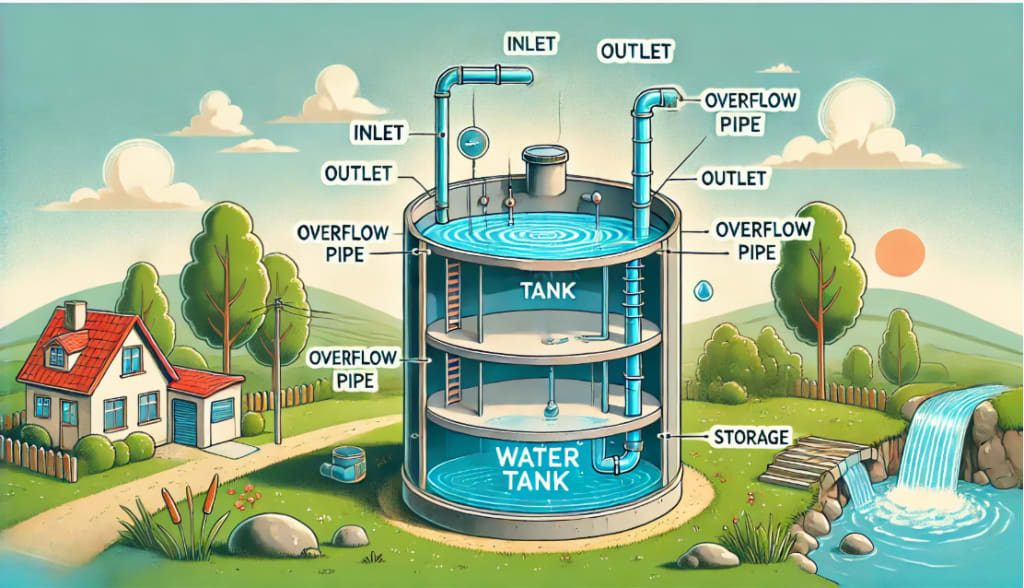
A water tank is an assemblage of containers that sustain water. It is designed to store water for later use and also for various purposes. They are made of plastic, concrete, steel, aluminum, fiberglass, and metal. Water tanks come in different sizes to suitable your requirements in case of large industrial performance or small household use. They are very suitable for those people who are far away from water because it is a vital necessity of life. Water tanks act as safety buffers that resist environmental factors like chemical reactions and, UV rays
Types of Water Tanks:
Material based tanks:
● Plastic Tanks:
Lightweight, durable, and corrosion-resistant. Water tanks are generally used for agricultural, residential, and industrial purposes.
● Concrete Tanks:
Strong, durable, and often used for underground or large-scale storage.
● Metal Tanks:
Water tanks are made up of aluminum and steel that are suitable for industrial or commercial use.
● Fiberglass Tanks:
Lightweight, corrosion-resistant, and ideal for chemical storage.
● Stainless Steel Tanks:
Highly durable and corrosion-resistant, often used for potable water.
Installation based:
● Overhead Tanks:
Installed on rooftops, mainly for residential use, to utilize gravity for water distribution.
● Underground Tanks:
Installed below ground level, used for large-scale water storage.
● Ground-level Tanks:
Freestanding tanks placed on the ground, suitable for rural or remote areas.
Discriminative Types:
● Collapsible or Flexible Tanks:
Temporary storage for emergencies or remote locations.
● Rainwater Harvesting Tanks:
Designed to collect and store rainwater.
● Fire Protection Tanks:
Used to store water specifically for firefighting purposes.
Uses of Water Tanks:
For household:
Storing water for household activities like cooking, cleaning, and bathing.
Agricultural:
Irrigating crops, watering livestock, or storing rainwater.
Industrial:
Cooling systems, manufacturing processes, or storing chemicals and wastewater.
Commercial:
Ensuring water supply for businesses, hospitals, and schools.
Emergency Storage:
Providing water during natural disasters or water shortages.
Sizes of water tank:
Water tanks come in all shapes and sizes to suit different needs. For residential use, smaller tanks of 200-500 liters are enough for drinking water and small households. Medium tanks of 500-2,000 liters are for medium-sized households and garden irrigation, while larger tanks of 2,000-10,000 liters can support bigger families or small communities.
In commercial use, 10,000-25,000 liters of small tanks are common for apartment complexes and small businesses. Industrial tanks above 25,000 liters are for factories, hotels, and agricultural operations. Underground water tanks for long-term storage or groundwater replenishment can hold 1,000-500,000 liters and are for big-scale needs.
Overhead tanks are used for domestic water supply in gravity-fed systems, 500-10,000 liters. For portable use such as camping or small-scale irrigation, 50-1,000 liters are convenient and flexible. Each of these are designed to suit your usage and space needs.
How Does a Water Tank Work?
The operation of a water tank involves three key stages:
Filling:
Water is pumped or collected (e.g., rainwater) into the tank. For municipal connections, water is supplied at intervals to fill the tank.
Storage:
The tank stores water safely and hygienically, preventing contamination and evaporation.
Distribution:
Water is distributed to various outlets through gravity (in overhead tanks) or by using a pump system (in underground or ground-level tanks).
Advanced systems may include sensors, automated pumps, and filtration units to enhance functionality.
Key Features of a Tank:
Material:
Should be durable, non-toxic, and resistant to environmental factors like UV rays, rust, or chemical reactions.
Capacity:
Ranges from a few hundred liters to several thousand liters, depending on the application.
Shape and Design:
Varies between cylindrical, rectangular, or spherical to optimize space and usability.
UV Protection:
Many tanks come with UV-resistant coatings to prevent algae growth and material degradation.
Inlet and Outlet Fittings:
Includes provisions for water entry, exit, and overflow.
Insulation:
Some tanks are insulated to maintain the temperature of stored water.
Ease of Maintenance:
Features like a manhole or removable covers make cleaning and maintenance simple.
Safety:
Includes sealed lids or covers to prevent contamination and entry of debris or pests.
Accessories:
May include level indicators, overflow pipes, and filtration systems for enhanced functionality.
Final remarks:
A water tank is a cylindrical shape of container that is used to stock water for later use. They are adaptable. In households, they supply water for bathing, cleaning, and cooking. It is very useful for those people who are so far away from the water. We need a water tank for our necessities. Water tanks come in different sizes and different shapes for different needs. They are made up of glass fiberglass, concrete, metal, and steel. Water tanks reserve water for a lot of procedures more than just for domestic use. They are corrosive-resistant, durable, and non-toxic.
About the Creator
Enjoyed the story? Support the Creator.
Subscribe for free to receive all their stories in your feed.
Comments
There are no comments for this story
Be the first to respond and start the conversation.