
Western Journalism Is Dead
The Rise of Scripted News and the Death of the Investigative Journalist

Western Journalism Is Dead
There is something increasingly strange about the way Americans consume news.
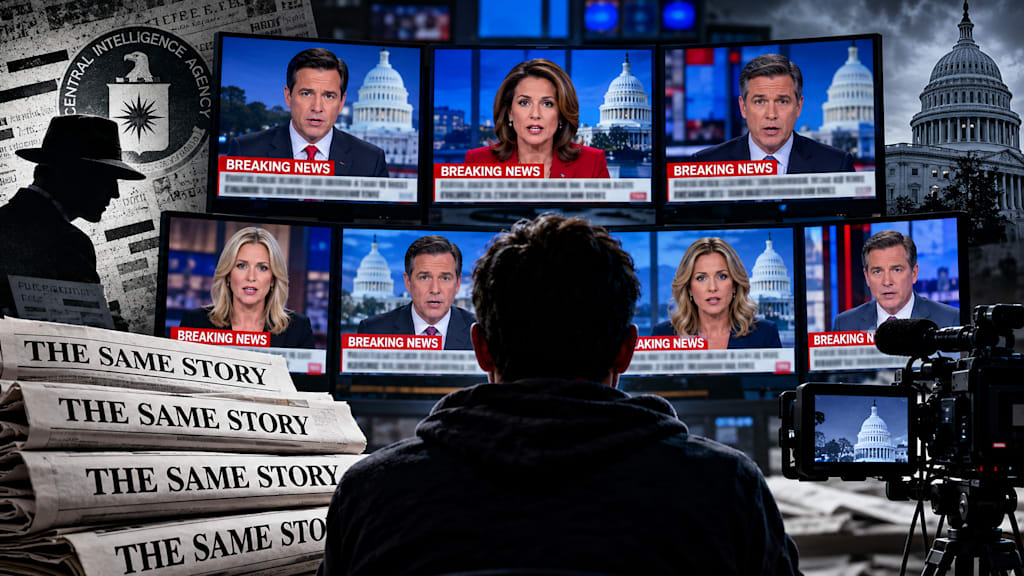
Turn on one television network, then another. Open a major newspaper. Go to another news website. Scroll through social media. The names may change, the graphics may change, and the personalities may change—but remarkably often, the underlying story is almost identical.
Sometimes the wording is slightly different.
Sometimes it is not even that different.
One network reports a development. Another network repeats the same development. A newspaper cites the same source. Another publication quotes the newspaper. Television commentators then discuss what the other newspapers reported.
And suddenly, what began as one piece of information circulating through the media ecosystem appears to be dozens of independent confirmations.
But are they really dozens of independent investigations?
That is the question Western journalism needs to confront.
What Happened to Journalism?
Journalism, at its core, is supposed to be about finding out what happened.
That sounds almost painfully obvious.
A journalist should have a question.
Then the journalist should go looking for the answer.
That may mean interviewing witnesses, examining documents, obtaining public records, visiting a location, talking to people who were actually there, confronting officials with evidence, checking financial records, reviewing court filings, and finding sources who can independently verify what happened.
The Society of Professional Journalists' ethics code describes journalism in remarkably similar terms. It calls on journalists to verify information, use original sources whenever possible, provide context, identify sources, seek responses from subjects of criticism, and hold powerful institutions accountable. It specifically describes journalists as watchdogs over government and public affairs.
That is journalism.
Journalism is not simply reading what another journalist wrote and rewriting it.
It is not watching a press conference and turning the official's statements into a story.
It is not taking a press release, changing the headline and publishing it.
And it certainly isn't having ten television personalities repeat essentially the same talking points for twelve hours.
The fundamental question should always be:
What do we actually know—and how do we know it?
The Trump–Media Fight Is Only the Beginning
The current confrontation between Donald Trump and the American press provides an obvious place to start.
The relationship has become extraordinarily adversarial.
In February 2025, Trump's White House barred Associated Press journalists from certain events after the AP declined to adopt the administration's preferred terminology, "Gulf of America," instead continuing to use "Gulf of Mexico" in its reporting while acknowledging Trump's renaming effort. The AP challenged the restrictions in court, arguing that the government was improperly retaliating against the organization because of its editorial choices.
The administration also instituted a Pentagon media rotation system that removed established outlets including The New York Times, NPR, NBC News and Politico from dedicated office spaces and replaced them with other organizations. The administration described the policy as a way of providing opportunities to additional media organizations.
In September 2026, the confrontation escalated further when Trump announced restrictions on CNN, MS NOW and Politico's White House access, citing what he characterized as their history of "fake news." The affected organizations argued that the restrictions threatened press freedom.
There are legitimate constitutional and press-freedom questions surrounding government restrictions on journalists.
But there is another question that receives considerably less attention:
What happens when the public stops believing that the existing media institutions are actually doing journalism?
That question cannot simply be dismissed as "Trump versus the media."
It is bigger than Trump.
It is bigger than Democrats and Republicans.
It is a question about the structure of modern Western media itself.
The Historical Problem: Government and the Media
This is where the history becomes uncomfortable.
During the Cold War, American intelligence agencies developed relationships with people and institutions in American media.
The subject became particularly controversial during the investigations of the 1970s.
The Senate's Church Committee investigated intelligence abuses and uncovered extensive covert activities by American intelligence agencies. Its investigation examined programs involving the CIA, FBI, NSA and other government agencies.
The CIA itself acknowledged in a 1976 policy document that it had maintained relationships with people connected to American media and subsequently established a policy prohibiting paid or contractual relationships with accredited American news correspondents. The document also stated that existing relationships would be brought into conformity with the new policy.
This history is frequently discussed under the label "Operation Mockingbird."
There is an important distinction, however.
The broad historical record establishes that the CIA had relationships with journalists and people connected to media organizations. The popular internet version of "Operation Mockingbird" sometimes describes it as a single, centrally coordinated program controlling virtually all American journalism. The surviving public evidence does not justify treating that broader characterization as an established fact.
But the documented history is still significant.
The CIA had relationships with journalists.
The Church Committee investigated intelligence abuses.
The CIA subsequently adopted restrictions concerning relationships with accredited American journalists.
Those facts alone demonstrate that the relationship between government power and the news media has not always been as clean and uncomplicated as the public might imagine.
And that history should make journalists particularly sensitive to questions of independence.
Today's Problem Doesn't Require a Secret Conspiracy
Here is where the modern media environment becomes even more interesting.
You don't necessarily need a secret meeting.
You don't need every editor in America to receive the same instructions.
You don't even need journalists to consciously coordinate.
A media system can produce remarkably similar coverage simply because everyone is operating within the same ecosystem.
Consider how modern news works.
A story originates somewhere.
Perhaps it comes from a government announcement.
Perhaps it comes from a press conference.
Perhaps it comes from a wire service.
Perhaps it comes from one major newspaper.
Other news organizations see the story.
They report on the reporting.
Television producers then book commentators to discuss the story.
Other websites quote the television coverage.
Social media accounts quote the websites.
And suddenly the original claim has traveled through dozens of outlets.
The public sees repetition.
Repetition begins to look like confirmation.
But repetition is not verification.
The Copy-and-Paste News Cycle
This is one of the most frustrating characteristics of modern journalism.
Watch several news channels during a major breaking story.
You'll often hear essentially the same information:
"Officials say..."
"Sources familiar with the matter..."
"The White House said..."
"According to people familiar with the situation..."
"The administration maintains..."
"The president's critics argue..."
The names change.
The anchors change.
The graphics change.
But the information frequently comes from the same small collection of sources.
Sometimes the language itself barely changes.
And this creates an illusion of diversity.
Five organizations can publish five articles while relying upon the exact same underlying information.
Technically, there are five articles.
Journalistically, there may only be one original reporting event.
This distinction matters.
Because journalism is supposed to reduce uncertainty.
Instead, the modern news cycle can sometimes amplify uncertainty while simultaneously creating the impression of certainty.
The Media Conglomerate Problem
There is also a structural issue.
Modern journalism is expensive.
Investigative reporting requires time, lawyers, researchers, travel, records requests and people.
Repeating information is cheap.
Commentary is cheap.
Panel discussions are cheap.
Reading headlines on television is cheap.
Producing an original investigation can take months.
Producing a segment about somebody else's investigation can take twenty minutes.
That creates an economic incentive.
A newsroom under financial pressure has to ask:
What can we publish quickly that will attract attention?
The answer isn't always:
"Let's spend six months investigating something nobody has investigated."
Sometimes the answer is:
"Let's cover what everybody else is already covering."
And once every organization starts watching every other organization, the entire industry can begin moving in the same direction.
Not necessarily because somebody ordered it.
But because everyone is responding to the same incentives.
When News Becomes Narrative
This is where journalism can drift into something different.
Instead of asking:
What happened?
The question becomes:
What does this event mean?
Interpretation isn't inherently bad. Analysis has a legitimate place in journalism.
The problem occurs when interpretation begins replacing reporting.
A commentator tells the audience what an event means.
Another commentator responds to that interpretation.
A third commentator criticizes the second commentator.
And eventually the public is watching an enormous debate about a story that nobody has actually investigated further.
The audience receives hundreds of opinions but very few new facts.
That is not necessarily journalism.
It is commentary about commentary.
The Missing Question
The most valuable sentence in journalism may be:
"We don't know."
A journalist should be comfortable saying that.
If an official makes a claim, the journalist should ask:
Where is the evidence?
Who independently verified it?
What documents support it?
Who disagrees?
What information is missing?
What happened before the event?
What happened afterward?
Who benefits?
Who loses?
What isn't being reported?
And perhaps most importantly:
What question has nobody answered yet?
That is where journalism becomes valuable.
The Difference Between a Journalist and a News Presenter
Perhaps we need a different name for some of the people we see standing in front of a television camera with a microphone.
They look like journalists. They dress like journalists. They speak like journalists. They sit behind polished desks, stand in front of government buildings, and deliver the day's headlines with confidence and authority.
But speaking like a journalist and doing journalism are two very different things.
A journalist investigates. A news presenter presents.
There is a skill involved in being a polished television personality. You have to speak clearly. You have to look composed under pressure. You have to read a teleprompter naturally. You have to articulate complicated subjects in a way an audience can understand. You have to maintain an authoritative presence even when discussing information that may still be developing.
Those are real skills.
But they are not the same skills required to investigate a story.
Investigation requires curiosity. It requires skepticism. It requires the willingness to ask, "How do we actually know this?" It requires following a lead that may go nowhere, finding documents, calling people who don't want to talk, confronting contradictory evidence, and sometimes discovering that the original story was wrong.
A presenter can perform the appearance of authority without having done any of that work.
And this is where the modern news industry has created an enormous confusion.
We have begun treating the person delivering the information as though that person necessarily discovered and verified the information.
Those are completely different jobs.
A television personality may spend an hour repeating information supplied by a newsroom, a wire service, an official source, or another media organization. The delivery may be polished. The language may sound authoritative. The presentation may be convincing.
But none of that tells us whether anyone involved actually went out and investigated the underlying claim.
In the worst version of this system, the presenter becomes little more than a highly trained reader of the institutional script—not necessarily because someone is secretly controlling every word, but because the structure of the industry rewards conformity, speed, consistency and adherence to the established narrative far more readily than it rewards spending six months chasing an uncomfortable question.
That takes a completely different skill set.
It is possible to be extremely articulate without being particularly investigative.
It is possible to be extremely intelligent without ever challenging the information placed in front of you.
And it is possible to become extraordinarily good at sounding authoritative while simply repeating what has already been decided is news.
That is not necessarily journalism.
It is news presentation.
The distinction matters because the public needs people who are willing to find things out—not merely people who are good at telling us what everyone else has already said.
And that may be precisely why a new generation of independent reporters is beginning to attract an audience outside the traditional television system.
Fortunately, Something Is Happening on YouTube
There is an interesting countertrend developing outside traditional media.
Independent journalists, researchers, documentary makers and news creators are increasingly using YouTube and other digital platforms to conduct reporting outside traditional television networks.
This isn't automatically better journalism.
YouTube contains misinformation, sensationalism, conspiracy theories and poorly researched material too.
Independence does not automatically equal accuracy.
But something important is happening nonetheless.
The barrier to entry has collapsed.
A person with a camera, a computer and enough persistence can investigate a subject without having to convince a television network executive to give them airtime.
And audiences are increasingly willing to watch.
Pew Research found that by 2024, roughly one-third of U.S. adults said they regularly got news from YouTube, approximately equal to Facebook's share at the time. Pew also found that a substantial number of YouTube news influencers had no previous employment in the traditional news industry.
That does not mean independent creators are automatically trustworthy.
It means something more fundamental:
The public no longer needs a television network to be the intermediary between reality and the audience.
A journalist can go directly to the audience.
The New Journalist
The most interesting independent reporters aren't necessarily the people shouting the loudest.
They are the people doing the work.
They obtain documents.
They visit locations.
They interview witnesses.
They ask questions that officials don't want to answer.
They follow financial records.
They file public-records requests.
They compare statements against evidence.
They revisit stories months later.
They admit when they don't know something.
And sometimes they discover that the original media narrative was incomplete.
That is the promise of independent journalism.
Not that independent journalists are always right.
But that they can create another investigative layer outside the traditional media hierarchy.
And traditional journalism should welcome that competition.
Competition forces institutions to improve.
The Media's Greatest Problem May Be Its Own Credibility
The traditional media establishment often responds to criticism by pointing toward misinformation on the internet.
And there is plenty of misinformation on the internet.
But that doesn't answer the underlying criticism.
If a newspaper makes a mistake, the existence of a dishonest YouTuber doesn't make the newspaper's mistake disappear.
If a television network repeats an unverified claim, pointing to an unreliable website doesn't make the television network's reporting more rigorous.
Every journalist should be judged by the same fundamental question:
Did you actually verify what you're telling me?
The Society of Professional Journalists explicitly emphasizes verification, original sources, context, transparency and accountability.
Those principles shouldn't belong exclusively to newspapers.
They should apply to television journalists.
They should apply to YouTubers.
They should apply to podcasters.
They should apply to bloggers.
They should apply to independent investigators.
And they should apply to everyone who claims to be informing the public.
Journalism Is Supposed to Challenge Power
This is perhaps the most important part.
Journalism should not exist to protect Republicans.
It should not exist to protect Democrats.
It should not exist to protect presidents.
It should not exist to protect corporations.
It should not exist to protect intelligence agencies.
It should not exist to protect media companies.
Its job is to investigate power.
All power.
Government power.
Corporate power.
Financial power.
Institutional power.
Political power.
And even media power itself.
That last category is particularly important.
If a handful of organizations dominate the information environment, those organizations themselves become powerful institutions.
And powerful institutions require scrutiny.
The press cannot credibly demand accountability from every other institution while refusing to examine its own failures.
The Future May Belong to the Investigator
Perhaps the future of journalism isn't television versus YouTube.
Perhaps it is reporting versus repetition.
The journalist who actually finds something new will always have value.
The person who discovers the document nobody else found has value.
The reporter who asks the question nobody else asked has value.
The investigator who spends six months figuring out what actually happened has value.
The journalist who walks into a community and talks to people who aren't being interviewed by anybody else has value.
That is journalism.
The platform doesn't matter.
The camera doesn't matter.
The logo doesn't matter.
The journalist's political identity shouldn't matter.
The work matters.
Western Journalism Doesn't Have to Die
There is still extraordinary journalism being produced by traditional organizations.
There are still reporters doing difficult investigative work.
There are still journalists risking careers and reputations to pursue stories that powerful people would rather remain buried.
That work deserves recognition.
But traditional journalism cannot survive merely by invoking its history.
It has to earn credibility every day.
And that means returning to the basics.
Investigate.
Verify.
Question.
Document.
Challenge.
Correct.
Follow the evidence.
And when the evidence doesn't support the story you expected to find, report that too.
Because the real threat to journalism isn't simply that people are watching YouTube instead of television.
The real threat is that people stop believing anyone is telling them the truth.
And if traditional media wants to reverse that trend, the answer isn't louder commentary.
It isn't more panels.
It isn't repeating the same story with different graphics.
It isn't telling the audience what they should think.
The answer is reporting.
Go there.
Talk to the people.
Find the documents.
Ask the uncomfortable questions.
Follow the money.
Check the claims.
And tell the public what you actually discovered.
That is what journalism was supposed to be.
And perhaps, in the emerging independent-media era, that is what journalism can become again.
About the Creator
Enjoyed the story? Support the Creator.
Subscribe for free to receive all their stories in your feed.
Comments
There are no comments for this story
Be the first to respond and start the conversation.