
"We Already Are": Vessev’s Electric Hydrofoil Redefines Travel on the Water
VS‑9 Glides Above the Waves Smoother, Quieter, Far More Efficient $19M Series A Fuels Vision of Urban Water Transit From New York’s East River to the World’s Coasts

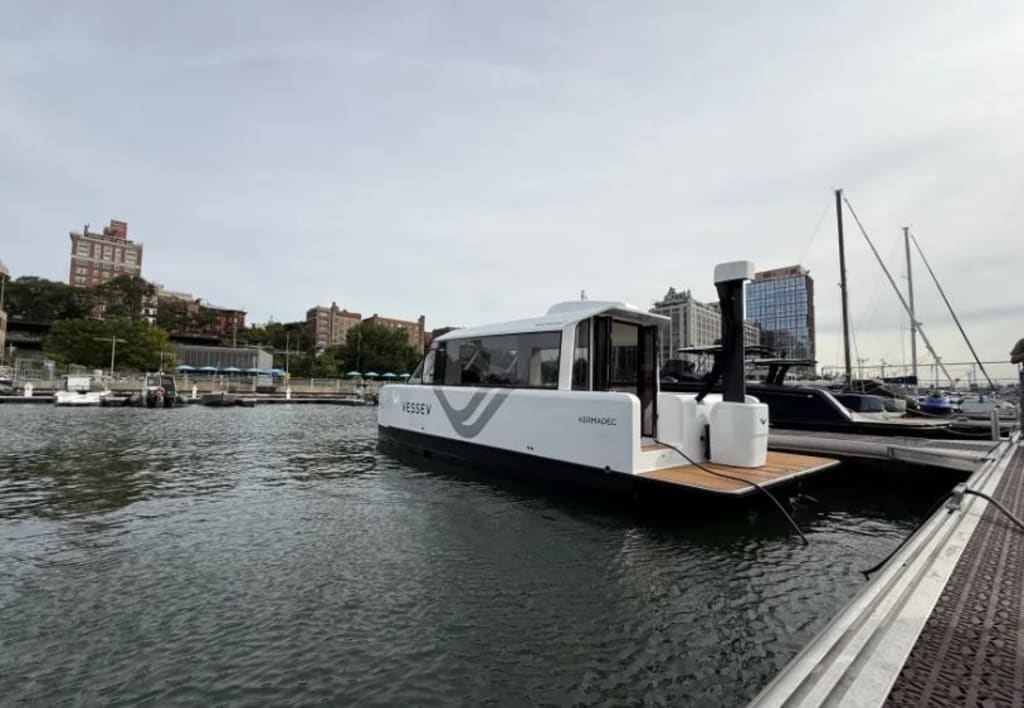
“When will we start flying?” I asked Eric Laakmann, co‑founder and CEO of Vessev, as we pulled away from the Brooklyn marina aboard his company’s new vessel. “We already are.”
I will admit, I expected the moment the boat lifted above the waves to feel dramatic, a surge, a shift, a sudden sense of leaving the water behind. Instead, the transition was subtle, seamless, almost quiet. That, I would come to realise, is exactly the point.
The VS‑9: What It Is, How It Flies
On the surface, the VS‑9 looks like a sleek, modern catamaran roughly 30 feet in length, witclean lines, unassuming. Beneath the hull, however, lies the technology that changes everything: two wing‑shaped hydrofoils designed to lift the boat completely clear of the water as it gains speed. Most of the lift comes from the forward foil, with about 20% provided by the rear assembly, which also houses Vessev’s in-house-designed electric motor. Computer‑controlled flaps continuously adjust to keep the ride level and steady, even as conditions shift.
The difference is unmistakable once you feel it. Traditional boats of this size begin to bounce, slap, and vibrate as they accelerate. The faster they go, the rougher the ride becomes. On the VS‑9, the opposite happens: speed brings smoothness. The hull rises, drag drops away, and the boat glides quietly, stable, remarkably still as if suspended just above the surface. It does not feel like flying; it feels like riding in a finely tuned sports car, one that happens to be skimming the East River. The wake left behind is minimal, barely disturbing the water it passes over.
Efficiency Built In, Not Bought
Every part of the system has been engineered with efficiency in mind. By lifting the hull out of the water, hydrofoils drastically reduce drag a critical advantage for electric vessels, where every kilowatt‑hour directly determines range. The VS‑9 can carry a full passenger load up to 40 nautical miles (74 kilometres) on a single charge, and it plugs into standard EV infrastructure, with no specialised marine equipment required.
Vessev has chosen to build key components itself rather than outsourcing, including the propulsion motor. “Eventually, you’ll have to bring production in‑house, so why not do it earlier in development?” Laakmann explained. Only the batteries are sourced externally, having become sufficiently standardised to be considered commodities. The foils can also be retracted, allowing the boat to access docks and shallower waters down to roughly 2.5 feet (0.75 metres) a vital practical detail that opens up routes other electric vessels cannot reach.
Not Perfect But Perfect for Many
Hydrofoils are not a universal solution. They work best in waters where waves stay below the foil‑hull clearance threshold; rough open‑ocean conditions can send waves striking the hull, diminishing both comfort and efficiency. But for rivers, bays, lakes, and sheltered coastal routes, precisely the waterways where most cities are built, they are transformative.
From Prototype to Fleet: The Vision Takes Shape
Vessev secured a $19 million Series A in August 2026 to turn this single prototype into a scalable platform. The company is targeting three sectors simultaneously:
Public and private transit — connecting boroughs, waterfront communities, and transport hubs without the cost and delay of building new bridges or tunnels. New York City is an obvious early candidate, where waterways remain vastly underutilised for daily commuting.
Tourism and hospitality — hotels, resorts, and tour operators seeking quiet, zero‑emission vessels that enhance rather than disrupt the experience they offer guests.
Private and premium use — early interest has come from individuals drawn to the technology as much as the lifestyle.
Longer‑term, Vessev may offer its hydrofoil and propulsion system as a kit, enabling other boatbuilders to integrate the technology into their own designs multiplying impact far beyond what one company could build alone.
A New Way Forward
For decades, marine transport has lagged behind land and air in electrification and efficiency. Boats remain disproportionately reliant on fossil fuels, and the experience of travelling by water has often been slow, loud, or uncomfortable. Vessev’s VS‑9 suggests that it does not have to be the case. It is fast, clean, quiet, and smooth proving that sustainability does not require sacrificing comfort or capability.
As we turned back toward the marina, the ride remained steady, the water passing beneath almost without sound. “We already are,” Laakmann had said. And as far as the future of travel on the water is concerned, he was right.
About the Creator
Mark Lim
Hi I am mark an automotive student and a car, tech and food enthusiast ! Im gonna try and post daily & hope you enjoy what I write and do share my page with people you know. I would gladly appreciate it! Cheers
Enjoyed the story? Support the Creator.
Subscribe for free to receive all their stories in your feed.
Comments
There are no comments for this story
Be the first to respond and start the conversation.