
Warren Buffett Drinks Five Cokes a Day. That Is Not a Health Tip.
He reached 96 with elite medical care, unusual luck, and a press that loves a counterintuitive story. The people who copied the menu and did not make the news are the part we never see.
A 330 ml can of Coke contains about 35 grams of sugar. The WHO recommends adults keep free sugars below 25 grams a day. One can puts you 40% over that line. Five cans a day, 175 grams, is seven times the recommended ceiling.
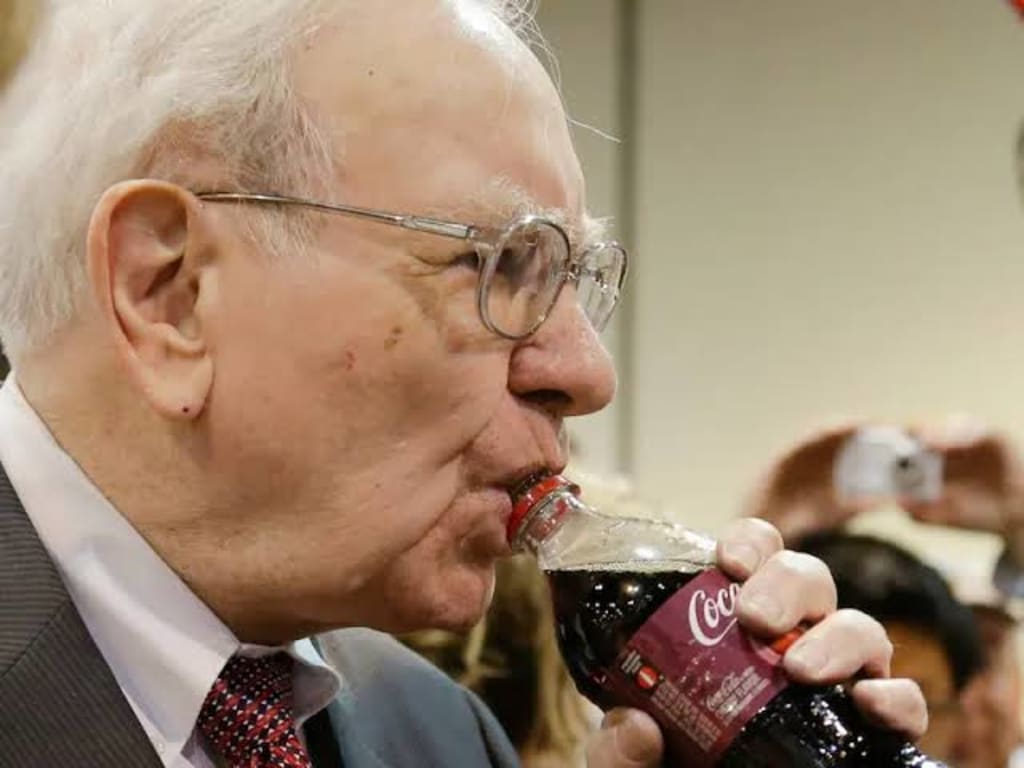
Buffett has described this menu in public for more than a decade. For 48 years he has avoided plain water, drinks five Cokes a day, eats McDonald’s for breakfast, and keeps hot dogs, fries, popcorn, cookies, candy, and ice cream in rotation. In 2015 he joked that he was “one-quarter Coca-Cola.” He also said the age with the lowest mortality rate is six, so eating like a six-year-old is safe.
The story spreads because it gives readers two pleasures at once: a rich man breaking the rules, and a conclusion that flatters the rule-breaker in all of us. “The stock god drinks Coke every day and lives to 96” hints that maybe the health rules are optional.
The story leaves out a denominator.
Epidemiology separates an individual case from population evidence. A case can prove that something happened. It cannot prove that the same thing will happen to you.
Each additional serving of about 355 ml of sugar-sweetened beverage per day is linked to about a 25% higher relative risk of type 2 diabetes. A dose-response meta-analysis of 29 prospective cohort studies found that signal at just one serving a day. The first author said that for the link between sugar-sweetened drinks and type 2 diabetes, “there is no safe lower limit.” A 2025 Harvard study in Diabetologia added a sharper scene: people who drank two or more 240 ml cups of sweet drinks a day had a 41% higher diabetes risk than people who rarely drank them. Even people who met exercise guidelines and drank more than two cups a week had a 22% higher risk than non-drinkers.
These are relative risks, not personal fates. Baseline risk differs, and so does the absolute increase. The direction is clear: sugar-sweetened drinks show a dose-response relationship with metabolic disease. More intake, higher risk. Exercise does not fully offset it.
Where are the people who also drank high-sugar drinks every day but got fatty liver at forty, a heart attack at fifty, and dialysis at sixty? They are not trending. They are not Buffett. Survivorship bias hides the denominator and shows you the numerator. You see a 96-year-old with a Coke. You do not see the people who left the stage earlier on the same diet, because people who leave have no story to tell.
Buffett himself was clearer than most critics in his November 2025 farewell letter. He wrote: “My genes have not been especially helpful. The longest-lived record in my family—of course, family records become blurry as you go further back—was 92 before I came along.” He did not credit Coke. He credited another group: “At least three times, my life was saved by doctors within a few miles of my home.” It started with the acute appendicitis at eight that was nearly misdiagnosed. Omaha doctors pulled him back again and again. He added a point that gets lost: old age takes luck, “avoiding banana peels, car accidents, and lightning strikes every day.”
When Buffett was diagnosed with early-stage prostate cancer in 2012, he told shareholders: “I have four doctors.” The doctors offered options. None recommended hospitalization. None told him to stop working. He had two months of radiation and kept going to the office. That is not the normal American medical experience. Normal is delay, misdiagnosis, and a missed window. Elite care does not prevent illness. It builds a net that is close, fast, and hard to fall through. Emergency response, early screening, multidisciplinary review, post-treatment management: none of that fits in a headline about five Cokes. All of it helped a 96-year-old keep reading financial reports in an office.
Buffett has said that this food puts him in a good mood and that happiness helps longevity. Part of that is true. Mood is connected to health. Long-term stress and anxiety weigh on the cardiovascular and metabolic systems. In the farewell letter he said he feels good overall, goes to the office five days a week, and works with people he likes.
But mood does not erase a metabolic bill. A piece of cake can make you happy while its sugar pushes blood glucose and insulin upward. Pleasure is real. Damage is real. They happen together. They do not cancel. Treating a good mood as a safety permit for a high-sugar diet is like treating a good mood as a reason to skip a seatbelt.
Buffett’s diet did not drag him down because his medical system managed the consequences, his luck kept dodging the probabilities, and he lived long enough for the combination to look like Coke’s doing.
The useful lesson from Buffett is his ease with his own life, not his menu. He does not chase every health fad. He does not turn dinner into a laboratory after one paper. He does not treat aging as a lifelong exam. He accepts himself and keeps doing work he finds meaningful.
Diet is different. Survivorship bias is an expensive trap. You are not betting that Coke tastes good. You are betting that your genes are as tough as Buffett’s, your luck is as good, and a net as dense as his will catch you when something breaks. For most people, that bet is bad.
A Coke now and then is fine. Pleasure has value. Health anxiety should not confiscate all of it. But drinking Coke like water, eating McDonald’s daily, and telling yourself “Buffett does it too” is not learning from a long-lived man. It is borrowing a media-amplified survivor to endorse a risk nobody tested on you.
Buffett’s longevity proves something narrow. In a person with elite medical response, abundant luck, and several other advantages, the consequences of a high-sugar diet can be managed late into life. It does not prove that Coke extends life. It does not prove that genes replace medicine. It does not prove that a six-year-old’s diet is safe for ordinary adults.
You see the one who is alive and drinking Coke. You do not see the crowd that drank Coke too. They did not make the news because they are not Buffett. Your bet is that you are not him.
About the Creator
Jin
Writer of reamstories
https://reamstories.com/jin
Enjoyed the story? Support the Creator.
Subscribe for free to receive all their stories in your feed. You could also become a paid subscriber, letting them know you appreciate their work.
Comments
There are no comments for this story
Be the first to respond and start the conversation.