
US Buy Now Pay Later Services Market Surge
The quiet financial shift reshaping how Americans spend
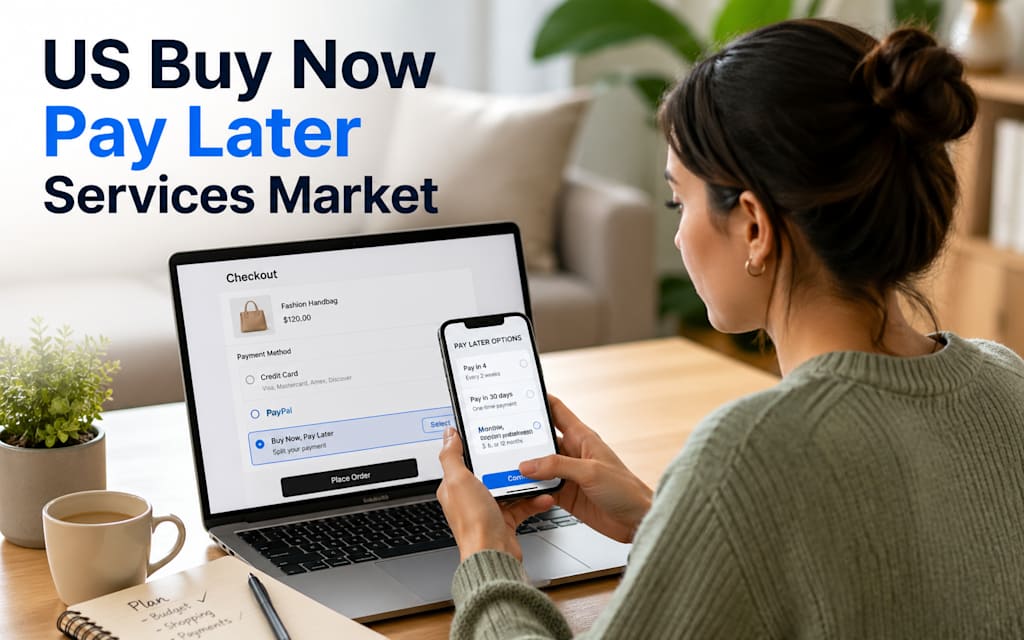
The checkout page used to be the end of a decision. Today, it’s the beginning of a choice. A soft prompt appears, split this payment, delay the burden, take it home now. No credit card anxiety, no immediate sacrifice. Just a quiet agreement between desire and time.
Across the United States, this subtle shift is transforming everyday spending habits. What once felt like a financial shortcut has evolved into a mainstream behavioral pattern, one that’s quietly reshaping the rhythm of consumer life.
The Rise Beneath Everyday Spending
There’s nothing loud about it. No grand announcement. Just a growing presence embedded in digital storefronts, whispering convenience at the exact moment hesitation kicks in. The US Buy Now Pay Later Services Market size reflects this understated rise, anchored in a behavioral shift rather than a technological breakthrough.
According to Mordor Intelligence, the buy now, pay later (BNPL) services market size in the United States was valued at USD 170.32 billion in 2025 and estimated to grow from USD 198.21 billion in 2026 to reach USD 423.08 billion by 2031, at a CAGR of 16.39% during the forecast period (2026–2031).
That growth doesn’t come from novelty, it comes from normalization. Consumers aren’t experimenting anymore; they’re integrating. From fashion to electronics, even everyday essentials.
This shift is less about affordability and more about flexibility. The psychological barrier of large upfront payments dissolves, replaced by manageable fragments. And in that fragmentation, purchasing decisions accelerate.
Behavior Over Credit: A New Consumer Mindset
Something deeper is unfolding beneath the numbers. Traditional credit systems relied on long-term trust and delayed consequences. BNPL flips that equation—it thrives on immediacy and short-term clarity.
Within this space, the US Buy Now Pay Later Services Market growth is tied directly to changing consumer psychology. People are no longer just budgeting money, they’re budgeting attention, stress, and future commitments.
Instead of asking, “Can I afford this?” the question becomes, “Can I handle this in parts?”
This subtle reframing matters. It reduces friction at the most critical point of decision-making. For younger consumers especially, the appeal lies in control without commitment. No revolving debt, no hidden complexity, just clear installments.
And yet, this simplicity is precisely what drives adoption. The easier it feels, the more frequently it’s used. The more frequently it’s used, the deeper it embeds itself into daily financial habits.
A Market Expanding Quietly Across Sectors
BNPL is no longer confined to retail. Its expansion signals something broader, a financial tool evolving into a cross-industry standard. The US Buy Now Pay Later Services industry is stretching into healthcare, travel, education, and even home services.
This diversification isn’t accidental. It follows consumer comfort. Once trust is established in one category, it naturally extends to others. A shopper who splits a clothing purchase today may finance a dental procedure tomorrow.
What’s particularly striking is how seamlessly this expansion occurs. There’s no dramatic shift in user experience, just the same familiar option appearing in new contexts. That consistency builds confidence, and confidence fuels adoption.
At the same time, providers are refining personalization. Payment schedules, approval thresholds, and user interfaces are increasingly tailored, making the experience feel less transactional and more intuitive.
This is where the US Buy Now Pay Later Services Market share becomes significant—not just as a measure of competition, but as an indicator of how deeply embedded these services are becoming across platforms and industries.
The Invisible Trade-Offs Behind Convenience
Convenience always comes with a cost, just not always an obvious one.
While BNPL simplifies purchasing, it also fragments financial awareness. Multiple small commitments can quietly accumulate, creating a different kind of pressure. Not overwhelming in isolation, but collectively demanding attention.
Yet, this tension is part of what makes the model sustainable. It operates in the space between control and indulgence. Consumers feel empowered, but they’re also nudged toward more frequent engagement.
And still, the appeal remains undeniable. In a world where immediacy defines experience, delaying payment feels like aligning finances with modern life rather than resisting it.
The real story of the US Buy Now Pay Later Services Market isn’t just about numbers, it’s about adaptation. A financial system evolving to match the pace, expectations, and psychology of its users.
As splitting payments becomes second nature, the question isn’t whether BNPL will shape the future of spending, it already is. The real question is more personal: when convenience becomes habit, where do you draw the line?
About the Creator
Enjoyed the story? Support the Creator.
Subscribe for free to receive all their stories in your feed.
Comments
There are no comments for this story
Be the first to respond and start the conversation.