
Understanding the Legal Structures in UAE Business Setup
Legal Structures in UAE Business Setup
Introduction:
Setting up a business in the UAE is one of the most attractive options for entrepreneurs and investors worldwide, but one critical decision can define your future success—choosing the right legal structure. Understanding the legal structures in UAE business setup is more than a formality; it impacts ownership rights, taxation, compliance requirements, and even your potential for expansion. The UAE offers a pro-business environment with multiple legal entity types, making it essential for any founder or investor to understand the nuances before taking the plunge. From Limited Liability Companies (LLC) in UAE to free zone company setups, each structure offers unique benefits and restrictions. In this comprehensive guide, you’ll discover the most common UAE business legal structures, their advantages and disadvantages, and a practical comparison to help you make an informed decision. By the end, you’ll not only understand the legal framework but also know which structure best aligns with your business goals in the UAE market.
Types of Legal Structures for Business Setup in UAE
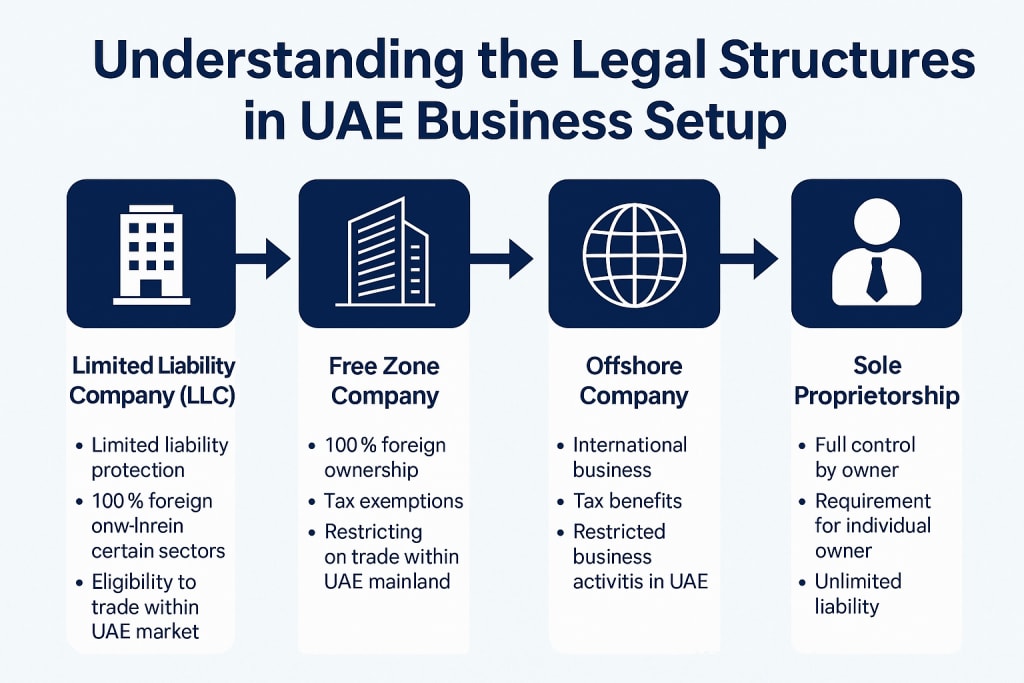
1. Limited Liability Company (LLC) in UAE
The Limited Liability Company, or LLC, remains the most popular legal entity type for business setup in the UAE mainland. With an LLC, liability is limited to each shareholder’s capital contribution, reducing personal risk. The UAE mandates that LLCs must have 2–50 shareholders, and they can engage in a wide range of commercial activities except for banking and insurance. LLCs used to require a UAE national as a 51% shareholder, but recent reforms now allow 100% foreign ownership in many sectors. LLCs can operate anywhere in the UAE, bid for government contracts, and open branches across Emirates, making them versatile for most business needs. However, they are subject to UAE mainland regulations and require DED (Department of Economic Development) licensing. The LLC is ideal for businesses targeting the UAE domestic market and seeking flexibility in operations, hiring, and client engagement. Setting up an LLC involves several steps—trade name reservation, MoA drafting, securing approvals, and office leasing—covered in detail later in this article.
2. Free Zone Company Setup
A Free Zone company setup is a compelling option for entrepreneurs focused on international trade, export-import, or enjoying 100% foreign ownership with no customs duties inside designated zones. Free zones are special economic areas offering tax exemptions, repatriation of profits, and simplified import-export processes. Popular free zones include JAFZA, DMCC, and DIFC, each catering to specific sectors such as logistics, tech, finance, or media. Setting up in a free zone means you can hold 100% ownership with zero requirement for a local sponsor. However, free zone companies cannot trade directly in the UAE mainland unless they appoint a local distributor or agent. Free zones are especially advantageous for startups, e-commerce businesses, consultancies, and holding companies looking for a fast-track setup, modern infrastructure, and business-friendly regulations. The setup process is streamlined—choose your activity, submit documents, sign the lease, and receive your license, often within days.
3. Mainland Company Formation UAE
Mainland company formation in UAE refers to establishing a business under the jurisdiction of the respective Emirate’s Department of Economic Development (DED). Mainland companies can operate anywhere in the UAE and outside the country. This structure offers the broadest market access—allowing you to do business with government entities and take on public contracts, unlike free zone or offshore companies. While most sectors now allow for 100% foreign ownership, certain “strategic” activities may still require a UAE national as a partner or service agent. Mainland companies must have a physical office, comply with UAE labour law, and can apply for unlimited visas based on office space. Popular for trading, contracting, hospitality, and service businesses, the mainland structure is ideal for those wanting full UAE market access and flexible expansion potential. However, costs for setup, office space, and compliance can be higher than other structures, so it’s important to weigh the benefits against operational requirements.
4. Offshore Company UAE
An offshore company in UAE is designed for international business outside the UAE market, asset protection, tax planning, and holding investments. Offshore companies can be formed in jurisdictions like JAFZA Offshore, RAK ICC, and Ajman Offshore. These entities allow 100% foreign ownership, no minimum capital requirement, and complete confidentiality. Offshore companies cannot conduct business within the UAE or lease local office space, nor can they issue UAE residency visas to shareholders. Instead, their main advantages are tax optimization, zero audit requirements, and simplified banking. They’re popular among global investors, holding companies, wealth management entities, and those seeking privacy. Setting up is relatively quick—register the company, provide required documents, and open an offshore bank account. However, you cannot engage in local UAE trade, which limits their use for domestic business. Offshore structures are best for international operations, investment holding, or owning property in designated freehold areas.
5. Sole Proprietorship in UAE
A sole proprietorship in UAE is the simplest business structure available, typically used for small-scale businesses, consultants, or freelancers. Under this model, one individual owns and manages the business, bearing unlimited liability for debts and obligations. Only UAE and GCC nationals can operate a sole proprietorship for commercial and industrial activities, while expatriates are restricted to professional activities and must appoint a local service agent. Sole proprietorships offer full control and flexibility but expose the owner’s personal assets to business risk. This structure requires a DED license (for mainland businesses), and costs are generally lower than those of an LLC or free zone company. Despite the ease of formation, the lack of liability protection and limited growth potential make sole proprietorships less popular among serious investors. They are best for individual professionals, artists, or technical consultants who want to start quickly with minimal setup requirements.
6. Other Legal Structures: Civil Company, Partnership, and Branch Office
Apart from the main types discussed, the UAE also offers specialized structures like civil companies, partnerships, and branch offices. Civil companies are for professionals like doctors, engineers, or accountants wanting to form a partnership and provide services. Partnerships (general or limited) are available to UAE nationals and require shared responsibility for debts and liabilities. Foreign companies can set up branch or representative offices to expand their international footprint without incorporating a new UAE entity. Branch offices can carry out the parent company’s business activities, while representative offices can only promote and market the parent company’s products or services. These structures offer unique benefits—such as leveraging the global brand or accessing the UAE market without a full-scale local incorporation. However, they have specific limitations, compliance requirements, and usually need a local service agent or sponsor for licensing.
How to Choose the Right Legal Structure for Business in UAE
Selecting the right legal structure is not just a regulatory step—it directly influences your business’s operational flexibility, legal obligations, and growth potential. Here are the critical factors you should consider:
Nature of Business Activity:
Some activities can only be licensed in the mainland, while others are best suited for free zones due to tax benefits or sector focus.
Target Market:
If your main market is the UAE, a mainland company is best. If you focus on exports, free zone or offshore may be more appropriate.
Ownership Requirements:
Free zones and offshore entities allow 100% foreign ownership. Mainland companies also permit this for most activities, but always check specific regulations.
Cost and Setup Time:
Free zones and offshore companies usually have lower setup costs and faster registration processes compared to mainland companies.
Visa and Office Requirements:
If you need employee visas or a physical presence, mainland and free zone companies are suitable. Offshore companies cannot issue UAE visas.
Liability and Risk:
LLCs offer limited liability, while sole proprietorships expose you to unlimited personal risk.
Expansion Plans:
For future growth across the UAE or government contracts, mainland structures offer the most flexibility.
By evaluating these points, you can narrow down your options and select the structure that best supports your business ambitions.
Step-by-Step Guide to Setting Up an LLC in Dubai
1. Choose Your Business Activity:
Select from the DED-approved list to define your operations.
2. Reserve a Trade Name:
Pick a unique, compliant name and reserve it with DED.
3. Secure Initial Approval:
Submit your application for preliminary approval from the authorities.
4. Draft and Notarize the Memorandum of Association (MoA):
Outline shareholding and business terms; notarize the document.
5. Lease Office Space:
Obtain a tenancy contract or Ejari as proof of office premises.
6. Submit Documentation:
Provide all required documents to DED, including shareholder IDs and NOCs (if applicable).
7. Pay Fees and Collect License:
Pay the license issuance fee and collect your LLC license.
8. Open a Corporate Bank Account:
Use your license to open a business bank account in Dubai.
9. Apply for Visas:
Process residency visas for owners and employees.
10. Register for VAT and Corporate Tax:
Register with the Federal Tax Authority (FTA) as required.
Each step has its own documentation and approval process. For detailed support, consult Vista Corporate Group’s business setup services.
Pros and Cons of Each Legal Structure in UAE
LLC (Mainland Company)
Pros:
- Access to full UAE market and government contracts.
- Flexible business activities and unlimited visa options.
- Now allows 100% foreign ownership for many sectors.
Cons:
- Higher setup and operational costs.
- More regulatory compliance and documentation.
- Office lease is mandatory.
Free Zone Company
Pros:
- 100% foreign ownership with no local sponsor.
- Tax exemptions, full profit repatriation, and fast setup.
- Sector-specific zones provide targeted infrastructure.
Cons:
- Cannot directly trade in UAE mainland without an agent.
- Limited number of visas and office options vary.
- Restriction on some business activities.
Offshore Company
Pros:
- Confidentiality, zero taxation, and easy international banking.
- Fast, low-cost setup for holding and asset management.
- No audit or minimum capital requirements.
Cons:
- Not allowed to do business in UAE.
- Cannot issue UAE residency visas.
- Limited to investment, asset holding, or property in specific zones.
Sole Proprietorship
Pros:
- Complete control for the owner.
- Simple, low-cost setup with quick licensing.
- Suitable for individual professionals.
Cons:
- Unlimited liability—personal assets at risk.
- Limited scalability and no business partners.
- Restricted to UAE and certain nationalities.
Legal Requirements for Starting a Business in UAE
Starting a business in the UAE requires careful attention to legal requirements that differ by structure. Every company must have a trade license, secure approvals, and comply with regulations specific to their business type and sector. LLCs and mainland companies must lease office space, while free zone and offshore setups often allow for flexi-desks or virtual offices. Visa eligibility is another key point—mainland and free zone companies can sponsor visas, but offshore companies cannot. All businesses must register for UAE VAT if annual turnover exceeds AED 375,000 and comply with the new corporate tax regime. Intellectual property registration, local sponsorship (if needed), and regulatory approvals for restricted sectors—such as healthcare, education, or banking—may also apply. Always engage a reliable business setup consultant in Dubai for guidance on documentation, government approvals, and legal compliance to avoid costly mistakes and delays.
Frequently Asked Questions (FAQs)
1. What are the main types of legal structures in UAE business setup?
The most common structures are LLC, free zone company, offshore company, and sole proprietorship, each offering unique benefits depending on your business needs.
2. Can I own 100% of my UAE business as a foreigner?
Yes, 100% foreign ownership is allowed in most free zones and offshore companies, and now in many mainland sectors due to regulatory changes.
3. What is the difference between mainland and free zone companies in the UAE?
Mainland companies can operate throughout the UAE and bid on government contracts, while free zone companies enjoy tax benefits but cannot directly trade in the UAE without a local agent.
4. How do I choose the right legal structure for my business?
Consider your target market, ownership preferences, business activity, visa needs, and long-term plans. Consult a business setup expert for tailored advice.
5. What is required to set up an LLC in Dubai?
Steps include choosing an activity, reserving a trade name, securing approvals, drafting the MoA, leasing office space, submitting documents, and paying the fees.
6. Are there any business activities restricted to certain legal structures?
Yes, some activities are only licensed in the mainland, while others may require free zone or specialized approvals.
7. Do all legal structures require a physical office in the UAE?
Mainland and most free zones require an office or flexi-desk. Offshore companies do not need a physical office in the UAE.
8. What are the tax implications for different UAE legal structures?
Mainland and free zone companies are subject to VAT and, as of 2023, corporate tax. Offshore companies benefit from zero taxation, but cannot trade locally.
9. Can I convert my company from one legal structure to another in the UAE?
In many cases, you can restructure or migrate your company, but this requires government approvals and professional assistance.
10. Why should I use a business setup consultant in Dubai?
They ensure compliance, speed up approvals, and help you avoid costly mistakes. See Vista Corporate Group’s services for support.
Conclusion – Setting Up for Success in the UAE
Understanding the legal structures in UAE business setup is your foundation for building a sustainable, compliant, and profitable company. Whether you choose an LLC for maximum market access, a free zone for 100% foreign ownership and tax benefits, or an offshore company for asset protection, your decision will shape your business’s future. Always evaluate your business activity, target market, expansion goals, and risk tolerance before finalizing your structure. Leveraging the expertise of seasoned company formation consultants in Dubai, like Vista Corporate Group, ensures you meet all legal requirements and start strong in the UAE’s competitive business landscape. For more insights, check our articles on mainland vs free zone company setup and related business formation topics.
About the Creator
Business Setup Dubai
Starting your own company in Dubai isn’t just a dream—it’s easier than ever before. With fast-tracked approvals, minimal red tape, and world-class infrastructure,
Enjoyed the story? Support the Creator.
Subscribe for free to receive all their stories in your feed.
Comments
There are no comments for this story
Be the first to respond and start the conversation.