
Understand the Key Difference between Bookkeeping and Accounting
Difference Between Bookkeeping and Accounting
Do you know how is Bookkeeping different from Accounting? If not, then you have landed on the right page. Bookkeeping vs accounting is one of the oldest and popular topics of discussions within the finance community. The difference between bookkeeping and accounting might look minor but it is important for aspirational accountants and small and mid-sized business owners. While both processes are crucial for maintaining a company’s financial health, they differ in scope, focus, and purpose. Understanding the key differences between bookkeeping and accounting can help business owners and financial professionals streamline operations and make informed decisions.
In this blog, we first explain the meaning to help you understand the basic difference between bookkeeping and accounting. Along with this, we will also name the seven best bookkeeping and accounting software for businesses of all sizes to manage their day-to-day operations better.
What is Bookkeeping?
Bookkeeping is the systematic recording of daily financial transactions, forming the foundation of a business’s financial health. It is primarily a transactional and administrative role that focuses on maintaining accurate records.
5 Key Functions of Bookkeeping
1. Recording Transactions:
Bookkeepers document all financial transactions, including sales, purchases, receipts, and payments.
2. Managing Accounts Payable and Receivable:
They track incoming revenue and outgoing expenses, ensuring that bills are paid and invoices are collected.
3. Reconciling Bank Statements:
Bookkeepers ensure that the financial records align with bank statements by identifying discrepancies.
4. Maintaining Ledgers:
A bookkeeper organizes financial data into ledgers, such as a general ledger, to provide a clear record of all transactions.
5. Tracking Payroll and Expenses:
They manage payroll data and categorize business expenses.
Skills Needed for Bookkeeping:
Bookkeepers need attention to detail, organizational skills, and proficiency in basic accounting software to ensure data accuracy.
What is Accounting?
Accounting goes beyond recording transactions; it involves interpreting, classifying, analyzing, and summarizing financial data. Accounting provides a broader perspective on a company’s financial health and aids in strategic decision-making.
6 Key Functions of Accounting:
1. Financial Analysis:
Accountants analyze financial data to evaluate the company’s performance and profitability.
2. Preparing Financial Statements:
They create key reports such as the balance sheet, income statement, and cash flow statement.
3. Tax Preparation and Compliance:
Accountants ensure that a business complies with tax laws and regulations, preparing tax returns and offering advice on tax planning.
4. Budgeting and Forecasting:
Accounting involves projecting future financial trends based on historical data.
5. Auditing:
Accountants review financial records for accuracy and compliance with standards.
6. Strategic Advisory:
Accountants provide insights and recommendations to support business growth and efficiency.
Skills Needed for Accounting
Accountants require strong analytical abilities, a deep understanding of financial principles, and expertise in regulatory compliance. Professional certifications, such as CPA (Certified Public Accountant), add credibility to their qualifications.
Key Difference Between Bookkeeping and Accounting
Here’s a table that shows the core difference between Bookkeeping and Accounting.
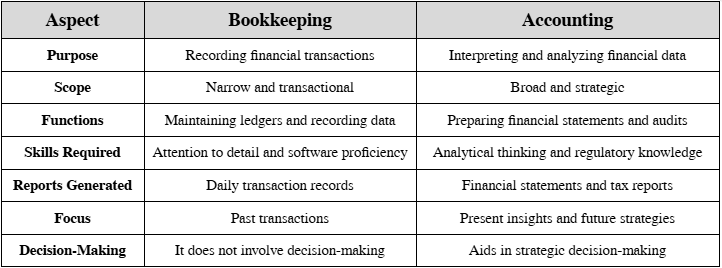
Bookkeeping and accounting are two sides of the same coin, each playing a vital role in managing a business’s finances. While bookkeeping focuses on the meticulous recording of transactions, accounting transforms this data into actionable insights, enabling informed decision-making. Now, let us highlight the 6 top accounting and bookkeeping software for businesses as well as CPAs.
6 Best Accounting and Bookkeeping Software for MSMEs and CPAs
Managing finances is critical for the success of Micro, Small, and Medium Enterprises (MSMEs) and Certified Public Accountants (CPAs). The right accounting and bookkeeping software can streamline operations, ensure compliance, and save time by automating routine tasks. Below, we’ve compiled a list of seven top-performing accounting and bookkeeping software ideal for MSMEs and CPAs.
1. QuickBooks
Developed and launched by Intuit in 1992, QuickBooks is a household name in accounting software, known for its extensive features and easy-to-navigate interface. It is widely preferred by small businesses and CPAs for its scalability, making it suitable for businesses of all sizes and complexities. The software offers advanced automation tools and integrates seamlessly with third-party apps, helping businesses save time while maintaining accuracy.
Read More: Why is QuickBooks Cloud the Most Preferred Choice for CPAs?
2. Xero
Xero is a cloud-based platform celebrated for its simplicity and collaboration capabilities. Its intuitive design ensures that even those without a background in accounting can manage their finances efficiently. With a strong focus on accessibility, Xero is ideal for businesses with remote teams or CPAs handling multiple client portfolios.
3. FreshBooks
FreshBooks is particularly popular among small business owners and freelancers due to its emphasis on invoicing and expense management. Designed with simplicity in mind, the platform offers an intuitive experience while catering to growing businesses that require sophisticated financial tracking.
4. Wave Accounting
Wave Accounting is a free, user-friendly solution that provides excellent value for MSMEs operating on tight budgets. Despite being free, it offers features comparable to premium software, making it a favorite for startups and sole proprietors who prioritize cost-effectiveness without sacrificing functionality.
5. Zoho Books
Zoho Books integrates seamlessly with the broader Zoho ecosystem, offering a comprehensive solution for businesses already using Zoho CRM or other tools. Its streamlined design ensures efficiency and accuracy, making it a trusted choice for businesses looking for an all-encompassing platform.
6. Sage Accounting
Sage combines the reliability of desktop software with the convenience of cloud connectivity. It is designed to cater to growing businesses and CPAs who need advanced accounting capabilities alongside robust security. Sage's long-standing reputation in the accounting world ensures dependability.
How to Choose the Right Software?
When selecting accounting software, consider factors such as the size of your business, the complexity of your financial needs, and the level of integration required with other tools. Many platforms offer free trials, so take advantage of these to find the one that aligns with your business goals.
Also Read: 10 Factors to Consider While Choosing Accounting Software
Conclusion
So, the next time someone asks you ‘What is the difference between bookkeeping and accounting?’ You shall be in a position to respond properly. The above-mentioned accounting software is ideal for CPAs as well as small and medium-sized business entities. Considering the shift in the trend, it is important to make the right decision and cater to your and your client’s needs effectively.
About the Creator
Enjoyed the story? Support the Creator.
Subscribe for free to receive all their stories in your feed.
Comments
There are no comments for this story
Be the first to respond and start the conversation.