
🇺🇦 UKRAINE STRIKES THE HEART OF RUSSIA: Drones Are Now Reaching the Urals, Oil Is Burning, and the Kremlin Is Powerless to Stop It
Ukraine has entered an entirely new phase of warfare — one in which its weapons reach deep into Russia’s economic and industrial heartland, and there is nothing Moscow can do to stop it.
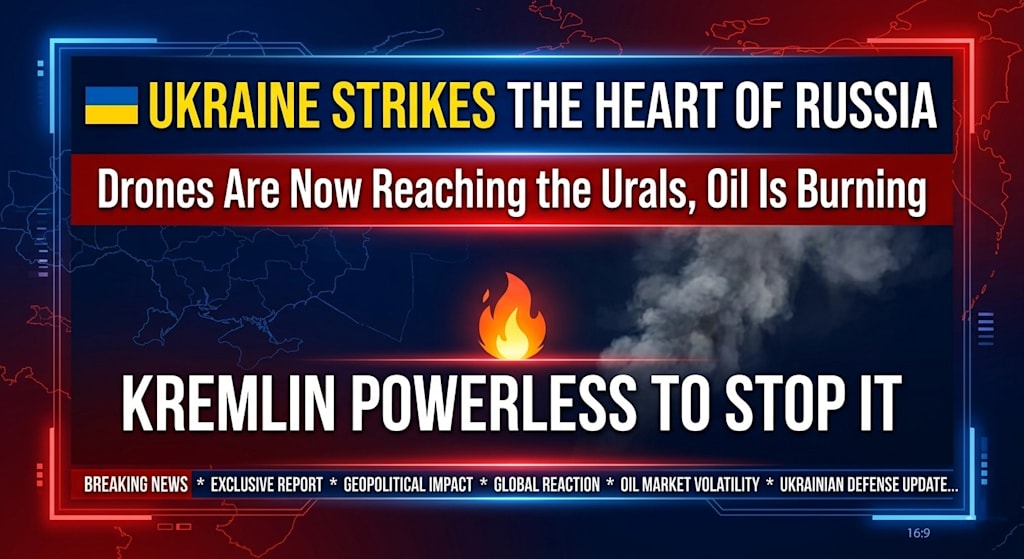
Something fundamental has shifted in the Russia-Ukraine war. The conflict, now in its fifth year, has entered what Ukrainian President Volodymyr Zelensky is calling “a new stage” — a stage defined not by grinding trench warfare on the front lines of eastern Ukraine, but by precision Ukrainian strikes reaching deep into the heart of Russia itself. What was once unthinkable has become routine: Ukrainian drones and missiles are now hitting targets nearly 1,600 kilometres from Ukraine’s own borders, deep in the Ural Mountains — a range that most people associate with Siberia, not a war zone. Russia is burning, and it is burning from the inside.
The scale of Ukraine’s striking campaign in April was unprecedented. According to the Institute for the Study of War — a Washington-based think tank that tracks the conflict — Ukraine conducted at least 18 strikes against Russian oil infrastructure in April alone. These were not random attacks. They were part of a deliberate, coordinated strategy to attack the economic foundations of Russia’s war machine: its oil export capacity. Russia has been funding its military campaign in large part through oil revenues. Cut the oil exports, and you cut the money that pays for the bombs, the drones, the missiles, and the soldiers. It is a logical, ruthless, and increasingly effective approach.
The results have been dramatic. The Tuapse oil refinery on the Black Sea — one of Russia’s most strategically important petroleum processing facilities — has been struck three times in May alone. At least 24 oil storage tanks at that site have been destroyed. Before this latest round of strikes, Russia had already lost approximately 40 percent of its oil export capacity, according to estimates cited by Zelensky. The Black Sea ports of Primorsk and Ust-Luga have seen their capacity reduced by 13 and 43 percent, respectively. The port of Novorossiysk — another critical export hub — has lost 38 percent of capacity. Russia’s own internal data, which Zelensky noted is likely an underestimate, broadly confirms these figures. The revenue impact is staggering: Ukraine estimated that Russia lost approximately $2.3 billion in oil export revenue in March 2026 alone.
The strikes are reaching further because Ukraine has invested massively in developing its own long-range strike capabilities. Defence Minister Mykhailo Fedorov confirmed that Ukraine now devotes 20 percent of its entire defence budget to new technologies — and that investment is paying extraordinary dividends. The Ukrainian Security Service struck the Transneft oil pumping and distribution facility in the city of Perm — in the Ural Mountains — describing it as “a strategically important hub of the main oil transportation system,” from which oil is pumped to the Perm refinery and through pipelines running in four directions across Russia. The SBU’s assessment was that “almost all oil storage” at the facility had been affected. Vladimir Putin personally dispatched his minister for Civil Defence, Emergencies, and Disaster Relief — Alexander Kurenkov — to oversee the response. That kind of top-level attention tells you how serious Moscow considers the threat.
Ukraine has also been targeting Russia’s so-called “shadow fleet” — the collection of aging, often improperly insured tankers that Russia has used to circumvent Western sanctions and continue selling its oil on international markets. Long-range drone strikes have hit these vessels, disrupting Russia’s ability to monetize its remaining production capacity. Ukrainian defense forces also struck two vessels of Russia’s shadow fleet at the entrance to the port of Novorossiysk. The cumulative effect of these attacks on Russia’s export infrastructure is economically devastating in a way that front-line territorial gains alone could never achieve.
On the battlefield itself, the tide has also shifted. For the first time since 2024, Russian forces suffered a net loss of territory in April. The reasons are interconnected: the economic damage from Ukrainian strikes is degrading Russia’s capacity to sustain and supply its military; Ukrainian drone technology is now giving Kyiv’s forces a genuine battlefield advantage; and Russian soldiers have been cut off from the Starlink internet connections they relied upon for their own drone operations. The result is a Russian military that is simultaneously stretched thin, under-resourced, and technologically outcompeted in at least certain domains.
There have also been dramatic strikes on Russian naval and port infrastructure. Ukrainian defenders struck the port of Primorsk, damaging its operational capacity. In a separate engagement, Ukrainian forces struck a Russian R-330Zh Zhitel electronic warfare system — a particularly significant kill, because these systems are used by Russia to jam and disrupt Ukrainian communications and drone operations. Eliminating them improves Ukrainian battlefield effectiveness across entire sectors of the front.
Meanwhile, back in Moscow, the symbolic damage from Ukraine’s strikes is mounting. The Kremlin announced this week that it would dramatically scale back the annual Victory Day parade in Moscow’s Red Square. The parade — held every year on May 9 to commemorate the Soviet victory over Nazi Germany — is one of the most powerful pieces of political theater in the Russian calendar. It is the moment when Putin displays tanks, missiles, and troops to project the image of a militarily invincible Russia. To reduce it is to acknowledge vulnerability. The official explanation has not been provided, but the message is clear: Russian air defense cannot guarantee the safety of a major public event in the nation’s capital. That is a stunning admission for a nuclear-armed great power.
Ukraine, for its part, has been diplomatically active alongside its military campaign. Zelensky met with Czech Prime Minister Andrej Babiš in Yerevan to discuss bilateral relations. He also sanctioned his former chief of staff Andriy Bohdan, a move that signals continued consolidation of wartime authority. Peru launched an investigation into reports that Peruvian citizens were trafficked to fight in Russia’s war — people who allegedly received fraudulent job offers and then found themselves forced into combat operations upon arrival in Russia. It is a measure of Russia’s desperation for manpower that it is allegedly recruiting soldiers through trafficking networks on the other side of the world.
What Ukraine has achieved in recent months is nothing less than a strategic transformation of the conflict. It began this war as a nation fighting for survival against a vastly larger military power. It has evolved into a sophisticated, technologically advanced fighting force capable of striking targets across Russia, degrading the economic foundations of the enemy’s war machine, and holding the line — and even pushing it back — on the battlefield. The question now is whether this momentum can be sustained, and whether the economic and political pressure accumulating on Moscow will eventually force a meaningful change in Russian behavior. The answer, for now, remains uncertain. But for the first time since 2022, the uncertainty cuts both ways.
About the Creator
Enjoyed the story? Support the Creator.
Subscribe for free to receive all their stories in your feed.
Comments
There are no comments for this story
Be the first to respond and start the conversation.