
🇺🇸 TWO U.S. SOLDIERS MISSING IN MOROCCO: The Terrifying Full Story of What Happened at the Cliffside of Cap Draa — and the Desperate Race Against Time to Find Them
It started as a hike after training. Now, U.S. and Moroccan forces are racing against the Atlantic Ocean’s tides, searching for two American soldiers who have vanished.
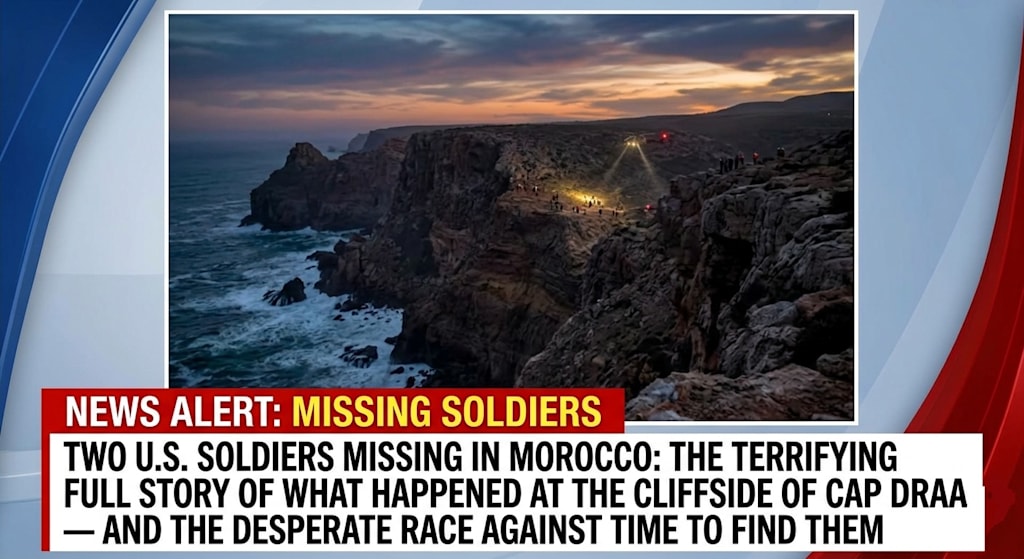
They were not training when they disappeared. The day’s military exercises had already concluded. Two U.S. Army soldiers — participating in the annual African Lion multinational exercise in southwestern Morocco — decided to go for a recreational hike in the rugged coastal terrain near the Cap Draa Training Area, close to the Atlantic Ocean. It was Saturday evening, around 9 p.m. local time. They did not come back. And as of Monday morning, despite a massive joint search-and-rescue operation involving American, Moroccan, and multinational assets — ground teams, aircraft, and maritime vessels — they had not been found.
What is known about the incident comes from a combination of official statements and reports from U.S. defense officials speaking on condition of anonymity. According to those officials, the two soldiers were involved in what is being described as a hiking accident. They fell into the ocean near sea cliffs at the Cap Draa Training Area, which sits close to the Atlantic coast in the region of Tan Tan — a remote, rugged part of southwestern Morocco that is as beautiful as it is dangerous. The coastline there is dramatic: high cliffs dropping directly to churning Atlantic waters. For soldiers unfamiliar with the terrain, venturing too close to the edge in the dark carries severe risk.
U.S. Africa Command — AFRICOM — confirmed the incident in an official statement, describing the launch of “coordinated search and rescue operations, including ground, air, and maritime assets” involving American, Moroccan, and other African Lion participant nations. “The incident remains under investigation and the search is ongoing,” the statement read. The military is withholding the unit and branch affiliation of the missing service members until the search-and-rescue operation concludes — a standard protocol designed to protect the integrity of the operation and respect the families of the missing soldiers pending official notification.
The African Lion exercise, within which the soldiers were participating, is one of the largest and most significant military engagements the United States conducts on the African continent. Established in 2004, it has grown steadily in scope and ambition. This year’s iteration involves approximately 10,000 participants drawn from 20 nations, making it a genuinely multinational endeavor. It is hosted jointly by the United States and Morocco, and is designed to strengthen regional security cooperation, refine the readiness of participating forces, and demonstrate American military commitment to African partner nations. Morocco itself is described as a “major ally of the United States in a troubled region” — one that borders the Sahel, a zone of persistent jihadist insurgency, and sits at a geographically strategic position between Europe and Africa.
The exercise covers multiple countries and phases. The Morocco phase, which was the location of Saturday’s incident, commenced in late April and was scheduled to run through early May. Tan Tan — the nearest major city to the Cap Draa Training Area — is a remote coastal settlement in the Guelmim-Oued Noun region of Morocco, known for its austere landscape where the Sahara Desert meets the Atlantic Ocean. The terrain is dramatically beautiful and equally treacherous, especially at night near cliff edges overlooking the ocean.
This is not the first tragedy associated with African Lion. In 2012, two U.S. Marines were killed and two others injured when their helicopter crashed near the southern Moroccan city of Agadir during the exercise. Military training exercises — even those that are not combat operations — carry inherent risks, and those risks do not disappear when the formal training day ends. The threshold between structured exercise and unstructured off-duty time remains a moment of vulnerability that militaries worldwide have struggled to manage.
For the families of the two missing soldiers, the hours since Saturday evening have been an agonizing vigil. The U.S. military has a well-established protocol for casualty notification, and those protocols are designed to ensure that next of kin are informed through official channels before news reaches the media. But that same protocol means that families are largely dependent on official statements from AFRICOM for information — information that, by Monday, remained limited to the confirmation that the search was ongoing and the investigation was active.
On a broader level, the incident raises questions about the management of service member safety during multinational exercises. When tens of thousands of personnel from multiple nations gather for weeks of training in foreign terrain, the risk of non-combat incidents — vehicle accidents, training mishaps, medical emergencies, and environmental accidents like the one at Cap Draa — is significant. The U.S. military has robust safety programs, but the combination of unfamiliar terrain, varied national protocols, and the inherent unpredictability of human behavior in off-duty hours creates conditions in which tragedies can occur. The investigation AFRICOM has launched will likely examine what safety briefings the soldiers received about the coastal terrain, what access restrictions were in place at the cliffside, and whether any changes to exercise protocols are warranted.
As Monday progresses, search teams continue to work the coastline of southwestern Morocco. The Atlantic is cold, the currents are strong, and the terrain is unforgiving. Every hour matters in a water-based search and rescue operation. The U.S. military, its Moroccan partners, and the multinational African Lion contingent are doing everything in their power to locate these two soldiers. The outcome remains unknown. The world waits for news.
About the Creator
Enjoyed the story? Support the Creator.
Subscribe for free to receive all their stories in your feed.
Comments
There are no comments for this story
Be the first to respond and start the conversation.