
Trump Just Paused Project Freedom and Said "Great Progress" Is Being Made Toward an Iran Deal. Here Is Exactly What That Means — and Why It Could All Still Collapse.
One day after launching the most aggressive U.S. military operation in the Gulf in decades, Trump reversed course and paused it entirely — citing deal progress. Stock markets surged. Iran said America expects them to "submit." Pakistan brokered the pause. Here is the full picture of what is actually happening.
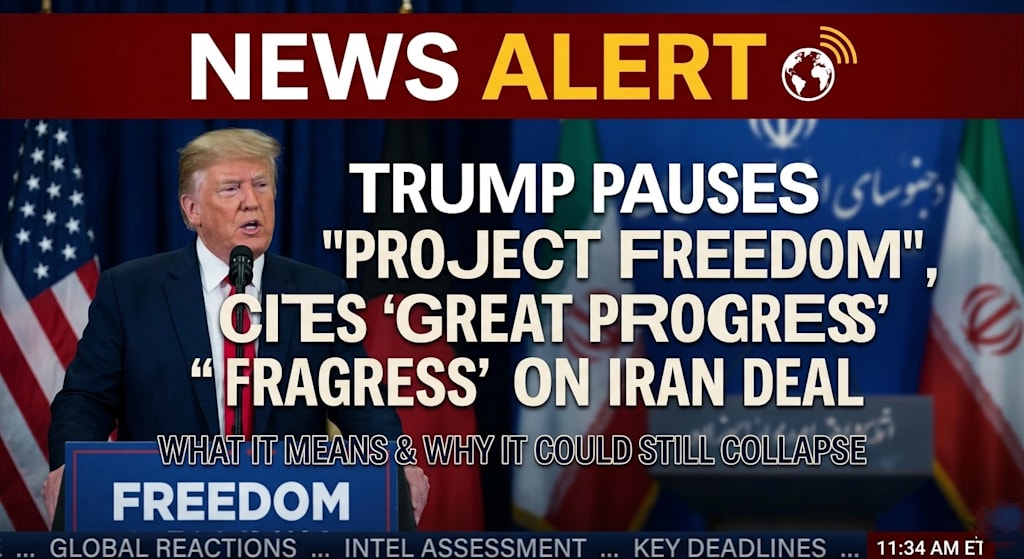
On Tuesday evening, May 5, President Donald Trump posted a message on Truth Social that upended the most volatile 48 hours in the Gulf since the war began. "Project Freedom," the U.S. military operation launched just 24 hours earlier to escort stranded commercial vessels through the Iranian-blockaded Strait of Hormuz, was being paused — "for a short period of time," Trump wrote — to allow for the finalisation of what he called "a Complete and Final Agreement" with Iran. The decision, made at the request of Pakistan — one of the key mediators in U.S.-Iran back-channel negotiations — came after a day of intense military exchanges, diplomatic warnings, and market volatility. Stock futures rose immediately upon the announcement, signalling that financial markets remain deeply invested in a diplomatic rather than military resolution to the crisis.
The about-face was stunning in its speed. On Monday, Secretary of State Marco Rubio had stood at the White House podium declaring that Project Freedom was a matter of life and death for more than 23,000 sailors from 87 nations stranded in the Persian Gulf, calling them sailors who had been "left for dead" by Iran. "They're sitting ducks. They're isolated, they're starving, they're vulnerable, and at least 10 sailors have already died as a result" of Iran's blockade, Rubio said. Less than 36 hours later, that framing was quietly set aside as Trump pivoted to diplomacy.
Trump said the pause was based on "great progress made toward a Complete and Final Agreement with Representatives of Iran." — Truth Social post, May 5, 2026
What drove the shift? According to multiple U.S. officials cited by Axios, the situation remains fluid and dangerous in equal measure. "There are talks. There are offers. We don't like theirs. They don't like ours. We still don't know the status of the Supreme Leader. And they're carrying messages by hand to caves or wherever he or whoever is hiding. It slows the process down," one official said bluntly. The same official summarised the binary situation with unusual candour: "It's either we're looking at the real contours of an achievable deal soon, or he's going to bomb the hell out of them." That is the choice before the United States right now — not a nuanced diplomatic spectrum, but a genuine binary between a historic peace agreement and a resumed full-scale war.
The key sticking points have not changed. The United States is demanding that Iran permanently abandon its nuclear enrichment programme — zero enrichment, no exceptions. Iran has categorically refused, insisting on its right to peaceful nuclear energy under international law and offering instead to submit to an enhanced inspection regime. Washington wants the Strait of Hormuz opened immediately as a condition of any deal. Tehran wants the U.S. naval blockade of Iranian ports lifted first. Each side sees the other's opening demand as a submission rather than a negotiation. Meanwhile, U.S. Defence Secretary Pete Hegseth confirmed Tuesday that the ceasefire "is not over," while Secretary of State Rubio declared that the U.S. military operation dubbed Operation Epic Fury had officially "concluded," reframing the conflict as a defensive posture aimed at restoring shipping rather than an offensive military campaign. The semantic gymnastics reflect a White House trying to project strength while simultaneously pulling back from confrontation.
Iran's President Masoud Pezeshkian, responding to Trump's pause, said the U.S. is pursuing "a policy of maximum pressure" and "expects Iran to submit to their unilateral demands," which is "impossible" for Tehran. Foreign Minister Abbas Araghchi, in Beijing for his first visit to China since the war began, was simultaneously sending Iran's message to its most powerful ally while Trump's envoys were sending theirs to Pakistan. The diplomatic traffic between Tehran, Islamabad, Beijing, and Washington has never been more intense — or more consequential.
What happens next could come within days. Trump has indicated a deal is possible "soon." Iran has indicated it will only accept a "fair and comprehensive agreement." Pakistan is carrying messages between sides. China is preparing to host Trump for a summit on May 14-15. If a framework can be agreed before that summit, the Beijing meeting could become the venue for formalising the end of the most disruptive conflict the global energy system has ever experienced. If it cannot, the pause in Project Freedom ends — and the next phase of the war begins.
This is the most important diplomatic story in the world right now.
About the Creator
Enjoyed the story? Support the Creator.
Subscribe for free to receive all their stories in your feed.
Comments
There are no comments for this story
Be the first to respond and start the conversation.