
Trump Is Heading to Beijing With an Unfinished War in His Pocket. The Xi Summit Could Be the Most Consequential Meeting of 2026 — or a Total Disaster
Trump's trip to China next week may determine whether the Iran conflict ends diplomatically or militarily. China holds Iran's economic lifeline. Xi holds Trump's most important diplomatic card. What happens in Beijing could decide the price of oil, the fate of the ceasefire, and the shape of the next world order.
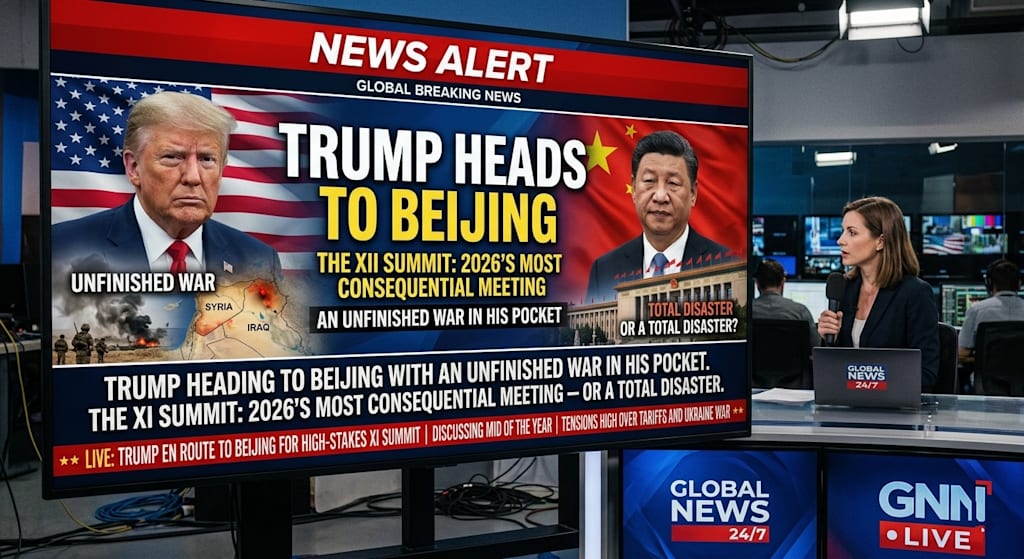
Sometime in the week of May 12, President Donald Trump is scheduled to travel to Beijing for a summit with Chinese President Xi Jinping — a meeting that was originally planned for April but delayed as the Iran war raged and U.S.-China relations deteriorated further. Trump will arrive in the Chinese capital with a very unusual set of diplomatic luggage: an unresolved war in the Middle East, a ceasefire that may or may not still exist, the world's most important oil shipping lane in dispute, and tariff threats hanging over the world's two largest economies. The meeting will be one of the most consequential summits in years — and it arrives at the worst possible moment.
China's stake in the Iran conflict is enormous and often underappreciated by Western audiences. According to pre-war shipping data, roughly one-third of China's total crude oil supply transited the Strait of Hormuz every single day. The closure of the strait since February 28 has forced China to draw down strategic reserves and scramble for alternative supplies from Russian pipelines and overland Central Asian routes — expensive, logistically strained alternatives that cannot fully replace what the Gulf once provided. China has approximately a billion barrels of strategic reserve, providing a few months of buffer. But every week the strait stays closed depletes that buffer and costs the Chinese economy real money.
Trump's visit to Beijing with the Iran conflict unresolved "could place Trump in a weakened position in his talks with Chinese leader Xi Jinping." — CNN analysis, May 4, 2026
The United States has accused China of "funding" Iran during the conflict, with a senior U.S. official urging Beijing publicly to help open the Hormuz and stop its purchases of Iranian oil. China has pushed back, saying it maintains the right to trade with any nation not under binding UN Security Council sanctions — and pointing out that the U.S. has no legal authority to dictate Chinese commercial relationships. The Trump administration has threatened to impose 50 percent tariffs on any country that continues to supply Iran with weapons or economic support. China, which has continued purchasing Iranian oil throughout the conflict, is the primary target of that threat. How Trump handles — or fails to handle — this issue in Beijing will shape the entire diplomatic landscape of the Iran conflict.
CNN's analysis of the summit noted the uncomfortable dynamic: Trump initially delayed the Beijing trip from April while the conflict raged. Now he will arrive with the conflict at best unresolved and at worst reigniting. "Arriving in Beijing with the conflict at best unresolved — or at worst raging yet again — could place Trump in a weakened position in his talks with Xi," CNN's analysts wrote. There is something to this. Xi has watched Trump launch a war, fail to achieve a clean military victory, struggle to produce a diplomatic deal, and now attempt a military operation in the strait whose first day produced more escalation than progress. Xi enters the summit from a position of comparative stability — and relative leverage.
What could come out of Beijing? The most optimistic scenario involves China agreeing to use its economic leverage over Iran to pressure Tehran toward a nuclear deal and a permanent Hormuz reopening, in exchange for tariff relief and U.S. acknowledgment of Chinese commercial interests in the Gulf. The most pessimistic scenario involves the summit collapsing in recrimination over tariffs, the Iranian oil question, and Taiwan — with each side leaving less willing to cooperate than before, and the Hormuz crisis grinding on toward a summer of $5 gas and possible renewed military strikes.
What is certain is that the Beijing summit has become the linchpin event of 2026's global diplomatic calendar. Whether it produces a framework for ending the Iran conflict or accelerates its deterioration, the world will feel the consequences for years. Trump is betting that Xi wants the strait open badly enough to help close it. Xi is betting that Trump needs a deal badly enough to offer real concessions. Both bets may be right. Or both may be wrong. In geopolitics, that is when history gets made — often in ways nobody intended.
The most important meeting of 2026 is coming.
About the Creator
Enjoyed the story? Support the Creator.
Subscribe for free to receive all their stories in your feed.
Comments
There are no comments for this story
Be the first to respond and start the conversation.