
🕊️ TRUMP AND IRAN: Secret Peace Talks Are Underway Right Now — Will the Most Dangerous War of 2026 Finally End, or Is This All Just a Dangerous Bluff?
The world is holding its breath. Thousands are already dead. Gas prices are crushing families across America. And somewhere behind closed doors, the fate of the entire Middle East is being decided.
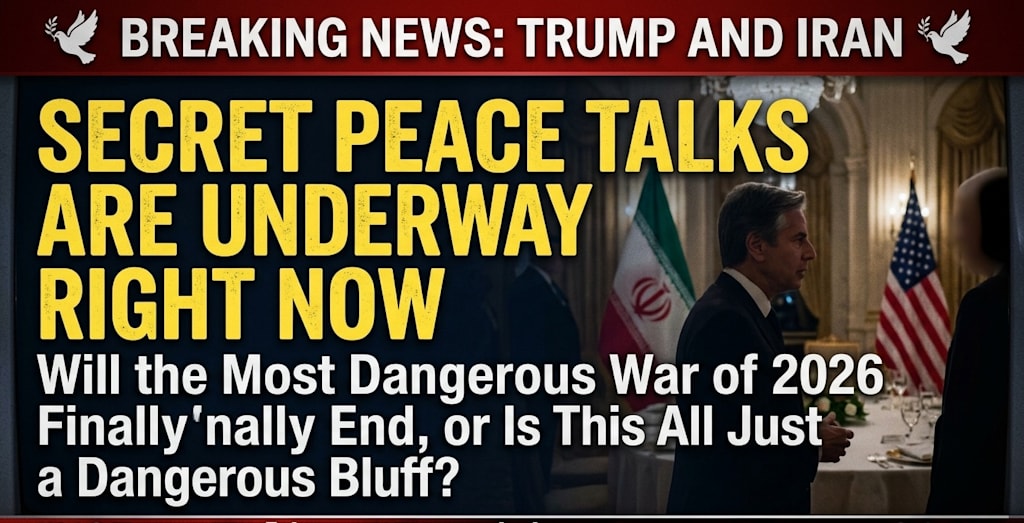
There is a quiet, tense drama unfolding in the back channels of international diplomacy — one that could end the most consequential military conflict of 2026, or collapse entirely and trigger a new round of catastrophic violence. On Sunday, President Donald Trump broke from his earlier hard-line posture and acknowledged publicly that his representatives are engaged in “very positive discussions” with Iran. The announcement, made through his Truth Social platform, marked a notable departure from remarks he had posted just the day before, in which he insisted Iran had not yet “paid a big enough price for what they have done to Humanity.”
The shift in tone was not accidental. It reflected real movement — however cautious — in back-channel diplomacy that has been quietly building over the past week. U.S. Special Envoy Steve Witkoff, appearing on CNN, confirmed the situation simply and directly: “We’re in conversation.” That phrase, brief as it is, carried enormous weight. It confirmed that despite the bombs, the rising death tolls, the blockaded strait, and the skyrocketing fuel prices, the two adversarial nations have not entirely abandoned the possibility of talking their way out of this conflict.
The vehicle for those conversations has been Pakistan. Pakistani officials confirmed to CBS News on Friday that a revised Iranian response to the latest U.S. peace terms had been conveyed to American negotiators through Pakistani mediators. Tehran had submitted what is being described as a 14-point proposal outlining conditions under which it would be willing to end the war. The previous version of Iran’s offer had attempted to delay any discussion of Iran’s nuclear program to a later phase of negotiations — a condition the Trump administration found unacceptable. The revised proposal, exactly what it contains, remains undisclosed, but its delivery through official channels is significant in itself. It means both sides are at least willing to put terms on a table.
To understand the stakes of these negotiations, one must first grasp the sheer scale of what this conflict has already cost. Preliminary figures place the death toll at approximately 3,375 people in Iran and 2,509 in Lebanon as a result of the wider regional conflagration sparked by U.S.-Israeli military operations and Tehran’s retaliatory strikes. Twenty-eight people have been killed in Gulf states. The human cost is staggering — and it is compounded by an economic catastrophe that is being felt far beyond the Middle East. The Strait of Hormuz, through which one-fifth of the world’s daily oil supply once flowed freely, has been effectively closed since the war began. The result is a global energy crisis: U.S. gas prices have climbed to $4.45 per gallon on average — a 50 percent increase since hostilities commenced — and the economic ripple effects are being felt in supply chains, consumer prices, and financial markets worldwide.
The Iranian ceasefire proposal comes amid growing internal pressure inside Iran. The war has been enormously costly for Tehran, both militarily and economically. U.S.-Israeli bombing campaigns have targeted Iranian infrastructure, military installations, and critical facilities. Iran’s retaliatory strikes on Israel and U.S. assets in the region, while significant, have not changed the fundamental military calculus. A ceasefire, from Tehran’s perspective, would offer relief from the punishing pressure of continued bombardment. But it would also require Iran to make concessions — on its nuclear program chief among them — that the Islamic Republic’s leadership may find politically untenable at home.
Trump’s position is equally complicated. He declared last week that the U.S. had “already won” the war but also said he wanted to “win by a bigger margin” and ensure Iran could never attain a nuclear weapon. That rhetorical framing leaves room for a deal — if Iran accepts American terms on the nuclear question — but it also sets a high bar that Tehran may struggle to clear. The 60-day War Powers deadline passed Friday, with Secretary of Defense Pete Hegseth arguing that the clock was paused during the ongoing ceasefire. But Congressional pressure to wind down hostilities without formal authorization is real, and it provides additional impetus for the administration to reach an agreement sooner rather than later.
The ceasefire that has been technically in place — fragile and contested as it is — provides the barest framework within which these talks can occur. Hezbollah and Israel are still exchanging fire in southern Lebanon, with each side accusing the other of ceasefire violations. More than one million Lebanese civilians have been displaced. The broader regional tinderbox has not been extinguished; it has merely been banked. One miscalculation, one rogue strike, one provocation that goes too far could reignite the full conflict in moments.
Analysts who track U.S.-Iran relations say the talks face profound obstacles beyond the nuclear issue. Decades of mutual mistrust, broken agreements, and cycles of escalation and de-escalation have created an environment in which neither side fully believes the other will honor any deal that is reached. The Trump administration has previously withdrawn from the Joint Comprehensive Plan of Action — the Obama-era nuclear deal — and Iran has experienced firsthand the consequences of American diplomatic reversals. For Tehran, any new agreement would need to include credible guarantees. For Washington, any deal would need to be verifiable and enforceable. Finding common ground on both fronts simultaneously, while bombs are still dropping and ships are still being hit in the strait, is a diplomatic task of extraordinary difficulty.
And yet, the conversations continue. The economic pain is real, the human cost is catastrophic, and both sides have political constituencies that are exhausted by the conflict. History suggests that wars end when the cost of continuing exceeds the cost of compromise. The question is whether the United States and Iran have reached that inflection point — and whether their leaders have the political courage to act on it before the next incident pushes them back from the brink. The next 48 to 72 hours may be among the most consequential in the 2026 conflict. The world is watching.
About the Creator
Enjoyed the story? Support the Creator.
Subscribe for free to receive all their stories in your feed.
Comments
There are no comments for this story
Be the first to respond and start the conversation.