
TRIS Base Procurement Guide: Purity, Impurity Limits, Buffer Applications and Packaging
Why TRIS Base Procurement Requires More Than a Purity Figure

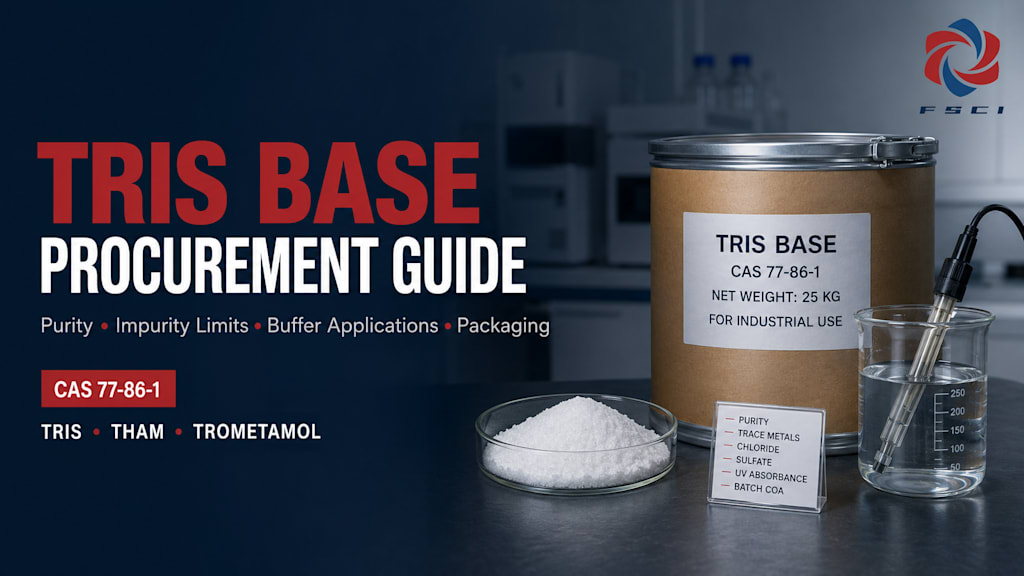
TRIS Base is widely used in laboratory buffers, molecular biology, biopharmaceutical processing, cosmetic formulations, analytical systems, and fine chemical manufacturing. Despite this broad range of uses, one grade should not be assumed suitable for every application.
A buyer may begin by comparing assay, availability, and price, but total purity provides only part of the quality picture. Trace metals, chloride, sulfate, heavy metals, moisture or volatile content, ultraviolet absorbance, and batch consistency may be important depending on how the material will be used.
Documentation requirements can also vary substantially. A research laboratory, pharmaceutical manufacturer, cosmetic formulator, and industrial chemical producer may request different specifications, quality statements, validation information, and supplier controls.
Successful procurement therefore begins with the intended application. Buyers should define the required grade, critical impurity limits, testing expectations, packaging, and supporting documents before comparing suppliers.
Confirm the Product Identity
TRIS Base can appear under several names in catalogs, quotations, technical documents, and shipping records. Common names include:
TRIS
TRIS Base
Tris(hydroxymethyl)aminomethane
THAM
Trometamol
Tromethamine
These names commonly refer to the compound identified by CAS 77-86-1, but buyers should still verify the complete chemical identity. Commercial naming conventions can vary between industries and geographic markets.
A request for “TRIS” without a CAS number or grade description may be too broad. Buyers should confirm the full chemical name, CAS number, molecular information, specification, intended grade, and application before approving a quotation.
When reviewing available grades, packaging options, and batch documentation for Tris(hydroxymethyl)aminomethane CAS 77-86-1, procurement teams should compare the information with their internal requirements rather than relying on the commercial name alone.
The same product identity should appear consistently on the specification sheet, Certificate of Analysis, Safety Data Sheet, label, packing list, and invoice. Any discrepancy should be resolved before shipment.
Define the Intended Application
Laboratory and molecular biology users may purchase TRIS Base as a biological buffer component. These buyers can be sensitive to impurities or ultraviolet absorbance that may interfere with optical measurements, nucleic acid work, protein-related processes, or other analytical procedures.
Biopharmaceutical buyers may require additional supplier qualification, change control, traceability, validation support, and application-specific documentation. A material sold as TRIS Base should not be considered suitable for pharmaceutical processing unless the required grade, documentation, and quality controls have been independently verified.
Cosmetic and personal-care formulators may evaluate TRIS Base for buffering, neutralization, or formulation-related functions. Their priorities may include color, odor, impurity profile, consistency, regulatory documentation, and compatibility with the complete formulation.
Diagnostic and analytical organizations may focus on ultraviolet absorbance, trace metals, moisture, and lot-to-lot consistency. Even small variations can matter when a method depends on a controlled background or sensitive measurement.
Fine chemical and organic synthesis buyers may place greater emphasis on assay, moisture, process-relevant impurities, commercial availability, packaging, and delivery reliability.
Before requesting a quotation, buyers should communicate the application, required grade, estimated volume, critical quality limits, packaging preference, and documentation needs. This allows a TRIS base supplier to respond with information relevant to the actual use.
Evaluate Assay Without Relying on It Alone
An assay of at least 99% can serve as an initial procurement benchmark. However, it should be treated as a starting point rather than proof that the product is appropriate for a sensitive biological, pharmaceutical, cosmetic, diagnostic, or analytical application.
Assay measures the amount of the intended compound detected under a defined test method. It does not fully describe the remaining portion of the material or identify every impurity that may affect the user’s process.
Two batches can report similar total assay values while differing in moisture, trace metals, inorganic ions, ultraviolet absorbance, or other application-relevant attributes. Buyers should therefore review the complete specification and batch-specific COA.
The assay requirement must also match the intended use. A research application may prioritize a different set of quality parameters than an industrial synthesis. Procurement teams should involve technical and quality personnel when establishing the acceptance criteria.
Review Critical Trace Impurities
Iron is one trace impurity that may be important in biological, analytical, formulation, or chemical processes. Its relevance and acceptable limit depend on the application, so buyers should confirm the agreed specification, analytical method, and batch result.
Chloride and sulfate are inorganic ions that may affect ionic balance, analytical background, formulation compatibility, or downstream processing. Their importance varies with the buffer system and manufacturing process.
Heavy-metal controls may also be required by internal quality standards or application-specific expectations. The term “heavy metals” can refer to different analytical approaches, so buyers should clarify which method, elements, or reporting convention applies.
A high total assay does not automatically confirm low levels of iron, chloride, sulfate, or heavy metals. These parameters should be listed separately when they are relevant to the purchasing specification.
Procurement teams should avoid applying one universal impurity limit to every application. Each acceptance limit should be agreed upon according to the intended use and verified through the current product specification and batch Certificate of Analysis.
Examine Ultraviolet Absorbance and Loss on Drying
Ultraviolet absorbance describes how much light a sample absorbs at a specified wavelength under defined test conditions. It can matter in molecular biology, optical measurement, biochemical analysis, and other applications where background absorbance may influence results.
A reported absorbance value is not meaningful without context. Buyers should confirm:
The measurement wavelength
Sample concentration or preparation conditions
Instrumental or analytical method
Acceptance limit
Actual batch result
Relevance to the intended application
Results measured at different wavelengths or under different conditions should not be treated as directly comparable.
Loss on drying measures the mass lost after a sample is held under specified drying conditions. It is often used as an indicator of moisture or other volatile content, but its interpretation depends on the method.
For moisture-sensitive applications, buyers should review the loss-on-drying specification together with packaging, storage conditions, and the batch result. A package that does not protect the product adequately during transportation or storage can undermine an acceptable result recorded before shipment.
Assess Batch-to-Batch Consistency
A single high-purity sample does not establish reliable commercial supply. Buyers should evaluate whether assay, impurity levels, loss on drying, absorbance, and appearance remain reasonably consistent across production lots.
Recent COAs from more than one batch can help identify normal variation. A representative sample provides an opportunity to compare the supplier’s reported results with the buyer’s internal evaluation.
Small validation orders can also reveal practical issues involving packaging, labeling, documentation, delivery, or communication. These factors may not be visible during the initial quotation stage.
For recurring purchases, supplier performance should be monitored over time. Procurement and quality teams can track batch acceptance, delivery reliability, COA accuracy, packaging condition, deviations, and complaint resolution.
A qualified supplier should also have a process for notifying customers about relevant specification, method, packaging, or production changes.
Confirm Packaging and Delivery Requirements
TRIS Base may be offered in 25 kg bags or 25 kg drums, but buyers should confirm the available format for each quotation. These options should not be assumed to be universal across every supplier, grade, or destination.
Packaging selection should consider consumption rate, warehouse conditions, handling capability, risk of moisture exposure, and the time a container may remain open. A bag may suit one facility, while a drum may provide a more practical format for another.
Buyers should confirm the inner liner, closure, seal, outer container, label format, net weight, and pallet configuration. The packaging should provide appropriate protection from moisture, contamination, and physical damage during the expected transportation and storage period.
Receiving personnel should inspect each package for broken seals, punctures, water exposure, contamination, missing labels, or other visible damage. Lot numbers should remain legible and correspond with the COA and shipping records.
Storage and transportation conditions should be taken from the current supplier documentation and reviewed against the buyer’s warehouse procedures. Customized packaging or labeling may be possible, but availability, minimum quantity, lead time, and cost should be confirmed in advance.
Audit Documentation and Supplier Quality Systems
Documentation requirements depend on the intended market and application. A research buyer may need a specification, COA, and SDS, while a biopharmaceutical or cosmetic organization may require additional quality statements and supplier review.
A basic qualification file should include:
Current product specification
Batch-specific Certificate of Analysis
Current Safety Data Sheet
Relevant test methods or method references
Packaging and storage information
Lot traceability records
Change-control procedures
Deviation and complaint-handling process
Export and transportation documents
Application-specific compliance statements where applicable
Buyers should not infer pharmaceutical, pharmacopeial, GMP, cosmetic, food, or medical compliance from the product name or purity alone. Any required status must be supported by current, relevant documentation and reviewed by qualified personnel.
When comparing a Trometamol supplier or THAM chemical source, documentation accuracy can be as important as product availability. Errors in the CAS number, lot number, test results, or packaging details can delay receiving approval and production use.
Validate TRIS Base in the Intended Application
A representative sample allows technical and quality teams to assess the offered material against their own application and incoming-control requirements. The sample should be traceable to a defined batch and accompanied by the relevant COA.
Evaluation may include identity, assay, appearance, impurity controls, loss on drying, ultraviolet absorbance, or other application-specific attributes. The scope should be established by the buyer’s approved internal procedures.
A small commercial order can extend this evaluation to packaging condition, delivery performance, document accuracy, lot labeling, and supplier responsiveness.
Validation of one sample should not be interpreted as permanent approval of every future batch. Ongoing review of batch documents and receiving results remains important for repeat procurement.
TRIS Base Supplier Qualification Checklist
Before approving a supplier, confirm the following:
Full chemical name and CAS 77-86-1 are verified.
TRIS Base, THAM, Trometamol, and other names are reconciled.
The intended application has been communicated.
The required grade is clearly defined.
The assay requirement is documented.
Iron, chloride, sulfate, and heavy-metal criteria are reviewed.
Loss on drying is included when relevant.
Ultraviolet absorbance conditions and limits are confirmed.
A representative sample is available.
Recent batch-specific COAs can be supplied.
A current SDS is available.
Bag or drum packaging is confirmed.
Inner liner, seal, and moisture protection are documented.
Lot numbers support complete traceability.
Quality-system and change-control information is available.
Production and delivery lead times are realistic.
Technical and quality contacts respond clearly.
Complaint and deviation procedures are established.
Questions to Ask Before Buying TRIS Base
Procurement teams can send these questions to prospective suppliers:
Can you confirm the full chemical name and CAS 77-86-1 for the offered product?
Which grade is recommended for our intended application, and what documentation supports that recommendation?
What limits apply to iron, chloride, sulfate, heavy metals, and other relevant impurities?
Are ultraviolet absorbance and loss on drying included in the specification and batch COA?
Can you provide a representative sample with its lot number and recent COAs from commercial batches?
Are 25 kg bag and drum options available, and what liner and sealing system is used?
What quality, traceability, change-control, storage, and export documents can you provide?
How are specification changes, deviations, damaged packaging, and quality complaints communicated and resolved?
Written responses allow procurement, technical, and quality teams to compare suppliers using consistent criteria.
Conclusion
Reliable TRIS Base procurement depends on matching the product grade to the intended application. An assay of at least 99% may be a useful starting benchmark, but it does not replace the review of trace impurities, ultraviolet absorbance, loss on drying, batch consistency, packaging, and documentation.
By confirming product identity, defining application-specific criteria, evaluating representative samples, and auditing supplier quality systems, buyers can make better-informed sourcing decisions. Continued COA review, receiving inspection, traceability, and change control help maintain confidence across future batches.
About the Creator
Enjoyed the story? Support the Creator.
Subscribe for free to receive all their stories in your feed.
Comments
There are no comments for this story
Be the first to respond and start the conversation.