
Top Predictive Analytics Tools for Financial Planning in 2025
Introduction: The Rise of Predictive Analytics in Financial Planning

In the rapidly evolving financial landscape of 2025, predictive analytics has become a cornerstone of strategic financial planning. With economic volatility, tighter regulations, and rising data complexity, finance leaders are turning to sophisticated tools to forecast trends, mitigate risks, and optimize resource allocation. This guide outlines the top predictive analytics tools redefining financial planning this year, based on features, scalability, ease of integration, and AI capabilities.
1. IBM Planning Analytics with Watson
Best for: Enterprise-level financial planning with AI-driven insights
IBM Planning Analytics, powered by Watson, delivers advanced forecasting capabilities through machine learning. Its dynamic interface allows finance teams to run what-if analyses, simulate outcomes, and automate complex workflows.
Key Features:
- Natural language processing for intuitive query input
- Built-in machine learning for continuous model improvement
- Real-time data consolidation across departments
- Integration with IBM Cognos for advanced visualization
Why It Stands Out: Watson's AI capabilities continuously learn from new data inputs, enabling more accurate and context-aware forecasts, especially for multinational corporations.
2. Oracle Fusion Cloud EPM
Best for: End-to-end enterprise performance management
Oracle’s Fusion Cloud EPM combines AI, machine learning, and embedded analytics to empower finance teams to model, plan, and report with high precision.
Key Features:
- Predictive planning and anomaly detection
- Built-in scenario modeling
- Seamless integration with ERP systems
- Customizable dashboards and KPI tracking
Why It Stands Out: Oracle’s unified platform reduces data silos, enabling real-time collaboration between finance, operations, and HR teams.
3. Anaplan
Best for: Real-time collaborative financial planning
Anaplan uses its proprietary Hyperblock™ technology to handle complex, large-scale financial data across multiple dimensions in real time. It’s ideal for enterprises requiring agile and collaborative planning processes.
Key Features:
- In-memory data processing for speed
- Scenario analysis and rolling forecasts
- Version control and audit trails
- REST APIs for integration with business tools
Why It Stands Out: Anaplan’s strong modeling engine and collaborative features make it a favorite for enterprises prioritizing agility in strategic planning.
4. Microsoft Power BI with Azure Machine Learning
Best for: Data-driven finance teams seeking custom ML models
Power BI’s integration with Azure ML allows finance teams to build, train, and deploy custom predictive models directly within their reporting dashboards.
Key Features:
- Seamless integration with Excel and Microsoft 365
- Azure AI integration for advanced forecasting
- Custom DAX formulas for tailored financial KPIs
- Visual insights with interactive dashboards
Why It Stands Out: For organizations already in the Microsoft ecosystem, this tool offers a low-friction, powerful analytics environment with enterprise-grade capabilities.
5. SAS Forecasting for Financial Planning
Best for: Statistical accuracy and industry-specific modeling
SAS is renowned for its statistical modeling tools, and its forecasting suite provides deep, granular control over model parameters, making it ideal for regulated industries.
Key Features:
- Automated forecasting with override options
- Hierarchical planning and reconciliation
- Forecast value-added (FVA) analysis
- Rich API and scripting capabilities
Why It Stands Out: SAS’s strength lies in its precision and regulatory compliance, especially for banking, insurance, and government finance applications.
6. Tableau with Einstein Discovery (Salesforce)
Best for: Visual analytics with integrated AI insights
Tableau’s predictive capabilities have expanded with the integration of Salesforce’s Einstein Discovery, enabling users to apply machine learning models directly within the dashboard.
Key Features:
- Predictive trend lines and scenario simulation
- Natural language explanations of forecasts
- Integration with CRM and ERP systems
- Drag-and-drop AI model deployment
Why It Stands Out: The blend of powerful visuals and accessible AI makes Tableau an excellent tool for decision-makers who rely on data storytelling.
7. Workday Adaptive Planning
Best for: Mid-market businesses seeking agility
Workday’s Adaptive Planning tool is a cloud-native solution focused on flexibility and scalability. It enables rolling forecasts, flexible budgeting, and interactive dashboards tailored for mid-sized companies.
Key Features:
- Driver-based planning and custom metrics
- Version comparison and variance analysis
- Pre-built connectors to Workday HCM and ERP
- Cloud-first architecture for easy deployment
Why It Stands Out: Workday’s user-friendly design and seamless integrations make it a powerful tool for organizations scaling up their financial planning capabilities.
8. TIBCO Spotfire
Best for: Advanced statistical forecasting with AI explainability
TIBCO Spotfire offers deep statistical capabilities with built-in AI and machine learning for predictive insights, along with natural language query features for accessibility.
Key Features:
- Automated data wrangling and cleansing
- AI-driven pattern detection
- Real-time event stream analysis
- Detailed audit trails and model transparency
Why It Stands Out: Spotfire balances robust statistical analysis with user-friendly AI features, ideal for data-driven finance teams.
9. Jedox
Best for: Excel-based users transitioning to enterprise planning
Jedox provides an Excel-like interface combined with powerful predictive analytics and workflow automation, easing the transition for teams familiar with spreadsheet-based planning.
Key Features:
- Predictive analytics powered by AI and ML
- Custom model builder
- Excel-native front end with cloud backend
- Integrated workflow and approval management
Why It Stands Out: Jedox's familiar interface reduces training time while offering enterprise-grade analytics, making it a popular choice for organizations modernizing legacy systems.
10. Planful (formerly Host Analytics)
Best for: Continuous planning and real-time collaboration
Planful enables finance teams to move from static, annual planning to continuous forecasting and analysis, promoting responsiveness and agility in decision-making.
Key Features:
- Continuous planning capabilities
- Pre-configured planning templates
- Financial consolidation and reporting
- Collaboration features for cross-departmental input
Why It Stands Out: Planful emphasizes speed and simplicity, with strong collaboration features that support modern, continuous planning practices.
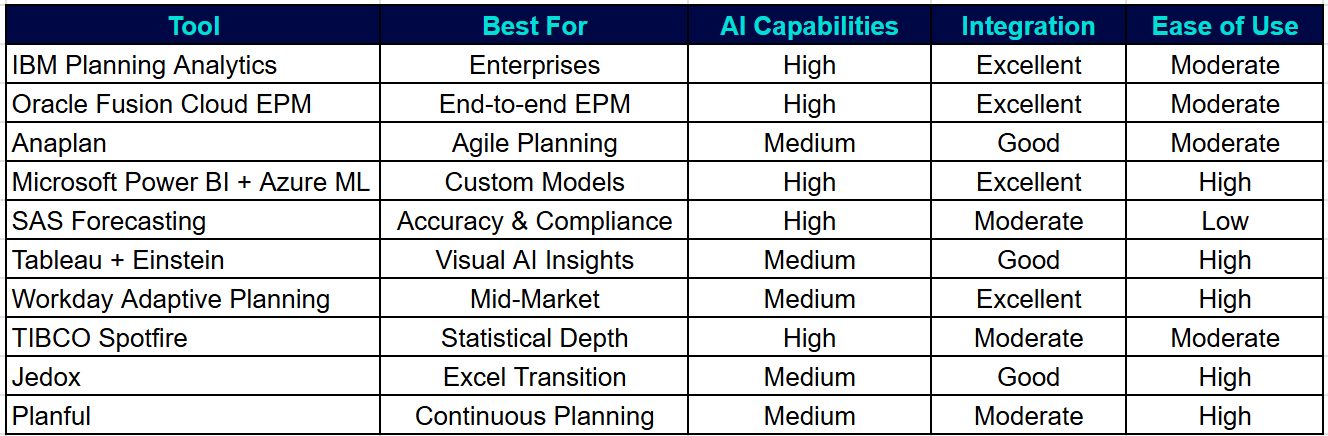
Comparative Overview
Final Thoughts
In 2025, predictive analytics tools are no longer optional—they’re imperative for finance teams looking to stay competitive, agile, and data-driven. From enterprise-grade platforms like IBM and Oracle to agile, mid-market solutions like Adaptive Planning and Planful, the landscape is rich with options to suit every business model.
Finance leaders must evaluate these tools not only on technical capabilities but also on alignment with organizational goals, team readiness, and integration ecosystems. The right tool will do more than forecast numbers—it will drive smarter decisions and long-term financial success.
About the Creator
Febi.AI
India’s first AI-powered bookkeeping – Automated tax compliances – Real time business insights with dedicated personal accountant. Features Including Transaction Management through AI, Automated File Management etc.
Website:- febi.ai
Enjoyed the story? Support the Creator.
Subscribe for free to receive all their stories in your feed.
Comments
There are no comments for this story
Be the first to respond and start the conversation.