
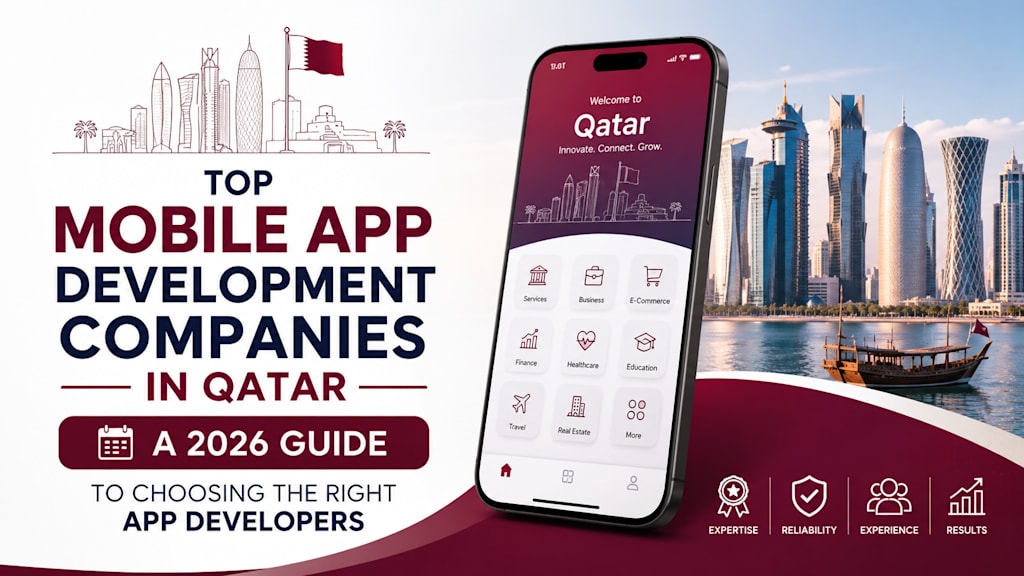
Top Mobile App Development Companies in Qatar: A 2026 Guide to Choosing the Right App Developers
A no-nonsense breakdown of the development firms worth your time in 2026, and the questions you need to ask before signing with any of them.

I did not expect finding an app developer in Qatar to be this complicated. A colleague recommended I just Google it, pick someone with good reviews, and move on. That advice aged poorly. Three months and several disappointing conversations later, I had a much clearer picture of how this market actually works — and who in it is worth talking to.
This guide is what I wish I had found at the start of that process. It covers what is genuinely driving app demand in Qatar right now, which firms came up consistently in honest conversations with other business owners, and what questions actually separate reliable partners from ones who will waste your time and budget.
What's Driving the Demand for Quality App Development in Qatar?
The demand is real, and it comes from several directions at once.
Government digitization has moved from policy to practice. Services that required office visits a few years ago are now expected to function on a mobile device, and that expectation is filtering into how citizens interact with private businesses too.
The 2022 World Cup left behind an infrastructure legacy that often goes unmentioned. Millions of people used transport apps, payment platforms, and ticketing systems during that period — and those systems largely worked. That experience quietly raised the baseline for what users in Qatar now consider acceptable from a mobile product.
Meanwhile, a younger generation of consumers is making choices based partly on digital experience. A slow checkout, a confusing interface, or an app that crashes under load is no longer forgiven easily. For businesses, the cost of a poorly built product has gone up.
1. TechGropse
One pattern I noticed when speaking with founders in Doha was frustration with agencies that were strong in one area and noticeably weaker in others. Good designers handing off to inexperienced developers. Strong technical builds with no real UX thinking. Capable launches followed by weeks of silence when post-launch problems appeared.
TechGropse was mentioned by several people as an exception to that pattern. What came up specifically was their habit of asking difficult questions early — challenging assumptions in the brief before any design or development work began. For one logistics company I spoke with, that process caught a fundamental flaw in their original concept before it became expensive. That kind of early friction, done well, saves money later.
They have worked across fintech, healthcare, retail, and logistics — sectors where mistakes have real consequences and where understanding the industry context matters as much as writing clean code.
2. Intellectsoft
Enterprise projects in Qatar — particularly in banking and energy — carry a specific kind of weight. You are rarely building from scratch. You are connecting new systems to old ones, managing competing priorities across departments, and staying within compliance boundaries that vary by sector and sometimes by project.
Intellectsoft has experience navigating exactly that environment. The value they offer is not speed or low cost — it is familiarity with the complexity of large organization projects, where the technical work is often the simpler part compared to the stakeholder management and integration challenges surrounding it.
3. Devsinc
Most clients focus on what they can see — the interface, the features, the design. What they often underestimate is the backend architecture holding everything together, which only becomes visible when something goes wrong.
Devsinc focuses on getting that foundation right from the beginning. For companies building marketplace platforms or enterprise tools in Qatar, a well-designed backend means the difference between a product that handles growth gracefully and one that requires a costly rebuild the moment user numbers start climbing.
4. Surf Your App
Early-stage companies face a different problem than established ones. They do not need a perfect product. They need a working one, fast enough to test whether their assumptions about the market are correct before they run out of runway.
Surf Your App operates in that space. They have delivered functional prototypes across on-demand services, eCommerce, and SaaS products at a pace that allows founders to gather real user feedback while there is still time to act on it. The goal is learning, not launching something polished that nobody ends up using.
5. Matellio
There is a difference between a developer who has built apps for healthcare before and one who understands how healthcare actually operates — the workflows, the compliance requirements, the way staff use software under the pressure of a working shift.
Matellio has invested in that kind of domain knowledge across healthcare, logistics, real estate, and education. In practice, that means fewer revision cycles because they arrive already knowing which questions to ask. For Qatar's expanding healthcare and real estate sectors, that prior experience with industry-specific constraints is genuinely useful rather than just a line on a website.
6. Innowise Group
Some projects are technically awkward in ways that are hard to explain to a general audience. A new system needs to talk to an old one that was never designed to be integrated with. A critical process needs to keep running while something new is built around it.
Innowise Group handles this kind of work without making it feel like a crisis. Their code quality after handover was something that came up in multiple conversations — specifically, that internal teams were able to continue development without needing to untangle what had been built. That matters if you plan to own the product long-term rather than stay dependent on an external agency.
7. Prometteur Solutions
Budget is a real constraint for most businesses, and it is worth being honest about that rather than building a guide that only applies to companies with unlimited resources.
Prometteur Solutions works across mobile, web, and IoT projects at price points that smaller and mid-sized businesses in Qatar can realistically afford. What came up most in conversations about them was not their technical capability but their communication — clear updates, honest timelines, and straightforward responses when something changed. For businesses without a dedicated technical team internally, that transparency makes a significant practical difference.
How to Evaluate These Firms for Your Specific Project
A list like this is useful context but not a substitute for your own due diligence. A few questions that consistently produced useful answers when I was doing this research:
Ask for outcomes, not just portfolios. Screenshots show what something looked like. What you need to know is whether it worked — whether users stayed, whether conversion improved, whether the client would build with them again.
Find out who specifically will work on your project. The people presenting in a sales meeting are not always the people writing your code. Ask to meet the actual team and ask about their direct experience with your type of product.
Ask how they handle changes in scope. Requirements shift during every real project. How an agency responds to that — whether they have a fair and clear process or whether scope changes become a source of unexpected cost and tension — tells you a great deal about what working with them will feel like.
Find clients they did not introduce you to. Provided references are selected. Find past clients independently, ideally through LinkedIn, and ask them specifically what went wrong and how the agency responded. That question reveals more than anything about what they are actually like to work with.
Conclusion
Choosing among mobile app development companies in Qatar is less about finding the most technically impressive option and more about finding the right fit for your specific project, timeline, and budget.
The companies in this guide came up through conversations with people who had actually worked with them — not through marketing claims. That does not make them the right choice for every project, but it makes them a reasonable starting point for anyone doing serious research.
The digital shift happening in Qatar is not going to slow down. Getting the partnership decision right is worth the time it takes to get it right.
About the Creator
Enjoyed the story? Support the Creator.
Subscribe for free to receive all their stories in your feed.
Comments
There are no comments for this story
Be the first to respond and start the conversation.