
The Wedding Was Real. The Fairy Tale Was Not.
Diana was chosen because she fit the role. The crown did the rest.
One
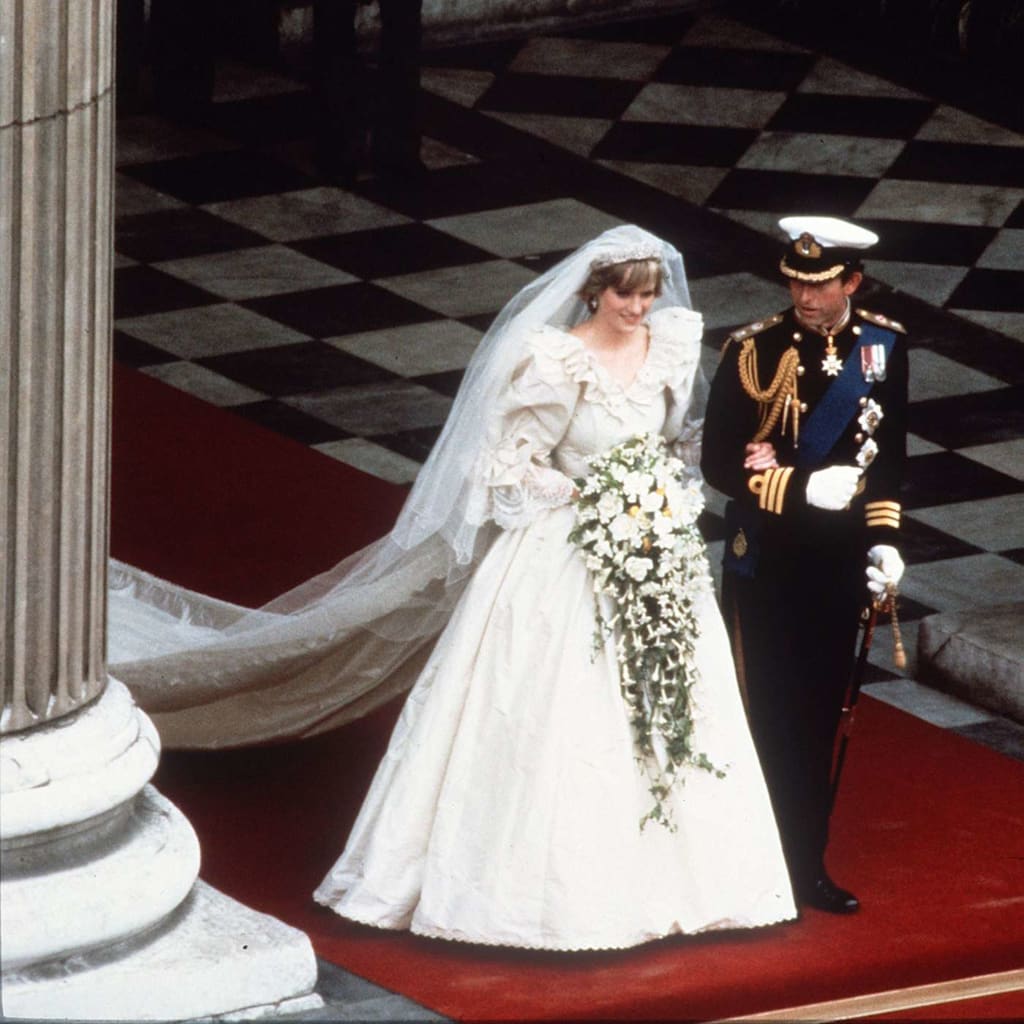
July 29, 1981. St Paul’s Cathedral.
When Diana stepped down from the carriage, the first thing she stepped on was her own hem. Ivory taffeta, twenty-five feet long. The designer David Emanuel later said in an interview that they had originally made it longer, but someone at Buckingham Palace called and said it would not fit in the carriage. So a section was cut off. No one ever asked where that cut-off piece of silk went.
As she bent to get into the carriage, her veil caught on the door frame and wrinkled a little. She tried to smooth it with her hand, but the glove was too slippery. The carriage started. She sat inside and heard the cheers outside surge toward her like a tide, muffled through the glass. She later told a friend one thing. What she remembered most about that day was not the church. It was the heat in the carriage and the petticoat sewn into the wedding dress scratching at the side of her waist. She could not reach down to scratch it because the windows were transparent.
Charles was waiting for her at the altar. He turned and looked at her and smiled. That smile was caught by the cameras and appeared on the front page of every newspaper the next day, with the headline “He has finally got her.” But Diana later told her voice coach Peter Settelen that as she walked toward the altar, she had only one thought in her head. She had called him “Charles.” He had just been talking to Camilla in the corridor, and she had seen Camilla smile.
She did not tell anyone about this. The wedding went on. The ring was placed on her finger, the bells rang, the kiss on the balcony was photographed. The whole world was watching a fairy tale, and the heroine of that fairy tale was thinking: why had he not looked at her first?
Two
The Spencer family had known the royal family since they were children. Diana’s grandmother had been a lady-in-waiting to Queen Elizabeth the Queen Mother, and her father, John Spencer, Earl Spencer, had played polo with Charles’s father, Prince Philip. She lived at Park House, half an hour’s drive from Sandringham. As a child, she had played hide-and-seek with Princes Andrew and Edward on the lawn at Sandringham.
So when word began to spread in royal circles that Charles was paying attention to the younger Spencer girl, no one found it surprising. Charles was in his early thirties then, and the palace was pressing him hard to marry. Several names had appeared on the candidate list, and the ones that lasted all shared certain qualities: clean family background, no complicated romantic history, young, highly malleable. Diana was sixteen at the time. Her sister Jane had married an assistant to the Queen’s private secretary. Another sister, Sarah, had dated Charles for a while and later withdrew herself.
According to Tina Brown in The Diana Chronicles, people in royal circles specifically assessed candidates’ adaptability. Could they endure the media? Could they adapt to the rhythm of court life? Was there any scandal in the family? Was their mental state stable? Diana’s parents had divorced when she was six. Her mother, Frances, had run off with someone, and her father had remarried. This was no secret in aristocratic circles. Some saw it as a minus. Others thought it was just right. A girl who had lacked love since childhood would be more easily moved by the feeling of being chosen.
The first time Charles really noticed her was in the autumn of 1977 at Althorp. Diana was wearing a plaid shirt and corduroy trousers, standing among a group of adults and looking bored. Charles walked over and spoke to her. She blushed and said, “Are you talking to me?” Charles later mentioned this detail in a letter to a friend, saying she was “quite amusing, like a child.”
By then Camilla had already married Andrew Parker Bowles. Charles was godfather to Camilla’s two children. He often visited the Parker Bowleses’ home. Camilla cooked for him, and they hunted together and listened to records together. According to some biographers, Charles and Camilla’s relationship had not ended after her marriage. This was no secret in their circles. Diana did not know it then.
Three
The courtship lasted about a year. Charles would call Diana’s flat in London, ask her to concerts, to dinner at Buckingham Palace, to royal gatherings at Balmoral. He listened to her talk about her childhood, about hiding in her room and crying when her parents divorced, about feeling that she was not clever enough or good enough. He would nod when he heard it and say, “I understand.” Diana later told Andrew Morton that it was the first time she felt someone was really listening to her.
But there were also small things she did not notice at the time. Charles never took Camilla’s calls in front of her. Once, while they were walking at Balmoral, Charles pointed to a wood and said Camilla liked to picnic there best. On the day he proposed, Diana later recalled in the tapes, Charles paused for a long time before saying “Will you marry me?”, as if he were reciting lines.
She said yes. She later said that at the time she thought it was fate. A girl who had felt unloved since childhood suddenly being chosen by the future king. That story would make anyone dizzy.
Buckingham Palace was preparing in parallel. The Queen’s private secretary’s office began arranging media strategy: when to release the news, what photographs to release, who should design the wedding dress, what route the wedding would take. According to reporting in The Times at the time, the royal PR team sent the media a wedding coverage guide with several suggestions. Take more photographs of Diana smiling, fewer of Charles’s expression. Emphasize the traditional significance of the wedding and play down the love story narrative. The media did not listen to the second half.
A week before the wedding, during rehearsals, Diana discovered that Charles had bought Camilla a bracelet. She saw it on the desk in his study, the box tied with ribbon. She asked. Charles said it was a gift for the godmother of Camilla’s two children. Diana did not ask again. On the eve of the wedding, she had dinner at Buckingham Palace. Charles was not there. He was at Clarence House. She ate a plate of chicken salad alone, then went back to her room and practiced smiling in the mirror.
Four
For the first month after the wedding, they stayed at Balmoral. Diana later told Morton that it was the loneliest time of her life. Charles went hunting every morning, had tea with friends in the afternoon, and called Camilla in the evening. Diana walked up and down the castle alone, counting the deer-head trophies in the corridors. She began binge eating, then vomiting, then eating again, because at least while vomiting there was something to do.
She tried to tell Charles about it. Charles said, “You’re too sensitive. My father was like that too. You’ll get used to it.” She went to the Queen. The Queen said, “Charles is that kind of person. He cannot change. You have to learn to accept it.” She went to Prince Philip. Philip said, “You’re too dramatic.”
The attitude of palace staff was changing too. According to former employees at Kensington Palace who later spoke to the media, the politeness shown to Diana before the wedding gradually turned into distance afterward. Her private secretaries changed several times. Her schedule was packed, but many engagements were repetitive: ribbon cuttings, handshakes, hospital visits, school visits. Her suggestions were rarely adopted. Once she proposed visiting an AIDS ward and was stopped by a palace official, who said, “That doesn’t fit the image of a princess.” She insisted on going. After she went, the newspapers wrote, “Diana shakes hands with AIDS patients without gloves,” and some inside the palace were displeased, saying she was not following the rules.
After William was born, things improved a little, but only a little. Charles’s interest in William was limited. He cared more about polo and Camilla. Diana put all her energy into the children. She insisted on taking William to McDonald’s, insisted that he queue for cinema tickets, insisted that he not take a private jet to school. The media photographed these things, and the newspapers wrote, “Diana wants the prince to live an ordinary life.” Some inside the palace said she was putting on a show.
After Harry was born, Charles’s first sentence was, “Another boy, and red hair.” Diana later said in the tapes that as she lay in the hospital bed and heard this, she felt like a defective machine.
Five
In 1986, Diana first saw Charles and Camilla together in public. It was at a friend’s birthday party. Charles was standing in a corner talking to Camilla, his hand on her waist. Diana walked over and said, “Camilla, stay away from my husband.” Camilla looked at her and said, “You already have two children. What more do you want?”
That sentence was later written into many books. Diana did not cry on the spot. She walked away, found another friend, talked about the weather for ten minutes, and then went home.
That night she called her yoga teacher and said she wanted a divorce. The yoga teacher said, “Calm down. You still have children.” Diana said, “I know. That’s why I haven’t left yet.”
She went to the Queen. After listening, the Queen said, “I don’t know what you should do. Charles is hopeless.” Diana’s friends later confirmed this sentence. The Queen did not say “I’ll help you.” She did not say “I’ll go talk to him.” What she said was “Charles is hopeless.” Then she told Diana to go have dinner.
After leaving Buckingham Palace, Diana sat in the car, looking at London outside the window, and called a friend. She said only one sentence: “I’m in the car.” The friend asked where she was. She said, “At the gates of Buckingham Palace.” The friend said, “Come back.” She said, “Okay.” The call ended. She did not go back. She sat in the car for an hour, then returned to Kensington Palace.
Six
In 1992, Andrew Morton’s book Diana: Her True Story was published. The book quoted Diana’s tapes and described Charles’s relationship with Camilla, her bulimia, and her suicide attempts. Before the book came out, Diana had not directly authorized it, but she had provided information through intermediaries. After publication, the palace was furious. People on Charles’s side said, “She is destroying the monarchy.” People on Diana’s side said, “She is just telling the truth.”
In December of the same year, Prime Minister John Major announced in the House of Commons that Charles and Diana had decided to separate. The statement included the sentence: “They have no plans to divorce.” Two years later, Charles admitted his extramarital affair with Camilla in a television documentary. Diana gave an interview to the BBC’s Panorama and said the line “There were three of us in this marriage, so it was a bit crowded.”
After the interview aired, the Queen wrote separately to Charles and Diana, suggesting they divorce. In August 1996, the divorce agreement took effect. Diana kept the title Princess of Wales but lost the style Her Royal Highness. She received the right to live at Kensington Palace and a lump-sum settlement. Custody of the children was shared, but the children mainly lived with Charles.
After the divorce, Diana put her energy into charity. She went to Angola for demining work, visited landmine victims in Bosnia, and helped at a homeless shelter in London. She auctioned seventy-nine of her dresses and donated the money to AIDS and cancer charities. She began dating a cardiac surgeon, and later a film producer. The paparazzi chased her even harder.
In the early hours of August 31, 1997, she was in a car crash in the Pont de l’Alma tunnel in Paris. The driver, Henri Paul, was over the blood-alcohol limit, and the car was traveling at more than twice the speed limit. The paparazzi chasing the car took photographs of the scene. By the time Diana reached the hospital, she was already gone. Resuscitation efforts lasted several hours, and finally the doctors pronounced her dead. She was thirty-six.
Seven
After Diana died, the palace did not at first fly the flag at half-mast. The Queen stayed at Balmoral and did not return to London. Newspaper front pages asked, “Where is the Queen?” Opinion polls showed that seventy percent of Britons thought the Queen should return to London. The palace PR team panicked. In the end the Queen came back and spoke on television, saying, “As a grandmother, and as a Queen, I say these words.” Flowers piled waist-high outside Buckingham Palace. On the day of the funeral, inside Westminster Abbey, Earl Spencer said in his eulogy that she needed no royal title to prove her specialness. The sentence was interrupted by applause.
Charles later married Camilla. Camilla’s title changed from Duchess of Cornwall to Queen. William and Harry grew up, each married, and each ran into problems of their own. On the day Harry and Meghan gave their interview to Oprah, many people posted photographs of Diana on social media with the caption “History is repeating itself.”
Diana’s wedding dress was exhibited at Kensington Palace and later put into storage. The crown was returned to the Queen. Every summer, when Buckingham Palace opens to visitors, it sells Diana souvenirs: mugs, postcards, keychains. One mug bears a photograph from the wedding day. She stands on the balcony, looking down at the bouquet in her hands. Beside it is printed a line: “The People’s Princess.”
No one prints the things she later said on the tapes. Those words are locked in some archive and will not be fully released until 2037. By then, perhaps not many people will care.
Eight
I am not writing this to prove that Diana was a perfect person. She was not. She was sometimes willful, sometimes emotional, sometimes short-tempered with the people around her. She quarreled with her private secretary, fell out with her bodyguard, and broke off contact with friends. She was not a saint.
Nor am I trying to prove that the royal family was entirely made up of bad people. After Diana’s death, the Queen did do a great deal of remedial work. Charles later raised his two sons with more care than he had shown Diana. Camilla has always kept a low profile in public and has never said a bad word about Diana. Those things are true.
The point is simpler. The cleverest thing about the Cinderella narrative is not that it makes people believe in love. It is that it makes people forget to ask the most basic question. In this marriage, who got what, and who paid what?
Diana got a title, jewels, and the attention of the whole world. She paid with privacy, health, and the right to choose her own life. Charles got a wife who met royal standards, two heirs, and the space to continue seeing Camilla. He paid with the nuisance of being hounded by the media, the pressure of public criticism, and a marriage he had not really wanted in the first place. The royal family got a princess who could repair its image, a wedding that could harvest goodwill, and two heirs who could continue the bloodline. What did they pay? They paid a little patience, a little PR budget, and the responsibility of being questioned for decades afterward.
Diana did this accounting on the tapes, in interviews, and in phone calls with friends. By the time she had it clear, she could no longer get out. Two children were locks, the title was a lock, and the eyes of the whole world were also a lock.
She said in an interview: “I would like to be a princess in people’s hearts, rather than a princess in the royal family.” When she said this, she was sitting on a sofa at Kensington Palace, wearing a white suit, her hair cut short. The camera moved in. She smiled, then looked down at her hand.
There was no ring on that hand anymore.
Nine
If you ask me what can be learned from Diana’s story, I will not say “Don’t marry into a wealthy family,” nor will I say “Love is not everything.” Those words are too light, as light as the veil at a wedding, blown away by the first gust of wind.
I will say this. When someone seems too perfect to you, do not be moved just yet. See whether he has told you anything bad about himself. See whether he has admitted a mistake in front of you. See whether he has set aside his own affairs when you needed him. If none of that is there, then his tenderness may be only a craft.
Diana never had the chance to learn this lesson. At sixteen she was put on the candidate list. At nineteen she was engaged. At twenty she was married. She had no time to learn to tell the difference between real listening and trained empathy. She learned later, but it was already too late.
Was Charles acting completely from beginning to end? I don’t know. Perhaps at some moment he really did want to be good to Diana. But he did not manage it. He did not choose between Camilla and Diana. He left Diana to face the entire royal family alone. When Diana broke down, he said she was emotionally unstable. These things do not require a conspiracy theory to hold true. A man accustomed to being looked after married a woman who longed to be looked after, and neither of them had learned how to look after anyone else. That is all.
As for the royal family, it does not need a conspiracy in a locked room. It only needs to keep doing what it has always done: hold weddings, take photographs, issue press releases, collect goodwill. Diana happened to be the person placed inside it. After she died, her photographs were still being used to do the same thing. Only this time, a line was added beside the photograph: “The eternal English rose.”
A rose has to be cut before it can be put in a vase. By the time it is cut, it is already dead.
In the garden at Kensington Palace there is a patch of white flowers that are said to have been planted by Diana herself. They bloom every summer. Tourists walk past, take photographs, post on social media, and caption them “Diana’s garden.” No one bends down to smell them.
The flowers have no scent. The gardener says that variety never had any scent.
About the Creator
Jin
Writer of reamstories
https://reamstories.com/jin
Enjoyed the story? Support the Creator.
Subscribe for free to receive all their stories in your feed. You could also become a paid subscriber, letting them know you appreciate their work.
Comments
There are no comments for this story
Be the first to respond and start the conversation.