
The U.S. Navy Just Sank 6 Iranian Boats and Opened Fire in the Strait of Hormuz. Is "Project Freedom" the Start of Round Two?
Trump launched the most ambitious military shipping operation since World War II. Iran responded with missiles, drones, and fast boats. Two American merchant ships got through. The ceasefire that has barely held for a month is now hanging by a thread.
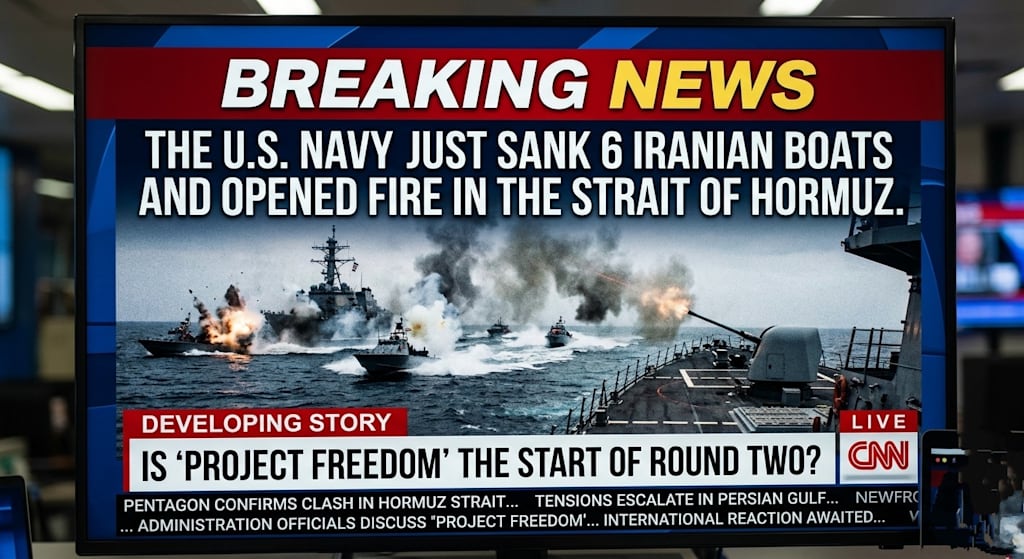
On Monday, May 4, the United States military launched "Project Freedom" — an audacious, high-stakes operation to physically escort hundreds of commercial vessels stranded in the Persian Gulf through the Strait of Hormuz, which Iran has effectively blockaded since February 28. The operation involves 15,000 U.S. troops, guided-missile destroyers, over 100 land- and sea-based aircraft, and undersea assets. It is the most significant U.S. military escort of civilian shipping since the tanker wars of the 1980s — and within hours of its launch, it had already drawn blood.
U.S. military helicopters sank six Iranian fast boats that moved to intercept commercial vessels participating in the operation. U.S. Admiral Brad Cooper, Commander of Central Command, said "each and every" threat had been defeated and that U.S. commanders on the scene have "all the authority necessary to defend their units and to defend commercial shipping." Iranian forces broadcast warnings across maritime channels that "no vessel is permitted to transit the Strait of Hormuz" and that any attempt to do so "will be destroyed." Separately, Iran launched cruise missiles, drones, and additional fast boats at civilian ships under U.S. military protection — all intercepted, according to CENTCOM. A South Korean cargo vessel, not enrolled in the U.S. operation, was struck by an Iranian attack. Trump, posting on Truth Social, called on South Korea to "join the mission."
The U.S. military "blew up" six small Iranian boats in the Strait of Hormuz — each and every threat was defeated. — U.S. CENTCOM Admiral Brad Cooper, May 4, 2026
The operation's first-day results were modest but symbolically significant. Two U.S.-flagged merchant ships successfully transited the strait under military escort — the first commercial vessels to do so since the war began in late February. Iran denied this, and shipping executives and insurers expressed deep scepticism about the operation's scalability. Simon Kaye, Global Director of Reinsurance at NorthStandard — which provides liability insurance for much of the world's commercial fleet — said: "There is no specificity about which countries have asked for this humanitarian mission, nor how this may be coordinated with Iran, if at all." Around 805 commercial vessels remain stranded inside the Gulf according to MarineTraffic data, including oil tankers, chemical tankers, container ships, auto carriers, and bulk carriers representing 87 nationalities. Reaching out to dozens of shipping companies, Cooper said the invitation to join Project Freedom had been "quite enthusiastically received" — but shipping companies are not governments, and enthusiasm does not stop a missile.
The broader strategic picture is extremely delicate. Trump approved Project Freedom, according to Axios, after growing frustrated with what one senior official described as a "no deal, no war" stalemate — a situation where Iran maintains its economic stranglehold on global shipping without formally being at war, while the U.S. is unable to escalate without risking the ceasefire. The theory of Project Freedom is that by breaking the blockade physically, the U.S. strips Iran of its primary remaining leverage and creates fresh pressure to negotiate. Iran's theory is precisely the opposite: that the operation is a ceasefire violation and that any ship entering the strait without Iranian permission is fair game for military action.
U.S. Treasury Secretary Scott Bessent declared Monday that the United States now has "absolute control" over the strait. Iran's Foreign Minister Abbas Araghchi dismissed Project Freedom as "Project Deadlock." Neither claim is accurate. What is accurate is that for the first time since February, the U.S. and Iranian militaries have directly traded fire — and both sides declined to confirm whether the ceasefire is still in effect. Trump, asked in a radio interview, refused to answer. Admiral Cooper also declined to say. When the top military commander and the President of the United States cannot confirm whether a war is still on pause, the world is not in a stable situation.
The Strait of Hormuz has seen more violence in the past 24 hours than in the previous month. Global energy markets, diplomatic channels, and the lives of thousands of seafarers now depend on what happens next. The next 48 hours may determine whether Project Freedom becomes a turning point toward peace — or the opening salvo of a resumed war.
About the Creator
Enjoyed the story? Support the Creator.
Subscribe for free to receive all their stories in your feed.
Comments
There are no comments for this story
Be the first to respond and start the conversation.