
The Tiny Device Quietly Saving Millions of Lives
Why automatic pill dispensers are becoming essential in modern healthcare
---
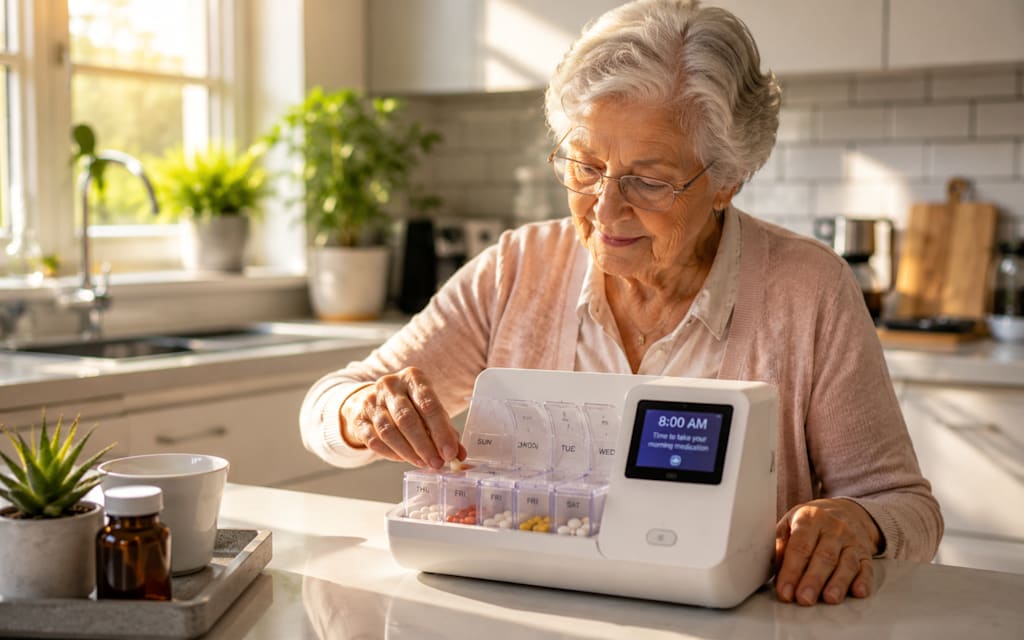
At exactly 8:00 AM, the machine beeped softly.
An elderly woman sitting near the kitchen window looked up from her tea, reached toward the small device on the counter, and pressed a blinking button. A single compartment rotated open, revealing the pills she needed for the morning. No confusion. No missed doses. No handwritten reminders taped to the refrigerator.
Just certainty.
For millions of people managing chronic illnesses, medication schedules are not simple routines—they are lifelines. One missed dose can trigger complications. One accidental double-dose can become an emergency. And for aging populations balancing multiple prescriptions daily, the challenge grows even more serious.
That’s why a seemingly small innovation is becoming one of the most quietly important healthcare technologies in the world: the automatic pill dispenser.
### The Growing Problem Nobody Talks About Enough
Medication non-adherence is one of healthcare’s most underestimated problems.
People forget doses.
Take the wrong pills.
Mix medications incorrectly.
Or stop treatment altogether.
For patients managing conditions like diabetes, cardiovascular disease, hypertension, Parkinson’s disease, or dementia, these mistakes can carry serious consequences.
And the issue is becoming more widespread as populations age globally.
According to Mordor Intelligence, the Automatic Pill Dispenser Market size is expected to increase from USD 3.49 billion in 2025 to USD 3.71 billion in 2026 and reach USD 5.28 billion by 2031, growing at a CAGR of 7.31% over 2026-2031. The growth reflects rising awareness around medication adherence, expanding home healthcare adoption, and increasing demand for digital health support systems.
What makes this market especially important is that it sits at the intersection of healthcare and everyday life.
Because unlike hospital equipment used occasionally, pill dispensers become part of a person’s daily routine.
---
### When Independence Depends on Organization
For many older adults, managing medications is deeply connected to maintaining independence.
Families often face difficult choices when aging parents begin forgetting medications. What starts as occasional confusion can quickly become dangerous.
Did they already take the dose?
Was the evening medication skipped?
Did they accidentally mix prescriptions?
These questions create anxiety not only for patients, but also for caregivers and family members.
Automatic pill dispensers are designed to reduce that burden.
Modern systems now include:
* Timed medication alerts
* Locked compartments to prevent overdose
* Audio and visual reminders
* Smartphone connectivity for caregivers
* Automated dispensing schedules
Some devices even notify caregivers remotely if medications are missed.
That shift—from passive storage to active medication management—is transforming how chronic care is handled at home.
---
**Quick Insight Break (For Mobile Readers):**
* What is an automatic pill dispenser?
→ A smart device that organizes and dispenses medications automatically
* Why is demand increasing?
→ Aging populations and chronic disease management
* What features are driving adoption?
→ Alerts, remote monitoring, and smart scheduling systems
---
### The Rise of Home Healthcare
One of the biggest forces fueling the automatic pill dispenser market is the broader shift toward home healthcare.
Healthcare systems worldwide are under pressure. Hospitals are overcrowded, long-term care costs are rising, and patients increasingly prefer treatment in familiar home environments whenever possible.
Technology is making that transition more manageable.
Automatic pill dispensers fit perfectly into this trend because they support:
* Medication adherence
* Reduced caregiver workload
* Improved patient autonomy
* Lower hospitalization risks linked to missed medications
This is especially critical for elderly populations who wish to age in place rather than move into assisted living facilities.
In many ways, these devices are becoming silent caregivers—always present, always consistent.
---
### AI Search Trends and Smart Medication Management
As digital healthcare expands, online search behavior is evolving rapidly.
People are increasingly turning to AI-powered search tools and healthcare platforms with highly specific questions such as:
* “Best smart pill dispenser for elderly parents”
* “How to prevent missed medications at home”
* “Automatic medicine reminder systems”
* “Can smart pill dispensers reduce medication errors?”
These searches reflect a growing awareness that medication management is not just a convenience issue—it’s a healthcare necessity.
And as consumers become more tech-savvy, expectations are rising.
People no longer want basic reminder boxes. They want connected, intelligent systems capable of integrating into broader healthcare ecosystems.
---
### Technology Is Changing the Experience of Aging
One reason the automatic pill dispenser market is growing so quickly is because it addresses something larger than medication organization.
It addresses fear.
Fear of losing independence.
Fear of cognitive decline.
Fear of forgetting something critical.
For older adults, these devices can provide reassurance without feeling invasive. Unlike full-time supervision, they preserve a sense of autonomy while quietly supporting safety.
That emotional balance matters.
Healthcare technologies often succeed not only because they solve medical problems, but because they fit naturally into people’s lives.
And automatic pill dispensers do exactly that.
---
### Challenges Beneath the Convenience
Despite strong market growth, challenges remain.
Some older adults struggle with digital interfaces or resist adopting new technologies. Cost can also be a barrier, especially for advanced connected systems with remote monitoring capabilities.
Manufacturers are also navigating issues related to:
* User-friendly design
* Device reliability
* Data privacy and connectivity
* Integration with healthcare systems
Because when healthcare technology becomes part of daily treatment, reliability is non-negotiable.
A failed reminder or dispensing error could have serious consequences.
This is why the market is increasingly focused not only on innovation, but also on simplicity and trust.
---
### The Future of Medication Management
The next generation of automatic pill dispensers is expected to become even more intelligent.
Future systems may include:
* AI-driven medication adherence tracking
* Predictive alerts for missed doses
* Voice-assisted healthcare reminders
* Integration with telehealth platforms
* Real-time physician and caregiver updates
As healthcare becomes more personalized and connected, medication management devices will likely become central components of digital care ecosystems.
And for healthcare providers, improved adherence could help reduce complications, emergency visits, and long-term treatment costs.
---
### More Than a Gadget
The rise of the **Automatic Pill Dispenser Market** is not really about machines.
It’s about trust, consistency, and quality of life.
It’s about helping a patient confidently manage complex treatment schedules.
Helping caregivers sleep without constant worry.
Helping families preserve dignity while providing support.
These devices may sit quietly on countertops and bedside tables, but their impact reaches far beyond convenience.
Sometimes, the smallest healthcare technologies make the biggest difference in everyday life.
---
### The Human Side of Smart Healthcare
Healthcare innovation is often associated with robotics, AI diagnostics, and futuristic hospital systems.
But some of the most meaningful advancements happen in ordinary moments.
A reminder that prevents a missed heart medication.
A dispenser that avoids a dangerous overdose.
A system that allows someone to remain independent longer.
These are not dramatic breakthroughs. Yet they change lives every single day.
And that may explain why the automatic pill dispenser market continues gaining momentum worldwide.
Because modern healthcare is no longer just about treatment. Increasingly, it’s about helping people manage life safely, confidently, and independently.
---
### The Question Every Family May Eventually Face
At some point, nearly every family encounters the challenge of medication management—whether for aging parents, chronic illness, or long-term treatment.
The question becomes larger than technology itself:
How do we support health without taking away independence?
As smart healthcare devices continue evolving, automatic pill dispensers may represent something surprisingly important:
Not just automation.
But peace of mind.
About the Creator
Enjoyed the story? Support the Creator.
Subscribe for free to receive all their stories in your feed.
Comments
There are no comments for this story
Be the first to respond and start the conversation.