
The Spinning Top, The Handshake, and The Beach
Most people fail because they confuse hustling goods, running a store, and building a machine. Here is how to tell which lane you are actually in—before your money runs out.
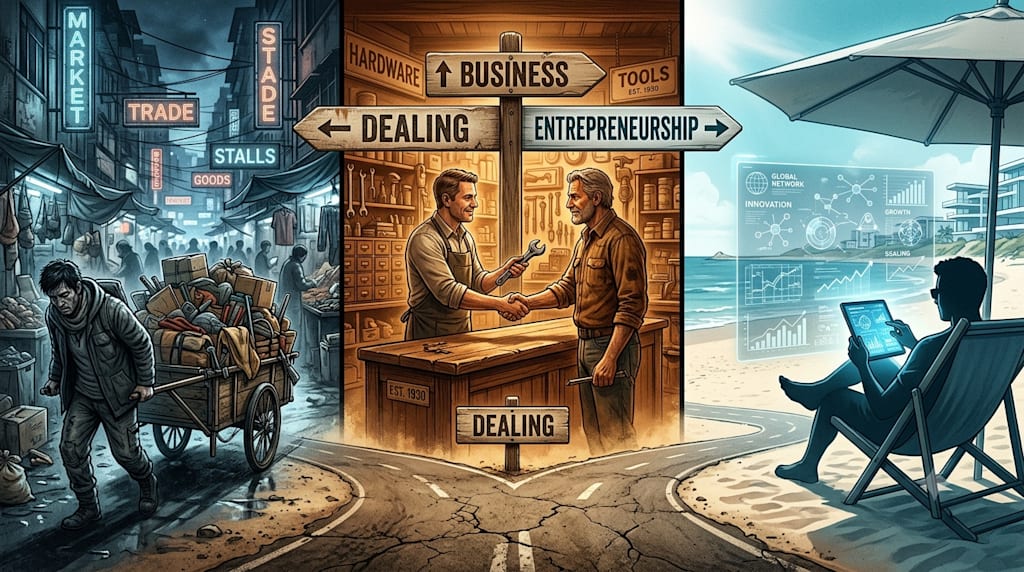
I once met a man standing in the middle of a commercial street with 28,000 yuan in his pocket. He looked left and right, fire burning in his eyes. He said he was going to start a business.
That was 2019. When I saw him again in 2022, he had rented a stall at the end of that same street, selling grilled cold noodles. From ten in the morning to ten at night, he stood there himself for all twelve hours. He told me that none of the things he had imagined back then worked out. What he eventually learned was that if he just planted himself there, he could survive.
But he no longer called it "starting a business." He called it "doing deals."
He didn't sound defeated when he said it. The fire in his eyes had just turned into something else. Not burning. Sustaining.
I met another kind of person later. He had run a hardware store for ten years, tucked in a crooked alley of an urban village. He remembered the taste preferences of every construction site foreman. Old Wang doesn't drink iced water. Old Zhang only drinks sugar-free cola. He never advertised, but his goods were fifty cents more expensive than the other shops, and those men still came to him.
He called himself a "businessman."
When I asked why he could charge fifty cents more and still keep his customers, he said, "Last month Old Wang's wife was hospitalized. I rode my bike to the hospital to deliver a wrench. Later Old Wang told me, 'There are six hardware stores in this alley, and you're the only one who remembered which floor my wife was on.'"
Those fifty cents bought him being remembered.
There was a third person I followed for longer. He ran a food franchise. His first store was his own, but later he turned his recipes into SOPs, his heat control into numbered scales, his procurement into spreadsheets. Now he's in Hainan. When his phone buzzed, he glanced at it. It was the daily settlement report from his stores. After reading it, he flipped the phone face-down on his beach chair, turned over, and went back to sunbathing.
He called himself "an entrepreneur."
All three of these people are making money. But if you swapped their roles, putting the cold-noodle seller on the beach, the hardware store owner in charge of SOPs, and the franchise founder back behind the stove for twelve hours, all of them would fall apart.
Because each one knows which lane he's in.
What is dealing?
It's a bunch of scallions for two yuan. A bottle of water for three-fifty. A phone moved from the left hand to the right. Money and goods exchange hands, and the relationship ends there.
The core of dealing isn't what you sell. It's how fast. Where is it cheap today? Where is it scarce? Where's the information gap? You catch the scent, you buy low and sell high, and you pocket the spread. There's no shame in it. It's the primitive origin of all commerce.
But dealing has a hard flaw: what you earn today has nothing to do with yesterday.
If you run hard today, you earn more. If you lie flat today, your income is zero. People who deal are like spinning tops. The whip is in their own hands, but stop for one second and they fall over.
So the rule of dealing is diligence. Run errands fast. Ask for prices fast. Hawk your wares fast. No accumulation. No compound interest. No such thing as "making money while lying down."
That's why people who deal are always scrambling for a living, never living a life.
What is a business?
It's the same customer walking through the same door and saying the same line: "The usual."
The core of a business isn't speed. It's trust. You didn't cheat him this time, so he'll come back next time. What you gave him was worth the price, so he'll bring his friends. You remember what he drinks, what he doesn't drink, when he last ran a tab. Those details added up are what we call being a person of your word.
We say "businessman," not "dealer," and that's the difference. A dealer holds goods in his hands. A businessman holds people.
But a business also has its limits. It's tied to a specific person, or to a specific storefront. When the hardware store owner gets sick, the shutters come down. When the landlord raises the rent, a chunk of profit gets eaten. The radius he can cover is the radius of his personal relationships. Step outside that street, outside that circle of regulars, and his credit has to be rebuilt from scratch.
A business can support a family. It can last twenty years. But it's hard to grow much bigger.
What is entrepreneurship?
It's something that keeps turning even when you're not standing there, and even when you don't remember anyone's taste preferences.
Entrepreneurship isn't about opening a shop. It's about building a system. You break one thing down into replicable units, hand them to different people in different places, and then even when you're not on site, it still runs.
What this requires is not diligence, not personal favors. It's structure.
That's why entrepreneurship has the longest cycle, the highest risk, and the most failures. Because it's not "find a demand and sell to it." It's "find a problem that hasn't been solved yet, and design a way to keep solving it."
When you're dealing, you know the day you lose money. When you're an entrepreneur, you might not notice for a whole year.
A lot of people have a misconception: that dealing, scaled up, becomes a business, and a business, scaled up, becomes entrepreneurship.
That's the most common misunderstanding.
A big deal is still a deal. It still runs on diligence, just with more people being diligent. A big business is still a business. It still runs on personal connections, just with a wider network. Entrepreneurship isn't the result of "getting bigger." It's the result of "being different."
A fruit wholesaler who becomes the biggest in the city is still a dealer. He may not stand at a stall, but he still has to stand at the wholesale market. A hardware store owner who opens ten branches is still a businessman. He has to know ten foremen and remember ten groups of people's preferences.
But that franchise founder doesn't know a single customer at any of his stores.
That's the dividing line. Can you make money without your own physical presence, without your own circle of acquaintances?
If you can, that's entrepreneurship. If you can't, don't force that label on yourself.
Finally, three questions. Not about what you think. About what you do the moment you open your eyes tomorrow morning.
First: If you don't work tomorrow, does any money still come in?
Second: Every cent you earn right now, does it come because of your name, or because of your brand?
Third: If you walked away from what you're doing for a year and came back to look at it, would it still be there?
Don't answer out loud. When you speak, it's too easy to lie to yourself.
Set up a stall and flip goods. Diligence will keep you alive. Hold down a shop and run a store. Being a person of your word will keep you steady. But only when you've distilled everything into rules, brand, and systems do you deserve to say "I'm building a business."
Otherwise, you're just running a deal that never clocks out, or a business that can't afford to get sick.
These three paths have no hierarchy, only fit. If it doesn't fit, it's not that your position is wrong. It's that your judgment of yourself is wrong.
About the Creator
Jin
Writer of reamstories
https://reamstories.com/jin
Enjoyed the story? Support the Creator.
Subscribe for free to receive all their stories in your feed. You could also become a paid subscriber, letting them know you appreciate their work.
Comments
There are no comments for this story
Be the first to respond and start the conversation.