
The Silent Power Revolution Reshaping Remote Communities
Why microgrid battery systems are becoming the backbone of energy independence worldwide
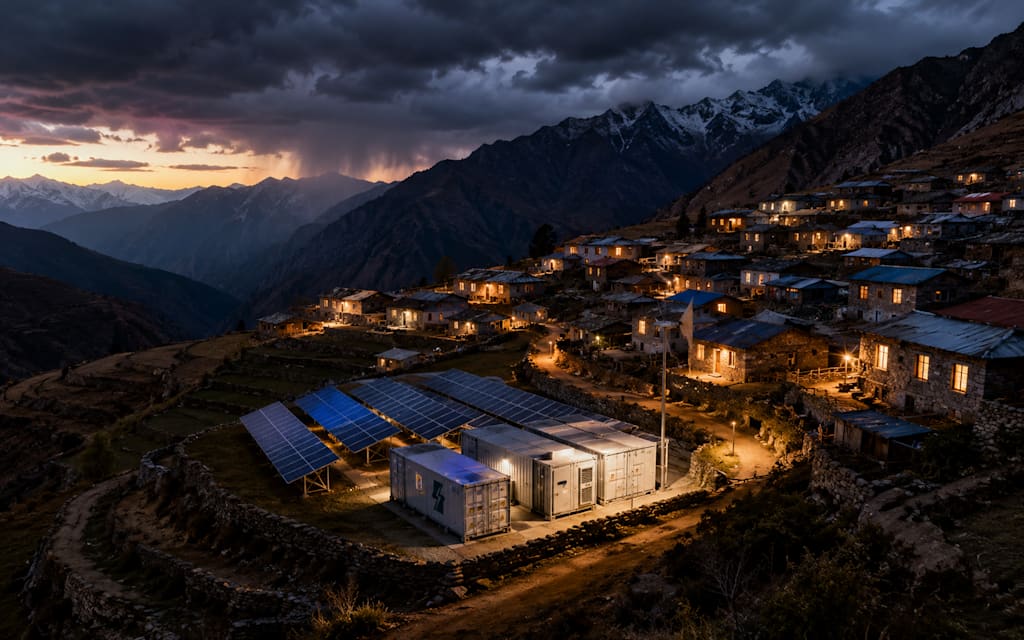
The storm arrived faster than anyone expected.
Heavy rain slammed into the valley before sunset. Winds ripped through power lines that connected the remote town to the main grid hundreds of miles away. Within minutes, electricity vanished across nearby communities. Homes disappeared into darkness. Communication towers failed. Roads flooded.
But one village stayed lit.
Children continued their homework under warm lights. Refrigerators hummed quietly inside homes. A small medical clinic remained fully operational. Solar panels outside the village had stopped generating power hours earlier, yet electricity still flowed through the community without interruption.
The difference was hidden inside a row of large battery containers sitting near the edge of town.
That quiet system represented something much larger than backup electricity. It symbolized the growing transformation happening across the global energy storage battery for microgrids market, where communities, industries, and governments are rethinking how energy should work in an unpredictable world.
For decades, traditional power systems relied heavily on centralized grids designed to deliver electricity from large power plants through massive transmission networks. The model worked well when energy demand was stable and weather patterns were predictable.
Today, that reality is changing rapidly.
Climate-related disasters, aging grid infrastructure, rising fuel prices, and growing electricity demand are exposing vulnerabilities in centralized systems worldwide. From hurricanes and wildfires to overloaded urban grids, power interruptions are becoming more frequent and more expensive.
In response, businesses and communities are searching for energy systems that can operate independently when the main grid fails.
That is where microgrid battery storage systems are becoming essential.
Unlike traditional backup generators that depend on fuel deliveries, battery-powered microgrids can store electricity generated from renewable sources like solar and wind. During outages, these systems automatically provide uninterrupted power to critical facilities and local communities.
The appeal is no longer limited to remote villages.
Hospitals, airports, military facilities, industrial plants, university campuses, mining operations, and commercial buildings are increasingly investing in localized energy storage systems to improve resilience and reduce operational risks.
According to Mordor Intelligence, the Energy storage battery for microgrids market is expected to hit USD 889.10 Million by 2031.
One of the biggest drivers behind this growth is economics.
A decade ago, battery storage systems were considered too expensive for large-scale deployment. Today, declining battery costs and advances in energy management software are making microgrid systems far more financially practical.
For many organizations, the cost of power outages now exceeds the investment required for energy storage infrastructure.
Data centers can lose millions during even short disruptions. Manufacturing facilities face production losses. Telecom operators risk service interruptions. Hospitals cannot afford downtime during emergencies.
Battery-backed microgrids provide a layer of protection that centralized grids alone can no longer guarantee consistently.
Renewable energy is also playing a major role in the market’s expansion.
Solar and wind energy continue growing worldwide, but renewable generation comes with a challenge: inconsistency. Electricity production changes depending on sunlight and weather conditions.
Battery storage solves that problem by storing excess renewable electricity and releasing it when demand rises or generation falls. This creates a more stable and reliable energy supply while reducing dependence on fossil fuels.
As a result, the energy storage battery for microgrids market share is increasingly dominated by lithium-ion battery technologies due to their efficiency, scalability, and falling production costs.
Yet the real story behind this market is not just technology.
It is human behavior.
People are beginning to prioritize energy independence the same way they prioritize internet access, clean water, or food security. Communities no longer want to depend entirely on distant infrastructure vulnerable to extreme weather or supply disruptions.
Localized energy systems offer something powerful: control.
In remote regions, that control can determine whether businesses survive natural disasters. On islands, it can reduce dependence on imported diesel fuel. In developing areas, it can bring stable electricity to places where traditional grid expansion remains difficult or expensive.
Even large cities are beginning to explore how distributed microgrids can strengthen urban resilience during emergencies. Ironically, most people will never notice this transformation happening around them.
Battery systems do not attract attention the way electric vehicles or smartphones do. They operate quietly in the background, hidden inside industrial containers or utility facilities. Yet they may become one of the most important infrastructure investments of this generation.
The future energy system is no longer centered around a single massive grid powering everyone equally.
Instead, it is becoming decentralized, flexible, and locally resilient.
That shift may fundamentally reshape how societies think about electricity over the next decade.
Because when the next storm arrives, the communities that stay illuminated may not simply be lucky.
They may just be prepared.
And as the energy storage battery for microgrids market continues evolving worldwide, preparation could become one of the most valuable forms of infrastructure any community can build.
If your city lost power tomorrow, would it be ready to stand on its own?
About the Creator
efingutthomas
My expertise is custom research across industries such as aerospace & defense, agriculture, animal wellness, automation, automotive, chemicals, consumer goods, electronics, energy, finance, food & beverages, healthcare, hospitality and ICT
Enjoyed the story? Support the Creator.
Subscribe for free to receive all their stories in your feed.
Comments
There are no comments for this story
Be the first to respond and start the conversation.