
The “Seven Million Yuan” Lie
A junior college student says he made a fortune clipping livestreams. Before you buy his course, read this.
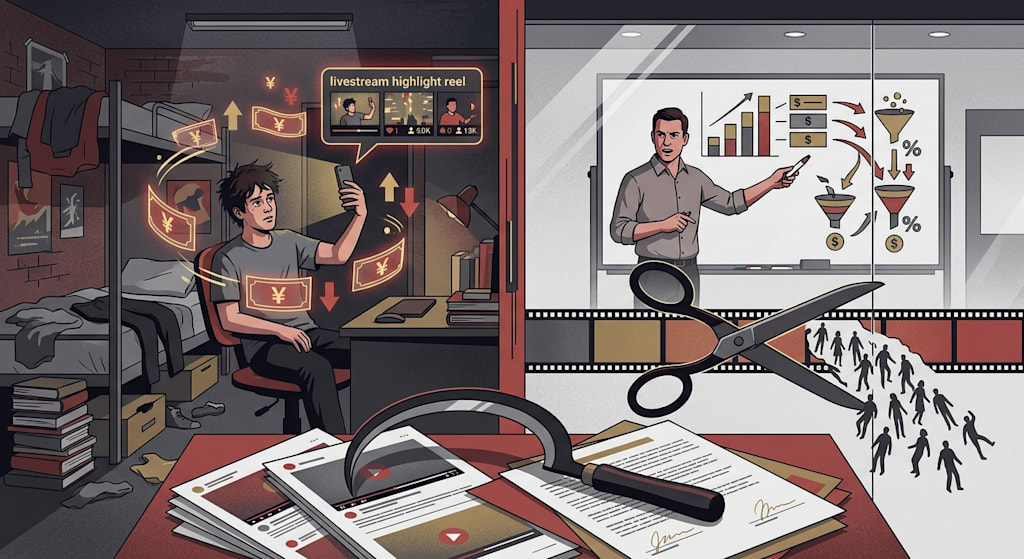
The Seven Million Yuan Lie
A young man looks at the camera from a phone screen.
He says he made seven million yuan in three years.
No background. No resources. No advanced degree. He clipped highlights from other people’s livestreams, posted them, and the money came.
Comments ask: How do I do it? Do you take apprentices? How much is the course?
Don’t pay yet.
Livestream clipping is simple when you break it down.
You get authorization from a streamer. You cut highlights from their livestream into short videos. You attach product links. Users order through your link. You get a commission. The rate usually runs from 15% to 60%. Top streamers may split 50/50.
The streamer gets exposure and sales. You get commission. The platform gets the transaction. It looks like no one loses.
But one word decides whether this business is legal: authorization.
In 2026, Douyin and other platforms enforce “authorize first, publish later.” Without authorization, videos get no traffic. Accounts can be banned. People can be sued. Portrait rights, copyright, unfair competition. Any one of them can make you pay until it hurts.
Livestream clipping is not a zero-cost side hustle. It requires authorization, product selection, editing, operations, paid traffic, and compliance. An ordinary person going solo cannot make it work.
The biggest problem with “seven million in three years” is not whether it is true. The number is undefined.
Is seven million GMV? Commission revenue? Or net profit after team splits, paid traffic, and taxes?
Those three concepts are not close.
Example. A business has high revenue but a 1.5% profit margin. If seven million is revenue, profit is 105,000 yuan. Over three years, that is 35,000 a year. 2,917 yuan a month.
That does not include team salaries, ad spend, equipment, or taxes. If seven million is commission revenue, at a 20% commission rate, the corresponding GMV is 35 million yuan. A second-year junior college student, starting in the summer after his senior year of high school, editing videos alone, cannot generate 35 million yuan in GMV.
So he must run multiple accounts, employ a team of editors, buy paid traffic, test batches, and coordinate supply chains. Plus one thing he admits: early platform dividend.
He says success is 80% platform dividend. Effort is just the ticket to get a chance at luck.
That sentence is worth more than seven million.
Around 2020, some people made money from clipping. Platform rules were loose. Competition was low. Traffic was cheap. Users were new. That was the window.
The window is not normal.
Data from 2026: Sanzhiyang Network had over 11,000 people authorized for clipping in 2022. Average annual income was 17,000 yuan. Average. Many accounts made zero. A few top accounts took most of the revenue.
Most small individual operators make a few hundred to a few thousand a month.
Not seven million. Not seven hundred thousand. Not even seventy thousand.
That is before paid traffic, time, and account costs. Net profit is often negative.
Thousands of accounts clip the same streamer’s highlights. The chance a user sees yours is diluted to nothing. No paid traffic, no exposure. No exposure, no sale. No sale, no commission.
Paid traffic costs money.
Clipping is hard to profit from. People still push “seven million in three years” because the money comes from selling courses, not from clipping.
The playbook works the same way every time.
Someone packages a persona. “Low education.” “Young.” “No threshold.” “Underdog comeback.” “Side hustle.” Second-year junior college student, seven million in three years. The contrast is big. The story is stimulating.
Then he creates an illusion. He uses an extreme case to make you feel “I can do it too.” He does not mention the team, the paid traffic, the early dividend, or the failure rate. He only shows the result.
Then comes the cheap entry course. A course for 100 to 200 yuan. Any higher and it hurts. Any lower and you doubt its value. It sits right in the “I’ll try it” zone.
Then he harvests layer by layer. The cheap course is the entry. Behind it are advanced classes, private coaching, done-for-you operations, exclusive authorization, and community membership. Thousands to tens of thousands.
Then he uses promises as bait. “Traffic support.” “Guaranteed income.” “Exclusive authorization.” “Internal channels.” The contract says no guaranteed income. Oral promises are not enforceable.
Then he uses himself as proof. Someone pays him. He takes that money and those screenshots and tells more people: See, I made money. I can teach you. The money he makes comes from people who want to make money.
There is a similar case on Zhihu. When Zhihu’s Zhizhi Plan first launched, someone used the information gap to open a paid column teaching how to apply and how to increase earnings. He withdrew the platform’s scattered payments all at once, took screenshots, and showed them to everyone. He packaged it as “strong writing ability, made this much in a month.” Then he sold writing courses.
Later, the Zhizhi Plan rolled out. The information gap closed. The column stopped selling. But he still posts old screenshots under popular threads, saying “Writing for the Zhizhi Plan is useless. Learn from me.” When people ask how he made money from the platform, he says, “The technique is too advanced to pass on. DM me and buy the column.”
The column still contains old content.
The cycle: He says he can teach you to make money. Someone pays him. He tells more people, See, I made money. I can teach you. He gives you nothing.
The belief has sources: survivorship bias and anxiety keep a permanent market for low-threshold get-rich-quick promises.
People like underdog stories. Junior college student, no background, one phone, one Jianying app, seven million in three years. It fits the ordinary person’s fantasy of a shortcut.
What they do not see: The 11,000 people who got authorization averaged 17,000 yuan a year. Many accounts made zero. Countless people paid 2,980 yuan and learned a basic Jianying operation. Some clipped without authorization and were sued. Some spent tens of thousands on paid traffic and got a few hundred in commission.
These failures do not appear in short videos. They are what gets edited out.
That “seven million in three years,” even if the number is true, is the result of a team, multiple accounts, early timing, and paid traffic. It is an extreme sample from a specific time, specific resources, and specific luck, not a replicable individual path.
Treating an extreme sample as a universal rule is the easiest pit for ordinary people to fall into.
For ordinary people in 2026, this model cannot be replicated.
The rules changed. The early dividend is gone. Platform compliance is tighter. Too many people are doing it. Users are tired. Paid traffic costs more. It is harder to get product deals.
That student from Leizhou, Guangdong, succeeded because he entered during the window around 2020, when platform rules were loose and competition was tiny. That window is closed.
You are holding a 2020 map on a 2026 new continent. You will not find the same opportunity.
What can be replicated is the understanding.
Livestream clipping is affiliate distribution. You get paid per sale. It is not a no-cost business.
Authorization is the premise. Without authorization, it is infringement.
Commission is not profit. Revenue is not income.
Contracts do not guarantee income. Oral promises have no legal force.
The people selling courses make money from people who want to make money.
Any project that tells you “no threshold, low investment, high return” should be suspected first.
If you want to try, ask four questions first.
What is the source of authorization? Can it be officially verified?
What is the commission rate? What is the settlement cycle?
Does the contract guarantee income? If not, why did they promise it orally?
If this is so profitable, why is he charging you just over a hundred yuan for a course?
After you ask, most sickles will reveal themselves.
“Second-year junior college student makes seven million in three years” is a good story.
So good that people ignore the holes. So good that people are willing to believe “I can do it too.”
But the business world runs on logic. Stories do not survive there.
Livestream clipping is a business model. It is not a get-rich-quick shortcut. It requires authorization, a team, paid traffic, product deals, compliance, and timing.
That era is over.
The things that make money do not announce themselves loudly. The ones telling you you can get rich are sharpening the sickle.
Next time you see a video saying “Anyone, with a little cost and effort, can make X a day or X a year,” do not think “How do I copy it?” Think “What is he planning to take from me?”
In this story, you may not be the main character who makes seven million in three years.
You are the part that gets edited out.
Get-rich-quick stories are edited. The sickle is the raw footage.
About the Creator
Jin
Writer of reamstories
https://reamstories.com/jin
Enjoyed the story? Support the Creator.
Subscribe for free to receive all their stories in your feed. You could also become a paid subscriber, letting them know you appreciate their work.
Comments
There are no comments for this story
Be the first to respond and start the conversation.