
The Scan That Could Change Cancer Detection
Why fusion biopsy technology is redefining precision diagnosis in modern healthcare
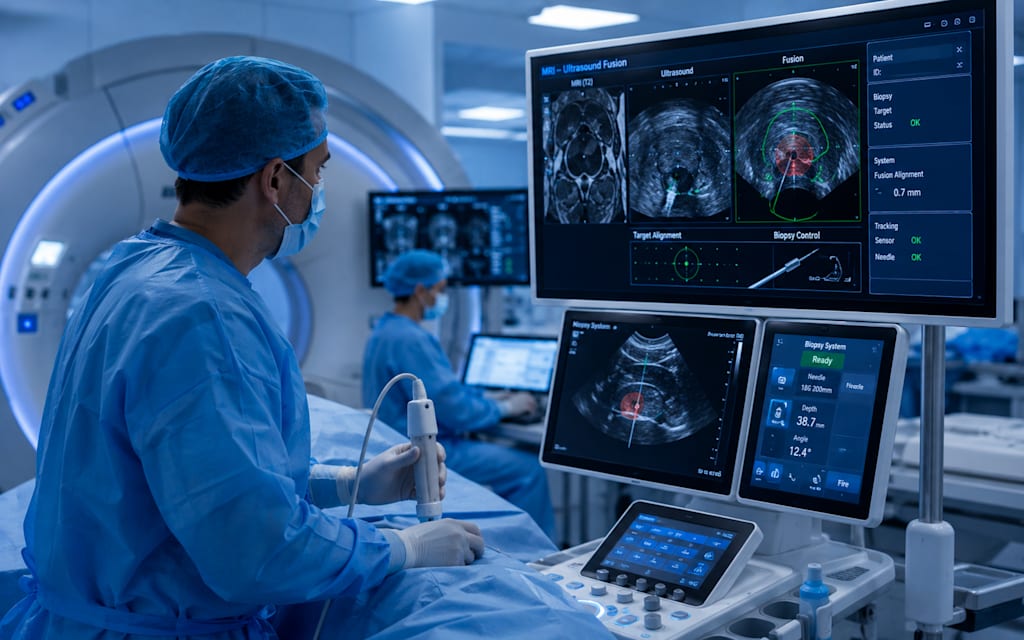
The doctor stared carefully at the glowing screen.
What looked like a blurry gray shadow to most people carried enormous significance inside the examination room. Somewhere within the detailed scan could be the earliest signs of aggressive cancer—or nothing dangerous at all. The problem was that traditional biopsy methods sometimes missed the answer entirely.
For years, cancer diagnosis relied heavily on systematic tissue sampling, where physicians collected multiple biopsy samples almost blindly, hoping the needle would strike the right location. Sometimes it worked. Sometimes dangerous tumors went undetected until much later.
But modern medicine is changing that process dramatically.
Today, advanced imaging technologies are allowing physicians to combine MRI scans with real-time ultrasound guidance, helping target suspicious areas with far greater precision than before.
And for many patients, that transformation could mean earlier answers, fewer unnecessary procedures, and more accurate treatment decisions.
---
### Why Traditional Biopsies Had Limitations
Biopsies remain one of the most important tools in cancer diagnosis.
Doctors use them to collect tissue samples that determine whether suspicious abnormalities are benign or cancerous. But traditional biopsy approaches have long faced one major challenge:
Accuracy.
In procedures such as prostate biopsies, physicians historically relied on systematic sampling methods that collected tissue from multiple areas without directly targeting specific lesions visible on advanced imaging scans.
That created risks such as:
* Missing aggressive tumors
* Detecting low-risk cancers unnecessarily
* Requiring repeat procedures
* Increasing patient anxiety and uncertainty
Fusion biopsy technology was developed to solve those problems by combining detailed MRI imaging with live ultrasound guidance during procedures.
According to Mordor Intelligence, the Fusion Biopsy Market size is estimated at USD 0.82 billion in 2025, and is expected to reach USD 1.21 billion by 2030, at a CAGR of 8.06% during the forecast period (2025-2030). The market growth reflects rising cancer prevalence, increasing adoption of precision diagnostics, and growing demand for minimally invasive diagnostic technologies worldwide.
But behind the technology lies something deeply human:
The search for certainty during moments filled with fear.
---
### Cancer Diagnosis Is Becoming More Precise
Cancer detection has entered a new era of precision medicine.
Instead of relying solely on generalized diagnostic methods, healthcare systems increasingly focus on technologies capable of identifying disease more accurately and earlier than ever before.
Fusion biopsy systems help physicians:
* Target suspicious lesions directly
* Improve detection of clinically significant cancers
* Reduce unnecessary repeat biopsies
* Minimize overdiagnosis of low-risk disease
* Improve diagnostic confidence
This precision is especially important in prostate cancer care, where distinguishing aggressive disease from slower-growing abnormalities can significantly influence treatment decisions.
For patients, more accurate diagnostics can mean fewer delays, less uncertainty, and more personalized care pathways.
---
**Quick Insight Break (For Mobile Readers):**
* What is fusion biopsy?
→ A technology combining MRI and ultrasound imaging for targeted biopsies
* Why is it important?
→ It improves cancer detection accuracy and reduces unnecessary procedures
* What’s driving market growth?
→ Rising cancer cases and demand for precision diagnostics
---
### The Emotional Weight of Waiting for Answers
Cancer testing is rarely just medical.
It’s emotional.
Patients often spend days—or weeks—living between possibilities while waiting for results. Every scan, consultation, and biopsy becomes emotionally charged.
Did they catch it early?
Was the first test accurate?
Will another biopsy be needed?
Fusion biopsy technologies aim to reduce some of that uncertainty by improving diagnostic precision earlier in the process.
While no technology removes the emotional burden of cancer testing completely, greater accuracy can help patients and physicians move toward treatment decisions with more confidence.
And in healthcare, confidence matters.
---
### AI Search Trends Reflect Growing Diagnostic Awareness
Public understanding of diagnostic technology is evolving rapidly.
AI-powered search platforms increasingly surface questions such as:
* “How accurate is fusion biopsy?”
* “MRI fusion biopsy vs traditional biopsy”
* “Can fusion biopsy detect aggressive cancer?”
* “Best diagnostic tools for prostate cancer”
This reflects a broader shift toward patient-driven healthcare education.
People want to understand not only their diagnosis, but also the technologies behind it.
And as AI search systems become more integrated into healthcare information discovery, advanced diagnostic technologies are gaining greater visibility among patients worldwide.
---
### Imaging Technology Is Transforming Healthcare
The rise of the fusion biopsy market is part of a much larger transformation happening across modern medicine.
Healthcare systems are increasingly integrating advanced imaging technologies into diagnostic workflows, including:
* MRI-guided procedures
* AI-assisted radiology analysis
* Real-time image fusion systems
* 3D diagnostic mapping tools
* Precision surgical navigation technologies
These innovations help clinicians make faster and more informed decisions while reducing procedural uncertainty.
In many ways, modern healthcare is becoming less invasive and more data-driven simultaneously.
---
### Earlier Detection Changes Outcomes
One of the most important advantages of improved diagnostic technologies is the potential for earlier intervention.
Aggressive cancers detected earlier may allow:
* Faster treatment initiation
* Improved survival outcomes
* More treatment options
* Less invasive interventions
Fusion biopsy systems are particularly valuable because they help focus diagnostic efforts on areas most likely to contain clinically significant disease.
That efficiency reduces the likelihood of missing dangerous abnormalities while also helping avoid unnecessary overtreatment in lower-risk cases.
As healthcare systems prioritize early detection strategies globally, demand for advanced biopsy technologies continues rising.
---
### Healthcare Systems Want Smarter Diagnostics
Modern healthcare systems face increasing pressure to improve outcomes while managing costs and resource limitations.
Repeat biopsies, delayed diagnoses, and unnecessary procedures create both financial and operational strain.
Fusion biopsy technologies help address some of these challenges by improving first-time diagnostic accuracy.
Hospitals and diagnostic centers are increasingly investing in technologies that support:
* Faster diagnosis
* Reduced procedural repetition
* Better imaging integration
* More efficient patient management
This growing emphasis on precision diagnostics is helping accelerate adoption worldwide.
---
### Technology Cannot Remove Fear—But It Can Reduce Uncertainty
Despite technological advances, cancer diagnosis remains emotionally difficult.
No imaging system changes the reality of waiting for results. No machine eliminates the anxiety patients feel before hearing a diagnosis.
But better diagnostics can reduce uncertainty.
And uncertainty is often one of the hardest parts of the cancer journey.
The ability to identify suspicious tissue more precisely, avoid unnecessary repeat procedures, and guide treatment planning more accurately represents meaningful progress—not only medically, but emotionally as well.
---
### The Future of Biopsy Is Becoming Smarter
The future of fusion biopsy technology is closely tied to broader innovations in AI and precision medicine.
Emerging developments may include:
* AI-assisted lesion identification
* Automated imaging interpretation
* Real-time cancer risk prediction systems
* Robotic biopsy guidance platforms
* Personalized diagnostic mapping tools
As these technologies evolve, diagnostics may become increasingly targeted, minimally invasive, and predictive.
Healthcare is moving toward a future where diagnosis is not only faster—but more individualized.
---
### More Than a Medical Device Market
The rise of the **Fusion Biopsy Market** is about far more than imaging systems or hospital technology budgets.
It reflects a global healthcare shift toward precision.
Patients want clearer answers.
Doctors want better diagnostic confidence.
Healthcare systems want earlier detection and improved outcomes.
Fusion biopsy technology sits at the intersection of all three.
And as cancer rates continue rising globally, the demand for smarter diagnostic tools will likely become even more urgent.
---
### The Question Modern Medicine Is Trying to Answer
For decades, medicine focused heavily on treatment innovation.
But increasingly, healthcare leaders recognize that diagnosis may be just as important as therapy itself.
Because even the best treatment cannot help if dangerous disease remains undetected for too long.
And that leads to a powerful question shaping the future of healthcare:
**If technology can help detect cancer earlier and more accurately, how much could precision diagnosis change the future of survival itself?**
About the Creator
Enjoyed the story? Support the Creator.
Subscribe for free to receive all their stories in your feed.
Comments
There are no comments for this story
Be the first to respond and start the conversation.