
The Robot Tax Is Back. Here’s the Part Nobody Wants to Admit.
From 18th-century loom taxes to Bill Gates to the IMF, the real fight has never been about machines. It is about who keeps the wealth they create.
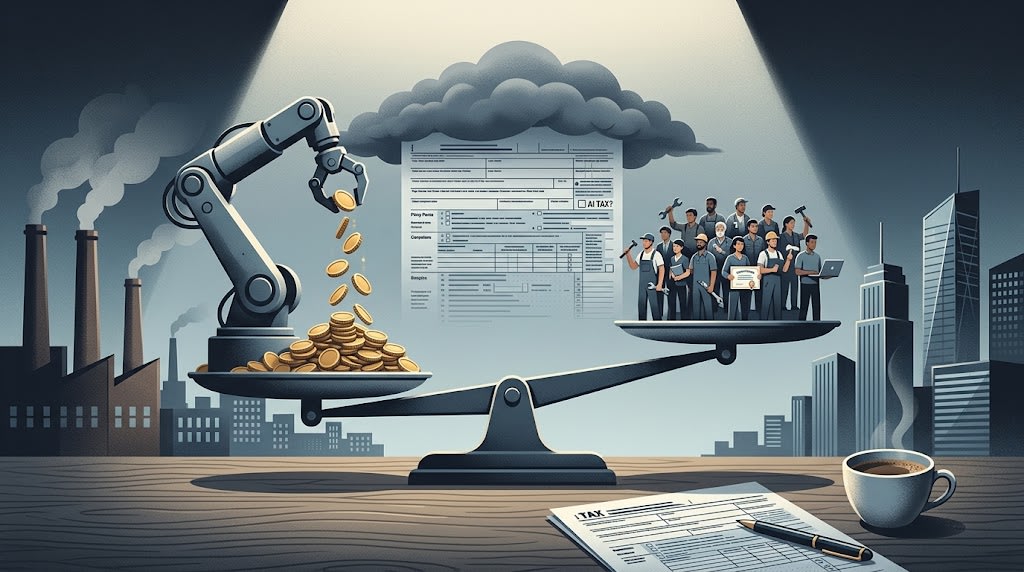
Taxing machines, or taxing capital?
An old question in a new shell
At the Bund Conference in September 2026, Miao Yanliang, chief economist at CICC, said China could consider moderately levying an "automation tax," a "robot tax," or an "AI tax." He called the AI shock a structural and distributional problem.
The claim is old. In the late 18th century, automatic looms in Britain pushed out large numbers of industrial workers. Some unions and MPs petitioned Parliament for a special tax on factories using steam engines and automatic looms, based on "mechanical horsepower" or the number of workers replaced. The petitions failed. In the late 19th century, capital returns in the United States far outstripped labor income, and a progressive personal income tax, a corporate income tax, and an inheritance tax followed. In 2017, Bill Gates called for a robot tax, arguing that working robots should pay as much tax as their human colleagues.
Two hundred years, three industrial revolutions, the same argument. But Miao Yanliang's remarks had two telling details. He said "could consider moderately levying," not "should levy." And he placed the AI tax inside a broader framework of adjusting the tax system to correct its differential treatment of labor and capital, rather than treating it as a standalone solution. The more operational part of his proposal sits elsewhere: fiscal interest subsidies and special relending to steer social capital into service industries that AI cannot easily replace, or that need human-machine collaboration.
Why the restraint? No country has ever directly taxed a newly created tool of labor. Not for lack of imagination. The path does not work.
The impossible trilemma
In 2017, the European Parliament voted on a bill that included a robot tax. It failed. The European Commission once proposed treating robots as "electronic persons" and granting them legal personality so they could be taxed. That ran into a fundamental legal obstacle. The taxable subjects that have come down through human history are natural persons and legal persons. Robots are neither. Under existing law, they are a third category, and not a taxable subject.
South Korea took another route. In August 2017, the government cut the tax deduction for industrial automation equipment from 7 percent to 2 percent. It did not tax robots directly. It raised the cost of using them by reducing the tax benefit. South Korea became the first country to implement a robot tax indirectly through tax policy. But this was a disguised tax. It did not solve the taxable-subject problem. It bypassed it.
The cost of bypassing it showed up later. The move drew strong opposition from affected companies. Research found that after the cost of automation investment rose, robot investment fell sharply. Firm-level employment did rise, but signs of investment restructuring appeared too. This exposes the core contradiction of an AI tax. Call it the impossible trilemma: curbing substitution, encouraging innovation, and raising revenue, at most two at a time. A tax high enough to curb AI substitution will dampen firms' willingness to adopt new technology. A tax low enough not to affect corporate decisions raises revenue that is a drop in the bucket.
A Cato Institute commentary put it more directly. The narrative behind the AI tax movement rests on three assumptions: capital is overwhelming labor, labor is taxed more heavily than capital, and AI is destroying capitalism. The data it cites show the U.S. labor income share has hovered around 70 percent for nearly a century, and real wages have risen by more than 40 percent since the 1990s. Those numbers may not travel to China. But claims about labor being overtaxed and capital being systematically undervalued need harder evidence than assertion.
AI changes the distribution, not the total
Miao Yanliang's sharper point: AI's impact on the overall labor market is not yet obvious, but in industries with high AI exposure, career entry points for some groups are already narrowing. The higher the income level, the higher the AI exposure, he said, and AI may first reduce demand for junior positions.
This is where the AI shock differs from earlier technological revolutions. It hits mid- and high-skill entry-level jobs before it hits low-skill repetitive work.
A study using Chinese firm data found that AI strengthens firms' market power, deepens their dominance in income distribution, and pulls down the labor income share. The market-power mechanism explains 64.55 percent of the decline. Another study quantified AI adoption: for each standard deviation increase, the share of service occupations rises 7.8 percent, and the labor income share falls 2.3 percent.
Read those numbers carefully. They show correlation, not simple causation. China's labor market has lower mobility and weaker collective bargaining than developed economies, so the shock may take a different shape. But the direction is clear. The distributional effect of AI matters more than its employment substitution effect, and it is already happening in China.
Oxford University's INET dug into where the inequality comes from. Without "task displacement," meaning automation directly replacing tasks humans perform, the Gini coefficient would be 21.5 percent lower than its actual level, and the wage share would shift sharply from the top 10 percent toward low- and middle-income groups. Technology drives wage inequality mainly through substitution, not through enablement.
From taxing tools to regulating capital returns
Directly taxing AI runs into the taxable subject, the tax object, the rate design, and a list of other problems. The more pragmatic path runs through the outcome, not the tool.
In a research report titled Broadening the Gains from Generative AI: The Role of Fiscal Policy, the IMF Fiscal Affairs Department proposed a supplementary tax on the economic rents AI generates. Economic rent is factor income above its opportunity cost: the excess over the minimum payment needed to keep the factor in its current use. In AI, that shows up as excess profits earned by leading firms through market power.
The appeal of this approach is that it never tries to send a tax bill to a robot. It regulates distribution after the fact. The tax base is the portion of profits above the normal rate of return. It can be implemented as a surtax on top of existing corporate tax, without defining or identifying AI-related assets. Rate design stays industry-neutral, with a high threshold. Only excess profits above the normal level get taxed, which protects normal corporate profits and startup returns from the extra charge.
A progressive corporate income tax plus a labor deduction works like this. Hire more workers, and the wage deduction lowers taxable income. Replace labor with AI and push profits up, and the firm lands in a higher bracket. The tax tool stops punishing a specific technology and starts regulating distributional outcomes. Almost every operational problem the AI tax faces disappears.
The IMF report adds a second piece: cut labor taxes. Many countries' tax systems favor capital and penalize labor. High payroll taxes widen the gap between what firms pay and what workers take home, which suppresses hiring. The report recommends shifting the burden from labor to capital, to offset a trend where AI rewards capital and squeezes labor.
Where does the revenue go?
How to spend the money on worker training, how to raise consumer willingness to spend, how to create new jobs. These are among the hardest questions in public finance.
The IMF report suggests channeling revenue into social security, training, and redistribution, while cutting social security contributions for low- and middle-skilled workers and setting income tax credits to cushion the transition. Miao Yanliang proposes fiscal interest subsidies and special relending to steer social capital into service industries that AI cannot easily replace or that need human-machine collaboration. Bill Gates's original idea used robot tax revenue for elderly care and school assistance, jobs for human workers.
The shared logic: do not park the unemployed on relief. Use the revenue to create demand for work that AI cannot do, and cut the labor tax burden to make hiring cheaper.
An unresolved problem runs through all of it. If AI replaces repetitive jobs across manufacturing and services at the same time, will the new jobs absorb the displaced workers? Monitoring data from the China Academy of Labor and Social Security Sciences show demand for AI-related roles such as algorithm engineers and AI trainers grew more than 100 percent year on year from January to August 2025. Demand for sales, administrative, financial, and legal roles fell 10 to 30 percent. That gap cannot be closed by training alone.
OpenAI's April 2026 policy paper went further: tax AI profits, set up a public wealth fund, move to a four-day workweek, expand the safety net. When AI companies call for taxes on themselves, read it two ways. It could be industry self-regulation in good faith. It could be a play to define the rules first. Either way, the AI tax debate has left academia and union petitions and entered actual policy making.
What tax reconstruction is really about
The first two industrial revolutions offer a pattern. In the first, direct machine-tax petitions failed, but Britain passed the Factory Acts, which limited employers' exploitation of machinery, and gradually legalized trade unions. In the second, U.S. capital returns far outstripped labor income, and the progressive income tax, corporate income tax, and inheritance tax followed. Germany built the world's first social insurance system, forcing capital to pay for part of workers' risks.
The pattern: distributional imbalances from technological progress get corrected by rebuilding the tax relationship between capital and labor, not by taxing new tools. Tools are neutral. How the returns they generate get distributed is a choice.
Miao Yanliang's value is not the phrase "AI tax." It is that he put a question already on the policy agenda onto the table of mainstream Chinese economic discussion: how should the tax system adapt to structural changes in the capital-labor relationship? The answer will most likely be to redesign the tax treatment of capital and labor, not to tax AI.
About the Creator
Jin
Writer of reamstories
https://reamstories.com/jin
Enjoyed the story? Support the Creator.
Subscribe for free to receive all their stories in your feed. You could also become a paid subscriber, letting them know you appreciate their work.
Comments
There are no comments for this story
Be the first to respond and start the conversation.