
The Red Stamp Rumble
Why corporate control wars in China always end up at the same tiny piece of rubber – and how it brings billion‑dollar companies to their knees.
I. Two Incidents, Six Years Apart
April 26, 2020, Dangdang.com. Li Guoqing walked into the office with four men, took dozens of official seals from under Yu Yu's nose, and left behind a notice to all employees. The media called it the "Qing‑Yu War."
August 18, 2026, Chengdu. Haite Gaoxin, together with four other shareholders, sent over a hundred people into Hiwafer's premises. They pried open the safe and removed the party committee seal, the company seal, the contract seal, and a few others. One side called it a robbery; the other said they "temporarily took the seals away."
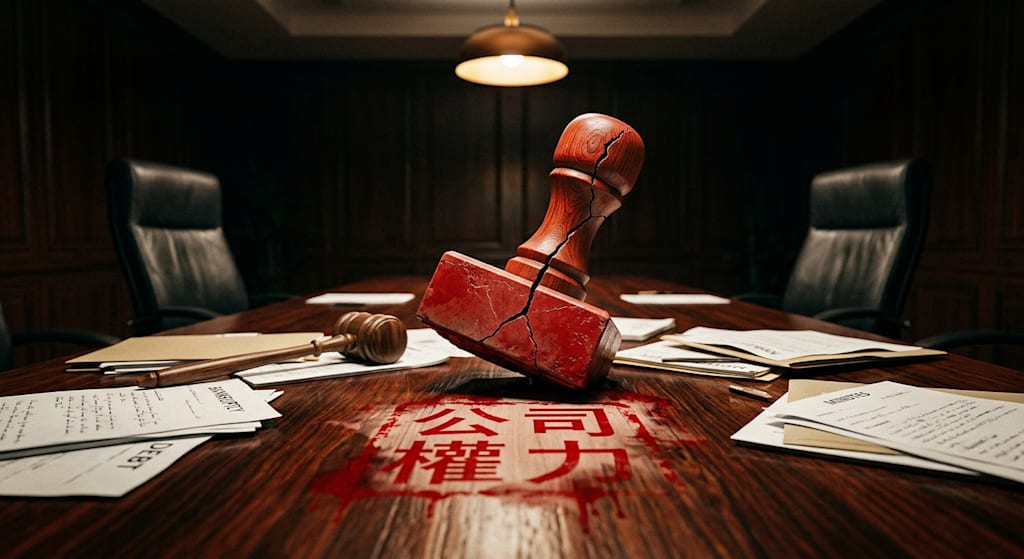
Six years apart, different players, but the same prop: a small red stamp.
Why does a physical seal still matter in an age of electronic signatures, facial recognition, and blockchain notarisation? Why do corporate control struggles in China keep going back to this primitive object? Is grabbing the seal actually effective, or is it a collective delusion?
Let's look at what the seal does, what it doesn't, and what happens when it changes hands.
II. What the Seal Can Do – and What It Cannot
It stops things, not rules
The seal does not decide who is in charge. But it does decide who can bring the company to a halt.
A manufacturing company stamps dozens of documents every day. Purchase contracts. Supplier receiving notes. Product dispatch slips. Bank payment instructions. Payroll authorisations. Tender documents. Each one requires that small red mark.
Hiwafer's statement was blunt: "From 16:00 on August 18, 2026, no individual or entity shall conduct any business dealings with the Company using the above seals, or sign any documents, contracts, agreements, or other legal instruments." That is not a threat. It is a fact. Without the seal, business stops.
Whoever takes the seal is not seizing control. They are pressing pause.
It does not settle authority
The seal does not answer "who is the legitimate representative." The Supreme People's Court has made this clear: the validity of a sealed document depends on whether the person affixing it has the authority to represent the company. The stamp itself is not the final word.
But when "who holds authority" is exactly what both sides are fighting over, the seal becomes the only tangible thing left to grab. The law cannot deliver a quick verdict. In the meantime, whoever holds the seal can freeze the other side's contracts. That is not legal control – it is de facto paralysis.
III. Seizure or Taking? The Difference Is Identity
Haite Gaoxin denied the word "seizure." Their defence: five shareholders jointly "temporarily took the seals away."
The core of that argument is one word: identity.
If an outsider with no connection to the company takes the seals, that is theft or robbery. The police file a criminal case.
But if a shareholder takes them, the picture changes.
Li Guoqing was never criminally prosecuted. Not because he was right, but because he was a shareholder. He could argue: "the shareholders' meeting I convened was valid," "I am the new legal representative," "I am taking over, not stealing." Whether those claims were true was a civil matter, not a criminal one.
Haite Gaoxin's situation is even more layered. The five shareholders acting together hold more than the largest single shareholder. Their argument: should the collective will of the majority shareholders outweigh that of a single largest holder?
Company law does not give a clear answer.
That ambiguity is why the police usually stay out. Their standard response: keep order, prevent violence, and tell both sides to go to court. As for the seals – they are rarely recovered by force, because handing them back to one side would instantly be rejected by the other.
So the seals remain with the party that "temporarily took them." No one is clearly breaking the law, yet no one can move forward.
IV. The Deadlock: Why You Cannot Just Get a New One
The obvious thought: if the seal is taken, report it lost and get a replacement.
In a control struggle, that route is blocked – for very concrete reasons.
To replace the seal, you need a certificate of loss from the public security bureau. But the bureau only issues that certificate when you genuinely do not know where the seal is. Here, everyone knows exactly who has it – the shareholder who "temporarily took it." That is not "lost"; it is "held under dispute." No certificate.
Without that certificate, you cannot publish a public notice, and without that notice, you cannot go to the authorised engraver.
Even if you somehow pushed through, you would hit another wall: replacement usually requires a resolution of all shareholders or the board agreeing to the replacement. In the middle of a control battle, that resolution is impossible.
The seals are not lost. They are in another shareholder's hands. That shareholder says they are held lawfully. The police issue no certificate. No resolution is possible.
Complete deadlock.
Could you just engrave a temporary seal yourself?
Article 280 of the Criminal Code says forging a company seal is a criminal offence, punishable by up to three years in prison. Even for internal use, the act itself crosses the line. And with the "genuine" seal in the other party's possession, any makeshift version you produce can be used against you as evidence of forgery.
That path is closed.
V. Two Cases, One Gamble
Li Guoqing: Founder vs. Ex‑Wife
Li Guoqing could walk into Dangdang and take the seals for one simple reason: he was the founder and a major shareholder. Identity protected him.
He claimed he had convened a valid interim shareholders' meeting, that he had been appointed the new executive director and legal representative, and that he was "taking over" rather than "seizing." The police gave him administrative detention – not for taking the seals, but for disorderly conduct. Criminal charges? None.
That outcome drew a fuzzy line for everyone who followed: if you have shareholder status, taking the seals may not be treated as a crime. That line lowered the threshold for later actors.
Haite Gaoxin: Coalition of Five vs. One
Haite Gaoxin's case differs in three ways.
First, the scale was larger – over a hundred people entered the facility, not a handful retrieving a few seals. The mix included outsiders, employees, and shareholder representatives, changing the nature of the scene.
Second, more parties were involved. Five shareholders acting together hold more than the largest single shareholder. Their narrative – "joint action by the majority shareholders to defend their rights" – is harder to dismiss in a single dimension than Li's "I alone decide."
Third, the party committee seal was involved. In a mixed‑ownership enterprise, that adds another layer of sensitivity.
Haite Gaoxin's defence – "temporarily taking the seals, not seizing them" – rests on a question: can the joint will of five shareholders constitute legitimate representation of the company?
There is no answer. And that is exactly where seal battles take root – where the law provides no immediate answer, physical action lands first.
What both cases share
Both incidents expose the same institutional gap: when all formal governance mechanisms fail, the only thing left is the object you can hold in your hand.
The law can determine a winner, but by the time it does, the company may already be dead. The seal battle gambles on that interval – forcing the other side back to the negotiating table before the court delivers its verdict.
VI. Stalemate Is Not a Solution – It Is Leverage
The endgame of a seal battle is rarely about who wins. It is about who breaks first.
Every day without the seal is a day the company bleeds. Contracts cannot be signed. Customers drift away. Suppliers wait on the sidelines. Employees grow restless. For a manufacturer, stoppage losses are not "recoverable in a few days" – they are a nose‑dive.
The taker bets that the other side cannot bear the losses and will come back to negotiate. The side that lost the seal bets that the taker will also be dragged down and eventually have to hand it back.
It is a contest of who starves first. And the race track is the company itself.
We do not know how the Haite Gaoxin–Hiwafer dispute will eventually be settled. But one thing is certain: no matter who ends up with the seal, the lost customers, broken partnerships, and departed talent during this period will never come back.
VII. One Honest Sentence
Grabbing the seal works in the short term. It does stop the company, and it does force the other side back to the table.
In the long term, it is useless. Stopping is easy; restarting is hard. By the time both sides finally reach a deal, the company may have no strength left to run.
Li Guoqing never took back Dangdang with those seals. Whether Haite Gaoxin can turn this around is unknown. But one honest sentence stands:
No one truly wins a seal war. The only question is whether the company that was fought over, when it is all over, still has the strength to begin again.
Hiwafer's statement ended with a line that was not a formality, but a real warning: "All documents, contracts, agreements, and transactions signed using the above lost seals shall not be recognised by the Company."
A company publicly declaring its own official seal invalid – that statement alone is already a cost.
About the Creator
Jin
Writer of reamstories
https://reamstories.com/jin
Enjoyed the story? Support the Creator.
Subscribe for free to receive all their stories in your feed. You could also become a paid subscriber, letting them know you appreciate their work.
Comments
There are no comments for this story
Be the first to respond and start the conversation.