
💣 THE PORTLAND BOMB ATTACK: An IED-Laden Car Driven Into One of America’s Most Prestigious Social Clubs at 3 a.m. — The Chilling Details of a Near-Catastrophe That Could Have Killed Hundreds
He circled the building. He drove in through the window. He had enough explosive devices to level a ballroom. If most of them had detonated, the death toll could have been catastrophic. This is the full story of the night Portland almost became a massacre.
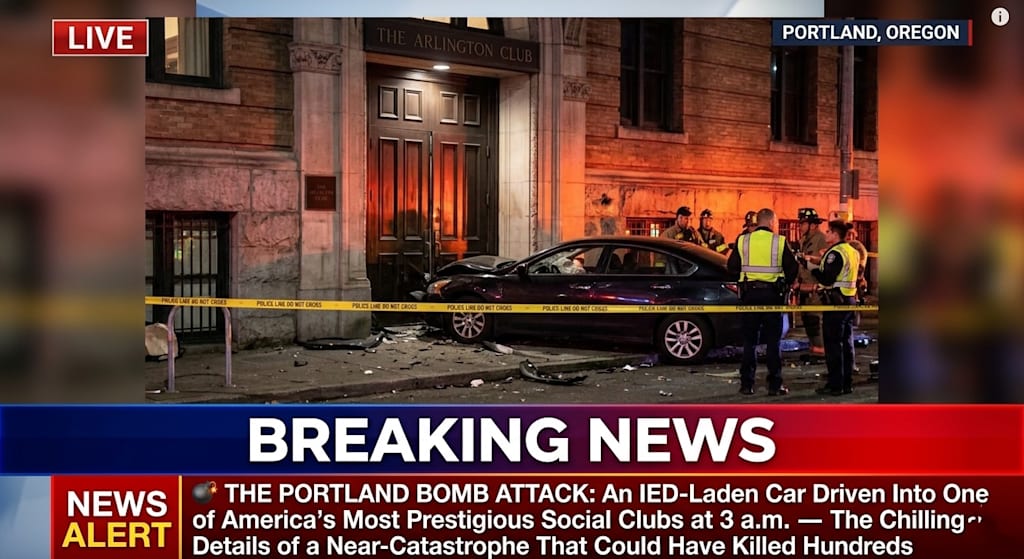
The call came in at 2:49 a.m. on Saturday, May 2. Portland Fire and Rescue received a report that a vehicle had crashed through the front entrance of the Multnomah Athletic Club — one of Portland’s most storied and prestigious private institutions — and was on fire. What responders found when they arrived would set in motion one of the most complex, terrifying, and consequential law enforcement and bomb disposal operations in Oregon history. What they nearly found — what was almost unleashed in the hours before dawn — is the part of this story that makes the hair stand up.
The Multnomah Athletic Club is not just any building. Founded in 1891, it is the largest private athletic and social club in the United States, with a membership of over 21,000 people. It occupies an eight-story main clubhouse within walking distance of downtown Portland, housing multiple restaurants, swimming pools, tennis, racquetball, handball and squash courts, exercise studios, a weight room, ballrooms, banquet facilities, and private meeting rooms. Its members include Portland’s business elite, civic leaders, families, and community figures. It has been, for 135 years, a cornerstone of the social and athletic identity of the city. It was, before Saturday morning, a place of celebration and recreation. It is now a crime scene.
Employees at the club who were working in the early morning hours were the first to notice something wrong. A vehicle — later identified as belonging to the suspect — was seen slowly circling the building. This is significant: it was not a reckless crash or an impulsive act. The driver was surveilling the target, mapping the approach, planning the entry. Then, at 2:49 a.m., the vehicle drove directly through the club’s front window entrance. Club employees who saw it happen reported that after entering through the window, the car continued driving inside the building — past the entry, down toward the interior, before being found engulfed in flames. Portland police confirmed that the car appeared to have been driven specifically toward the club’s restaurant area, where the building’s gas line is located. The choice of target was not random. The gas line, if ruptured and ignited, would have dramatically amplified the destructive power of any explosion.
After firefighters extinguished the blaze, they made a grim discovery: one person, the driver, was found dead inside the vehicle. The cause of death has not been officially confirmed. Shortly after, investigators made a second discovery that elevated the situation from a tragic accident to a major federal criminal investigation: evidence of explosive devices inside the car. The Metropolitan Explosive Disposal Unit — a multi-agency bomb squad — was called to the scene. What they found over the next several hours was, by the account of one bomb technician with 13 years of experience, the most complex scene he had ever dealt with.
“This is a dirty, dangerous, complex job,” Portland Police Bomb Technician Sergeant Jim DeFrain said. “I’ve been a bomb technician here in the city for over 13 years. This is by far the most complex scene that I’ve ever dealt with.” Investigators located multiple incendiary devices and improvised explosive devices — IEDs. Propane tanks were among the materials found. Some of the devices had already partially detonated, causing significant damage to the club’s interior. Others were found in varying states of activation — meaning they were primed to go off but had failed to do so. Bomb disposal robots were deployed to recover and safely detonate the remaining devices. The operation took more than 14 hours.
“There was an intent to detonate a number of explosive devices that just didn’t go off,” said Commander Jim Crooker of PPB’s Special Resources division. “It looked like there was more to detonate than was actually detonated.” Portland Police Chief Bob Day, speaking at a press conference attended by Portland Mayor Keith Wilson, FBI representatives, and other officials, was direct: “Based on the preliminary investigation, detectives believe the driver intentionally entered the building with the intent to deploy explosive devices.” This was not an accident. This was a deliberate, planned attack on a specific target, designed to cause mass destruction. The reason it did not succeed in killing many people was, by the account of first responders, a combination of timing — the attack occurred in the early morning hours when the club was sparsely occupied — and the partial failure of the explosive devices to detonate as intended.
Mayor Keith Wilson, in his remarks, offered a chilling counterfactual: “They got the call early and they responded with their quick work, their training; they took a possible catastrophic event, and we’re here talking about a tragic event instead.” That sentence encapsulates the terrifying arithmetic of Saturday morning. Had the devices detonated as intended. Had the attack occurred during daytime hours. Had the gas line ruptured and ignited. The death toll could have been measured not in ones but in dozens, possibly more.
The investigation is now being led jointly by the Portland Police Bureau, the FBI’s Portland field office, and the Bureau of Alcohol, Tobacco, Firearms and Explosives. Police confirmed they executed a search warrant at the home of a man named Bruce Whitman — who had previously been identified in letters sent by the Multnomah Athletic Club to its members as early as 2022. Those letters warned that Whitman, a former club employee, had been approaching members in public and at their homes, verbally accosting at least five members at their doorsteps. After his verbal threats escalated, he was detained by Portland police and placed on a psychiatric hold. It is unclear when he was released. Police have not officially named Whitman as the suspect in the attack. The medical examiner has not made an official identification of the deceased driver. The investigation is ongoing.
Police Chief Day addressed the question of whether the attack was related to domestic terrorism: “With the best information we have right now, this was an isolated event and not related to domestic terrorism.” He called the situation “bad luck or bad timing for the Multnomah Athletic Club,” referencing an earlier, unrelated car incident at the club in April. The club itself has been closed “until further notice,” with its communications team saying it is “still assessing the full extent of the damage” and cooperating fully with law enforcement.
One club member, Steve Blair, received a notice from the club that morning and told reporters the incident was “worrying” and “very sad.” Another member, John Carroll, recalled what he had heard: that the driver had gone through the front lobby and continued all the way to the ballroom. “It’s got to be frightening,” he said. The building houses 21,000 members’ worth of memories, activities, and community. It will not reopen soon. And Portland, a city no stranger to civil unrest, is now confronting the reality that it came terrifyingly close to something far worse than what happened.
The FBI is investigating. The bomb squad has cleared the scene. One person is dead. And the questions — about who did this, why, how they obtained the devices, and how close the city came to catastrophe — are only beginning to be answered.
About the Creator
Enjoyed the story? Support the Creator.
Subscribe for free to receive all their stories in your feed.
Comments
There are no comments for this story
Be the first to respond and start the conversation.