
The One-Yuan Parcel Problem: Why Door-to-Door Delivery Keeps Hitting the Same Wall
A courier’s daily earnings, the hidden economics of post stations, and the fight over who actually pays for the last mile.
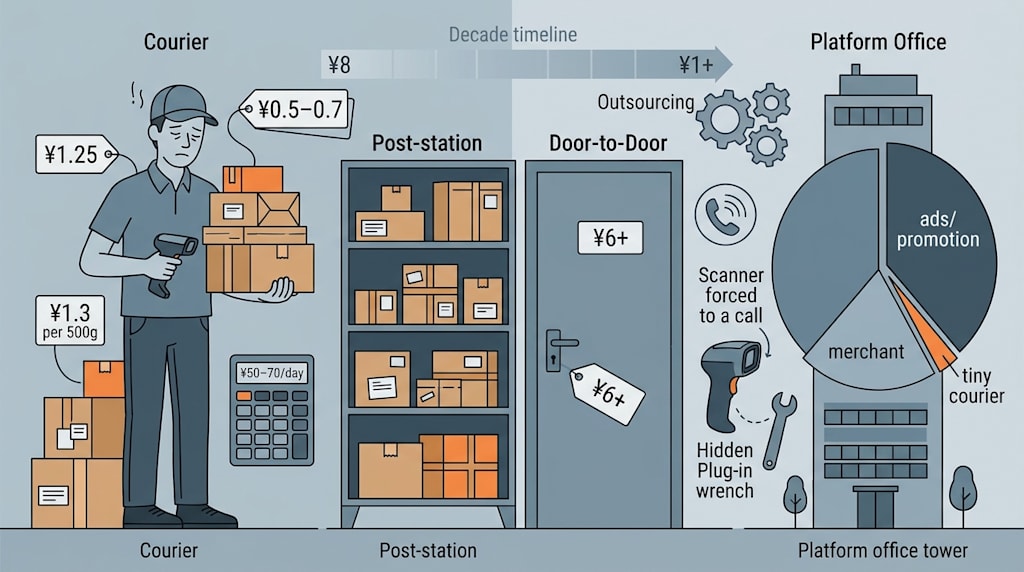
A courier who delivers 100 parcels to the door in a day, earning 0.5 to 0.7 yuan per delivery, makes 50 to 70 yuan a day. That number is the first wall the “door-to-door for every parcel” policy hits when it tries to land.
Shentong charges 1.25 yuan, Yunda 1.3 yuan, YTO 1.3 yuan, and China Post 1.3 yuan per 500 grams for e-commerce parcels in Central China. For a 20-kilogram bulky item, Shentong is just over 10 yuan and Yunda just over 9 yuan. A courier gets five to seven mao per delivery. A seasoned courier doing door-to-door work, affected by floors, phone calls, waiting, signatures, weather, and route, can handle around 100 parcels a day at best. At 0.5 to 0.7 yuan each, that is 50 to 70 yuan a day. That income cannot support the service standard of door-to-door delivery and a phone call for every parcel.
Compare that with JD, SF Express, and EMS standard items (tracking numbers starting with 1) that mandate door-to-door delivery. Their prices start at around 6 yuan, and the delivery fees are high enough for the process to work. The author gives the example of China Post’s “E-commerce Standard Express.” Prices start at 2 to 3 yuan. The system requires a phone call for every parcel, and the scanner is set so delivery cannot be completed without a call. The delivery fee paid is very low. Couriers bought plug-ins to cope with the system. Even banning accounts when plug-ins were detected could not stop the trend. When assessment requirements and compensation are severely mismatched, the front line will not honestly execute. It will get around the rules. This is an incentive problem.
Many people forget that express delivery was not always this cheap. The author recalls that when he started working, delivery was 5 to 8 yuan per order. His first account was a famous underwear company in Wuhan: 8 yuan per order, door-to-door delivery as a basic requirement, and a settled delivery fee never below 3 yuan. At an e-commerce-led company at the time, the biggest expense was express delivery fees, far above ad spend and other costs. In that model, the express company made money and the third-party platform did not. Over time, ad spend became the main cost, and express fees dropped to about 10% of total e-commerce costs. Prices fell from 8 yuan to just over 1 yuan over ten years. The post-station model was the biggest contributor, turning door-to-door deliveries into bulk drop-offs. Massive outsourcing was the second contributor: customer service at 0.02 yuan per item, labor outsourced in sorting and transfer, and costs squeezed in transportation. Only then was a balance reached that all parties barely accepted. Recipients got used to picking up at post stations. Merchants got used to cheap express. Platforms got used to high ad revenue. Express companies got used to high volume with thin margins.
The policy now demands door-to-door delivery. That breaks the balance. Prices do not move. Only the service side moves. The cost will be shifted onto couriers or force out more formalism. The author puts it sharply: more service for the same price will eventually be ended by more outrageous maneuvers. The China Post e-commerce standard express plug-in shows how that happens.
There are four roles in the e-commerce express chain: platform, merchant, express company, and consumer. The merchant pays the express fee on paper. The real distribution gives the platform the largest share through ad spend, promotion, and commissions. The merchant takes a medium share. The express company takes a small share. Express fees as a proportion of total e-commerce costs have dropped from the big-ticket item of the past to about 10%. Under this distribution, demanding better service at the last mile without giving the last mile a share of the profit makes the weakest link carry the policy cost. The platform has room to share the burden. It can adjust traffic allocation, change the express fee settlement method, subsidize door-to-door parcels, and make door-to-door delivery an optional service with clear pricing. Platforms prefer to use rules to force service. They do not touch their own slice of the pie. The author’s line, “Pinduoduo, aren’t you bullying the honest guy?” carries a real dilemma. In a system where price wars have been fought to the extreme, any policy that unilaterally adds service without adjusting the distribution of benefits will be distorted.
Door-to-door delivery is a consumer’s legal right to choose. The policy’s original intent is to correct the widespread violation of dropping parcels at post stations without consent. It does not require unconditional door-to-door delivery for every parcel. The problem is implementation. How do you distinguish between a request for door-to-door delivery and consent to a post-station drop-off? Who pays for door-to-door service? SF Express and JD can do door-to-door because their pricing systems support it. Tongda companies take the low-price, high-volume route. Applying the same door-to-door standard to all express companies without distinguishing price tiers is unrealistic. A more workable approach is service by price. Low-priced parcels default to post stations but require consent. Door-to-door parcels pay a corresponding fee. Platforms subsidize door-to-door demand or guide merchants to choose different service tiers. Service can be tiered. The right to know and the right to choose cannot be absent.
This complaint matters because it names a cost that policy language hides: service has a price. A one-yuan-plus express fee cannot support a six-yuan door-to-door service. A 0.5-yuan delivery fee cannot support a phone call and a flight of stairs for every parcel. Post stations and outsourcing brought prices down. They also turned door-to-door delivery into a scarce good that requires extra payment. Add service without adding price, and couriers will vote with their feet, plug-ins will run rampant, or service will meet the standard in form while shrinking in experience.
The question is who pays for door-to-door delivery. The platform gives up a little profit. Merchants choose the right service tier. Consumers pay a reasonable fee for explicit door-to-door demand. Express companies pay adequate delivery fees. Regulators enforce the ban on dropping at post stations without consent. That is the sustainable path. Otherwise, the harder the policy pushes, the more distorted the front line becomes. The people bullied in the end are the honest guys who deliver parcels in good faith.
A one-yuan parcel cannot reach the door. Couriers are trying. The pricing and distribution structure has not budgeted for door-to-door service.
About the Creator
Jin
Writer of reamstories
https://reamstories.com/jin
Enjoyed the story? Support the Creator.
Subscribe for free to receive all their stories in your feed. You could also become a paid subscriber, letting them know you appreciate their work.
Comments
There are no comments for this story
Be the first to respond and start the conversation.