
The Most Important Technical Features of a Rubber Tyred Gantry Crane (RTG)
An Engineering Analysis of the Critical Components Defining High-Performance Lifting Solutions.
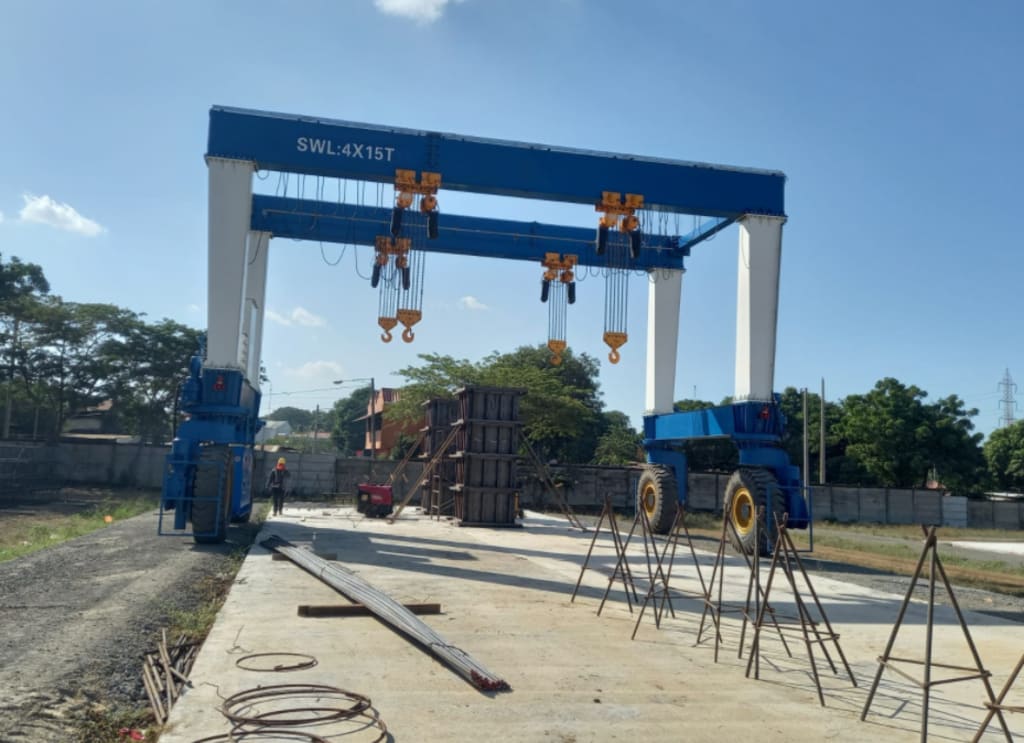
The Rubber Tyred Gantry (RTG) crane is a primary asset in heavy-duty logistics and industrial manufacturing. While historically associated with container terminals, the modern RTG has evolved into a versatile material handling solution for shipyards, steel mills, precast concrete plants, and large-scale infrastructure sites. Its utility is defined not by its ability to stack boxes, but by a specific set of technical features that enable it to lift, move, and position heavy loads with extreme precision in unstructured environments.
The following are the critical technical features that distinguish a high-performance RTG crane and dictate its operational capability.
1. Advanced Mobility and Steering Geometry
The defining feature of an RTG gantry crane is its mobility. Unlike rail-mounted gantries (RMGs), which are restricted to fixed tracks, the RTG moves on rubber tires. This mobility is enabled by complex steering systems that provide operational flexibility in diverse environments.
Multi-Mode Steering: High-performance RTGs utilize sophisticated steering systems capable of 90-degree movement, circular steering, and crab steering. This allows the crane to navigate tight corners, maneuver around fixed obstacles, and position itself parallel or perpendicular to the load without requiring massive turning radiuses.
Tire Configuration and Load Distribution: The choice of tire configuration—ranging from 4x4, 8x8, up to 16-wheel systems—is not arbitrary. It is engineered to distribute the total weight of the crane and its payload over a larger surface area. This is essential for operation on non-reinforced surfaces or ground with limited bearing capacity. The steering linkage must maintain precise alignment under load to prevent excessive tire scrub, which causes rapid wear and tear.
2. Versatile Load Interface Systems
In industrial applications outside of shipping ports, a standard container spreader is often insufficient. The flexibility of the load interface is perhaps the most critical feature for non-containerized cargo.
Interchangeable Lifting Gear: An effective industrial RTG must support a variety of interface tools, including hook blocks, C-hooks, electromagnets, vacuum lifters, and custom-designed lifting beams. The ability to swap these tools quickly—often through a modular quick-connect system—is what transforms the RTG from a specialized container handler into a multi-purpose lifting machine.
Load Balancing for Irregular Cargo: Unlike a container with a known, centered mass, industrial loads often have asymmetric centers of gravity. Modern RTGs feature advanced reeving arrangements and automated spreader tilt control to manage these loads. This ensures that even when lifting long steel girders, wind turbine blades, or irregular manufacturing components, the load remains balanced during travel and hoisting.
3. Structural Design and Torsional Stiffness
The gantry frame is the skeletal structure that absorbs all operational forces. For non-container applications, where loading conditions can be more unpredictable, structural stiffness is paramount.
Box-Girder Construction: The use of high-strength, steel box-girder designs provides superior torsional rigidity compared to lattice-style structures. This rigidity is necessary to prevent "twisting" of the mobile gantry crane when the trolley is offset or when lifting heavy, unbalanced loads.
Modular Gantry Leg Design: The legs must transfer vertical loads into the sill beams. Industrial RTGs often employ a modular leg design, allowing the span and clear height to be adjusted to accommodate different site requirements, such as clearing high production equipment or navigating through narrow factory bays.
Corrosion and Environment Protection: Because many RTGs operate in exposed shipyards or dusty industrial plants, structural longevity depends on surface treatments. High-grade industrial coating systems, along with sealed enclosures for critical components, protect the structural integrity from environmental degradation.
4. High-Efficiency Power and Drive Systems
The power system determines the operational uptime and energy efficiency of the RTG. Modern units have shifted from pure diesel engines to diesel-electric or full-electric configurations.
Diesel-Electric Hybrids: Most RTGs employ a diesel-electric setup, where a diesel engine powers a generator that feeds electric motors. This configuration provides high starting torque, which is essential for lifting heavy loads from a dead stop.
Variable Frequency Drives (VFDs): VFDs are the "brains" of the power system. They control the speed and torque of the hoist, trolley, and gantry motors. By modulating frequency and voltage, VFDs enable smooth, stepless acceleration and deceleration, preventing "load swing" and reducing mechanical stress on the wire ropes and gearboxes.
Regenerative Braking: Energy efficiency is a key feature of modern RTGs. When the hoist lowers a load, the motor acts as a generator, capturing the kinetic energy and feeding it back into the electrical system. This reduces fuel or electricity consumption and lowers the thermal stress on braking resistors.
5. Control Systems: Automation and Safety
The control system dictates how safely and efficiently an operator can handle complex loads.
Load Moment Indicators (LMI) and Weight Measurement: These sensors are mandatory for safety. They monitor the weight of the load, the radius, and the angle, comparing them against the safe working load (SWL) of the crane in real-time. If the system detects an overload or a tipping condition, it automatically inhibits the hoist and travel functions.
Sway Control Algorithms: For heavy loads that tend to oscillate, sway control software is an essential feature. By adjusting the acceleration and deceleration profiles, the PLC (Programmable Logic Controller) can neutralize the pendulous motion of the load, significantly increasing the speed at which materials can be transported safely.
Remote Operation Capabilities: Many industrial RTGs now support remote operation. By moving the operator from a cab on the crane to a centralized control room, terminals and plants can improve operator ergonomics, safety, and operational oversight, particularly in hazardous or high-temperature environments.
6. Reliability and Maintenance-Centric Design
The most capable RTG is one that remains functional. Design features that prioritize ease of maintenance are essential for maximizing the return on investment.
Accessibility: Critical components such as motors, brakes, and electrical panels must be housed in easily accessible machinery houses. Walkways and platforms should be designed for safe, rapid maintenance access.
Diagnostic Integration: Modern RTGs include comprehensive telemetry systems that monitor the health of every major subsystem. These systems provide predictive analytics, alerting maintenance teams to potential issues—such as gearbox overheating or wire rope fatigue—before they lead to downtime.
Standardization of Components: The use of standard, off-the-shelf industrial components (for contactors, sensors, and drive systems) reduces the cost and complexity of the supply chain, ensuring that spare parts are readily available.
Conclusion
The Rubber Tyred Gantry Crane is defined by its versatility and structural robustness. Whether it is used for container stacking or heavy project cargo handling, the core features—multi-mode mobility, interface adaptability, structural stiffness, and precision control—remain the same. For organizations seeking to optimize their material handling, focusing on these technical pillars ensures that the RTG operates not just as a piece of equipment, but as a long-term, scalable component of their industrial infrastructure.
About the Creator
Aicrane01
Welcome to the Aicrane Blog, your practical guide to lifting solutions. Discover articles covering overhead cranes, gantry cranes, winches, steel structures, boat lifts, and more.
Website: https://steelmillcranes.com/
Enjoyed the story? Support the Creator.
Subscribe for free to receive all their stories in your feed.
Comments
There are no comments for this story
Be the first to respond and start the conversation.