
The Machines Are Running, But Nobody’s Buying
How a 140‑year‑old economic theory built a system that produces everything—except what people actually want.
A physicist heats water. At 100 degrees Celsius, it boils. Change the altitude and the number shifts, but given the pressure, you can calculate the boiling point anywhere on earth. The person boiling the water does not need to know thermodynamics.
An economist raises workers' wages. Sometimes output goes up—better-fed workers are more productive. Sometimes output goes down—workers trade the raise for shorter hours, or switch to a job closer to home. Inside the regularity sits a variable called "choice." That choice depends on what the worker heard yesterday, what the neighbor earns, what strangers on a phone screen seem to have. An economic model is not a physics equation. It is a sieve. A sieve does not reproduce reality. It brings one layer of texture into focus.
The problem is not simplification. The problem starts when a sieve is mistaken for the whole body of water—and then sinks, settles at the bottom, becomes the riverbed. After that, water flows only through its pores.
I. Three Holes in the Sieve
In Suzhou, a 3C electronics factory with fully automated production lines reported a net profit margin of 12.8% in 2025. The lines run robotic arms, AGV carts, and vision-inspection systems. The number of direct production workers: four. Their job is patrol inspection and resetting errors.
In the first volume of Capital, Marx wrote that only living labour creates surplus value. Machinery and other constant capital merely transfer their own value. By that logic, the living labour of four patrol workers cannot support a double-digit margin.
The audit report split that profit two ways: "returns on fixed assets" and "technology licensing income." The first is cash flow generated by the machines themselves. The second is deferred return on past R&D. Capital earned interest. Interest does not sweat.
This was not Marx's oversight. He saw the machines. He saw the large factories. When he pushed "full automation" to its limit, he reached a conclusion: if human labour falls to zero, surplus value falls to zero. What he did not foresee was that capital could collect rents through monopoly access to technology and market power—with no labour involved. At least eight percentage points of that 12.8% margin come not from "exploiting labour" but from "preventing others from using the same machines." A patent wall holds better than a factory fence.
A larger crack runs between the second and third volumes of Capital. In Volume I, sectors with a higher ratio of capital to labour (less labour-intensive) should have lower profit rates. In Volume III, Marx faced reality and conceded that average profit rates tend to equalize across sectors. To bridge the gap, he introduced "prices of production"—a mechanism that redistributes value among sectors so asset-heavy industries can earn average profits.
In 1884, Böhm-Bawerk exposed the gap: constant capital, which in Volume I could only "transfer value," participates in value distribution in Volume III. The mathematical appendix is missing. After 140 years, it is still missing. Later scholars tried to patch it with the Okishio theorem. But that theorem essentially admits that technical change alone can raise the profit rate—no extra labour required. That is no longer the labour theory of value. It is a back-door admission that capital itself produces.
Then there is a third hole. Marx dismissed market-demand discovery, resource allocation, and team organization as "unproductive labour"—parasitic. One counterexample suffices.
In 2024, China's industrial finished-goods inventory grew 6.8% year-on-year. Consumer electronics inventory turnover stretched from 52 days to 78. Every extra unit of inventory was "produced." Every extra unit ties up capital, accrues interest, eventually sells at a discount. The hands that made them sweated. But the sweat created no value, because consumers did not want the goods.
Knight distinguished, a century ago, that part of profit is the return for bearing non-insurable uncertainty. Get the direction wrong, and more sweat only means bigger losses. Throw the entrepreneur out of the value-creation room, and you have thrown the helmsman overboard—then you ask the oarsmen why they cannot reach the shore.
II. When a Broken Sieve Becomes the Riverbed
The Soviet Union turned this theory into a state philosophy: production first. Production became both the origin and the terminus of economic life. Production determines distribution, exchange, and consumption. Consumption is merely production's derivative—a shadow that follows the person.
This logic worked when capital was extremely scarce. Build the furnace first; otherwise, no molten iron. The trouble starts when enough furnaces are built and the logic refuses to stop. It has grown three self-reinforcing layers of institutional shell.
First shell: taxation. China's value-added tax (VAT) contributes over 30% of total tax revenue. The cascading nature of VAT means that as long as a transaction involves a production act—buying raw materials, processing, shipping—tax is generated at each circulation stage. The final sale to a consumer, at the same rate, yields a much smaller amount.
For local governments, attracting a chemical plant generates VAT revenue in the year the factory breaks ground and equipment arrives. Attracting a thousand consumers to move to the locality and shop every day produces scattered retail taxes that are hard to attribute.
In one prefecture-level city in 2025, VAT contributed 62% of general public budget revenue. Of that, 80% came from the input-output differences of three heavy chemical plants and two electronics contract manufacturers. At the local tax bureau's monthly dispatch meetings, the director tracks industrial electricity consumption and freight throughput—two indicators that predict tax revenue a month in advance. The dozen yuan of output tax from a resident buying milk at the supermarket does not earn a separate line on the statement.
Consequently, the annual assessment list of "key promoted projects" always ranks industrial land levelling, substation expansion, and park wastewater treatment at the top. Consumer infrastructure—community commerce, cultural venues, sports facilities—sits at the bottom. Spending on those yields no current-period tax recovery.
Second shell: land. Local governments monopolize construction-land supply. In 2025, residential land transfer prices in 300 cities averaged roughly 29 times industrial land prices.
The logic: supply industrial land at ultra-low or zero prices, with massive infrastructure subsidies attached, to pull in factories. Then tighten residential land supply and use homebuyers' money to cover the deficit.
A concrete calculation. In a second-tier city in 2025, a 500-mu industrial plot sold for a semiconductor project at 280,000 yuan per mu—yielding 140 million yuan. The government had spent 320 million yuan on demolition and site preparation. Net loss: 180 million yuan.
Three residential plots in the same area covered that loss—300 mu total, at an average price of 8.2 million yuan per mu, generating 2.46 billion yuan. Those residential plots held houses bought by more than ten thousand families, signed to 30-year mortgages with average monthly payments of 12,000 yuan. Out of each monthly payment, roughly 400 yuan subsidizes the land-price discount for that semiconductor factory.
Residents are using thirty years of discounted labour income to subsidize current industrial production. No one designed this mechanism consciously. It is the natural outcome of two parallel land-price systems. But every day, it injects subsidies into production and extracts purchasing power from consumption.
Third shell: welfare. In 2025, an internal training document from a provincial finance department quoted the phrase "preventing the trap of welfarism." Immediately after, it reported the province's social-security fund deficit: 8.7 billion yuan, to be covered by general budget transfers. The same document listed special subsidies for major industrial projects: 21 billion yuan—2.4 times the welfare shortfall.
The choice was not moral. It was administrative: which expenditure forms fixed assets within three years and enters assessment milestones? Subsidizing factories comes with site photos, equipment commissioning reports, and quarterly fixed-asset investment growth. Medical reimbursements and pensions are fiscal expenditures counted only as "final consumption" in GDP—no multiplier, no reporting glory.
Poured together, these three shells solidify into one incentive structure: unlimited factor subsidies on the production side, and a high capital-transfer cost borne by the consumption side.
III. The 40-Trillion-Yuan Shadow
In 2024, China's final consumption expenditure as a share of GDP stood at 54.7%, with the household share at 38.2%. The U.S. household consumption rate was 69.1%. Multiply the 30.9-percentage-point gap by 130 trillion yuan of GDP, and you get roughly 40 trillion yuan. Per person, that is 28,000 yuan less consumption per year.
That money did not hide under mattresses. It became gross capital formation. China's investment rate has long stayed around 43%. In the U.S., it is 21%. In Germany, 22%. The extra 20-plus percentage points have poured into factory floors, bridge piers, industrial parks, and empty plazas in front of high-speed rail stations.
In 2024, manufacturing investment grew above 9%, but capacity utilization hovered around 75%. One-quarter of production capacity sat idle or semi-idle.
The incremental capital-output ratio—the additional investment needed to generate one unit of GDP growth—was around 3.5 in 2008. By 2025, it had risen above 6. To generate one yuan of GDP now, you have to sink six yuan of fixed investment. That figure never exceeded 5 during the high-growth periods of East Asian neighbours. Marginal returns are already below the cost of capital. Yet investment growth has not slowed. The leverage on balance sheets will not allow it.
IV. The Maturity Schedule Does Not Recognize Ideology
By the end of 2025, the outstanding interest-bearing debt of local government financing vehicles was estimated at roughly 65 trillion yuan. Over 70% of that corresponds to asset-heavy projects: industrial parks, expressways, municipal pipelines, new-town developments.
The median internal rate of return on these projects had fallen to 3.2%—below the weighted average financing cost of local debt at 4.1%. The net interest-spread loss comes to about 585 billion yuan per year.
That number itself is small—less than 0.5% of GDP. But the problem is liquidity structure. Assets on these projects run thirty years or more. Liabilities run three to five years. Severe maturity mismatch. If you stop new projects, the rolling over of short-term debt collapses. So you must keep starting new projects to roll old debt. Stop the line, and banks call loans. Banks call loans, and every construction contractor and materials supplier on the chain sees its receivables turn bad simultaneously.
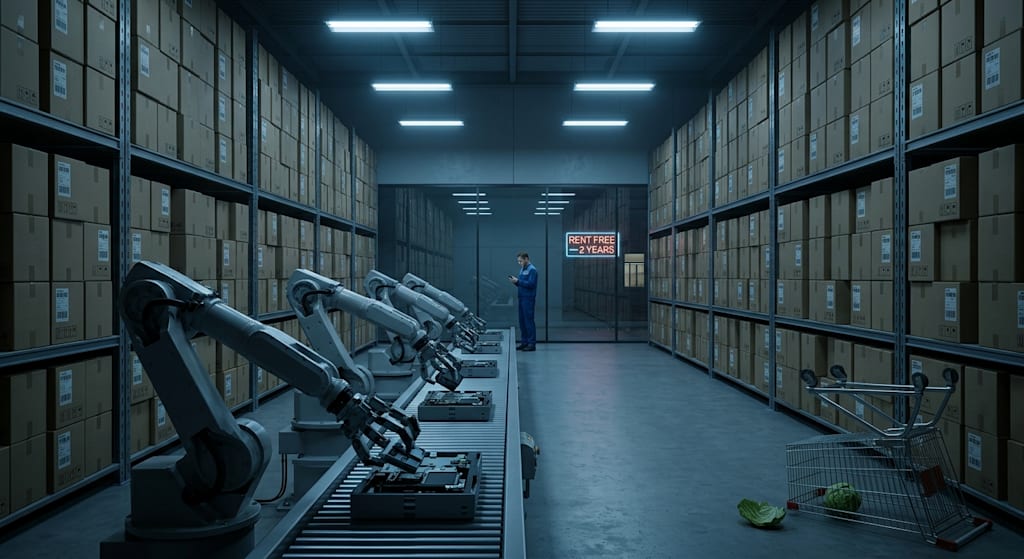
In 2025, an industrial park reported a 23% vacancy rate. The property management hung a banner at the gate: "Warmly Welcome Quality Enterprises to Settle In—Two Years' Rent Free."
Phase III of the same park was still under construction. The tower crane remained. The project had been funded with special-purpose bonds; the funds had to be used within the fiscal year, or the following year's quota would be cut. So a daily scene unfolded: the concrete frame of Phase III topped out, while the leasing department in the next building stared at the vacancy report. Two departments in the same building do not call each other.
On the workshop floor, the logic is locked too. A Shenzhen electronics contract manufacturer produced enough wireless earphones in 2024 to cover 18 months of inventory. The lines did not stop. Three shifts ran unchanged. Every morning at the pre-shift meeting, the workshop director still said, "More work, more pay."
Last month, a worker took home 5,200 yuan. Pork at the supermarket next door was 6% more expensive than a year earlier. He stood in front of the freezer for thirty seconds. Two pork ribs: 38 yuan. He did the math. He picked up four frozen buns and went to checkout.
In the same month, the factory applied for and received 4.7 million yuan in local "employment-stabilization subsidies" and "production-increase bonuses." The condition: output value must not fall year-on-year. So the warehouse piled up another month's worth of goods.
V. The Variable Called "Choice" Returns
What Marx wrote in the first volume of Capital was a critique: capital extracts surplus value by depressing wages. But he did not anticipate that later institutional designs would fossilize "suppress consumption, increase accumulation" into a faith in production itself.
When production no longer serves consumption—when consumption is instead required to serve the reproduction of production—the variable called "choice" disappears from the economic equation.
Consumption is not production's derivative. Consumption is the only purpose of production. Human beings do not need material abundance as such. They need material goods to enter their bodies and households at a specific time, in a specific place, at a specific quality.
A warehouse left unattended, where robotic arms assemble Bluetooth earphones 24 hours a day, and no one ever wears those earphones—that output exists in the physical sense. It does not exist in the economic sense. It is a debit balance on an accounting ledger.
In the winter statistics of 2025, buried in a footnote under manufacturing investment: electrical machinery and equipment manufacturing grew 11.2% year-on-year. Total profits in that sector fell 7.6% over the same period.
More money invested. More goods produced. Less money earned.
Inventory rises. Unit prices fall.
The lines cannot stop. Stopping triggers cross-default clauses in loan contracts.
The machines keep turning. The shelves keep filling. The shopping carts are empty.
About the Creator
Jin
Writer of reamstories
https://reamstories.com/jin
Enjoyed the story? Support the Creator.
Subscribe for free to receive all their stories in your feed. You could also become a paid subscriber, letting them know you appreciate their work.
Comments
There are no comments for this story
Be the first to respond and start the conversation.