
The Iran War Has Now Killed More Than 6,198 People. Behind Every Number Is a Name. This Is the Human Cost the Diplomats Are Negotiating Around.
As U.S. and Iranian officials draft a one-page memo in air-conditioned rooms, the confirmed death toll from the 2026 Iran war stands at 3,468 in Iran, 2,702 in Lebanon, and 28 in Gulf states. These are preliminary figures. The real number is almost certainly higher. Here are the lives inside the statistics.
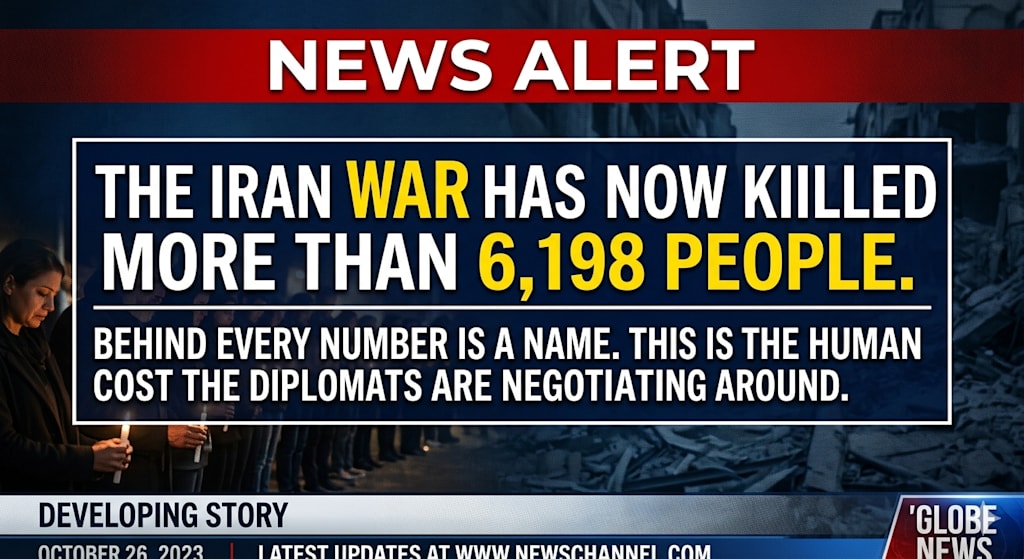
Every negotiation has a number attached to it — a death toll that both parties in a peace process must either acknowledge or ignore. The Iran war's number, as of May 7, 2026, stands at a minimum of 6,198 confirmed dead: 3,468 in Iran, 2,702 in Lebanon, and 28 in Gulf states, according to preliminary figures compiled by Al Jazeera from available sources. The word "preliminary" carries enormous weight here. Iran — a country of 90 million people whose national internet has been severed since February 28, whose independent press has been silenced, and whose government controls all official data — has not published final, independently verified casualty statistics. The Lebanese figures do not capture all who have died from infrastructure collapse, medical system failure, or displacement. The Gulf state figures do not include migrant workers or seafarers whose deaths go unregistered. The real number of dead from this war is higher. Perhaps significantly higher. Perhaps catastrophically so.
The 3,468 deaths in Iran come from a war that struck a country of 90 million in the early hours of March 1 local time, when U.S. and Israeli warplanes hit military sites, government buildings, and critical infrastructure in a coordinated opening campaign. Subsequent strikes targeted Iran's military command structure, missile production facilities, and naval assets. Human rights organisations operating with limited access have documented civilian deaths in proximity to military installations, as well as from the secondary effects of infrastructure destruction: power grid failures that shut down hospitals, water treatment system damage that produced contaminated drinking water, and medical supply chain disruptions that prevented treatment of war-unrelated conditions including heart disease, cancer, and obstetric emergencies. These deaths are not counted in strike tallies. They are among the uncounted.
"Preliminary figures are 3,468 people dead in Iran, 2,702 dead in Lebanon, and 28 killed in Gulf states." — Al Jazeera, May 2026
Lebanon's 2,702 confirmed dead come from a country that was already in catastrophic condition before the first Iranian missile crossed its airspace toward an Israeli target in late February. Lebanon's financial system effectively collapsed in 2019. The Beirut port explosion of 2020 killed over 200 people and left the capital's commercial infrastructure in ruins. Poverty rates before the Iran war already exceeded 80 percent. Into this pre-existing catastrophe, the Iran war introduced a new dimension: Israeli strikes on Hezbollah targets in southern Lebanon, which have continued throughout the conflict and which the Lebanese government has publicly called war crimes, since they occur despite a declared ceasefire that Israel has stated explicitly does not apply to Lebanon. Families in southern Lebanese villages have now been displaced three times in a decade: by the 2006 war, by the 2024 Israeli campaign, and by the strikes continuing in 2026. Their homes are rubble. Their communities are gone. Their government cannot protect them. Their deaths barely register internationally.
The 28 deaths in Gulf states include a Pakistani national killed in Baniyas, UAE, when a missile's intercept debris fell on a civilian area. A Palestinian man was killed in Abu Dhabi when a missile struck his vehicle. Three Indian nationals were injured — and subsequent reports indicate one died of wounds — in the Fujairah oil facility strike on May 4. These are people who had nothing to do with the Iran war, who lived and worked in Gulf cities because global economic migration had brought them there, who died because a missile or its shrapnel found them. Their names are not in the diplomatic briefings. They are not discussed in the one-page memo being drafted in Washington and Tehran. They were not given the opportunity to object to the war that killed them.
As the peace process inches forward, the temptation — in journalism, in politics, in public discourse — is to focus on the living: on the negotiators and their counterproposals, on the stock markets and the gas prices, on the IRGC's "new procedures" and Trump's Truth Social posts. All of that matters. But the 6,198 dead — and the ones not yet counted — are the argument for urgency that transcends negotiating positions and leverage calculations. They are what it costs when diplomacy fails. They are what makes every day without a signed agreement not merely a delay but a moral event. The one-page memo being drafted today is, in the end, a document to stop adding names to a list that is already too long. Every hour it is not signed, the list grows.
About the Creator
Enjoyed the story? Support the Creator.
Subscribe for free to receive all their stories in your feed.
Comments
There are no comments for this story
Be the first to respond and start the conversation.