
The Iran Ceasefire Is Dying in Real Time — and Neither Trump Nor His Top General Will Say Whether It Still Exists
Ships are being struck. Missiles are flying over the UAE. Iranian fast boats have been sunk. The U.S. and Iran have exchanged live fire for the first time since April 8. And when reporters asked if the ceasefire is still in effect, both Trump and his CENTCOM commander refused to answer.
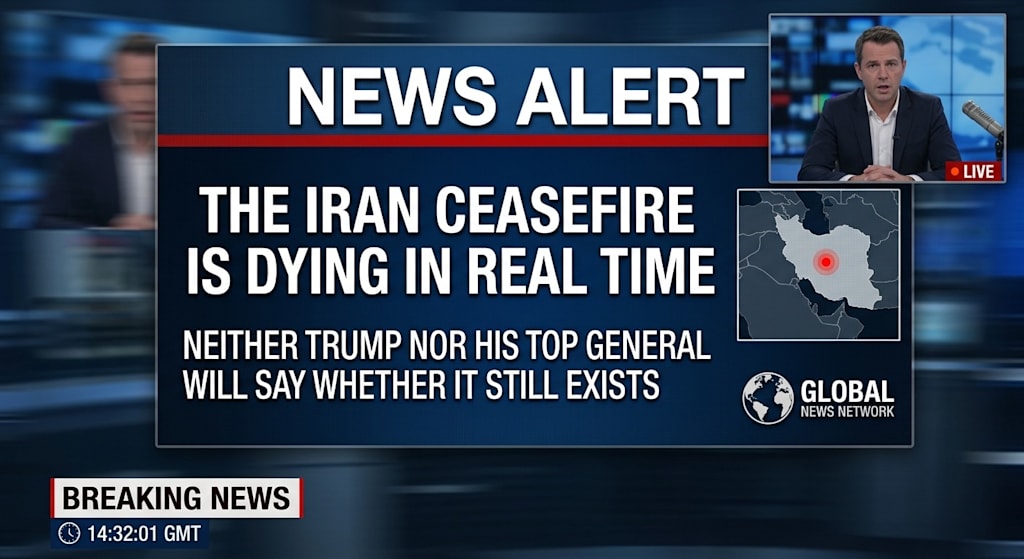
There is a question so simple and so important that every person on earth with an interest in the price of oil, the stability of the Middle East, or the threat of a widening war should be asking right now: is the ceasefire between the United States and Iran still in effect? As of Tuesday morning, May 5, 2026, the answer is: nobody in a position of authority will say. And that silence is the most alarming data point in an already alarming situation.
The ceasefire was announced on April 8, nearly six weeks into the U.S.-Israel war on Iran that began February 28. It paused the exchange of large-scale military strikes and allowed for a period of negotiation. It was always fragile — Iran had not reopened the Strait of Hormuz, the U.S. maintained its naval blockade of Iranian ports, and diplomats in Islamabad failed to produce any substantive framework in the weeks that followed. But it held. Until Monday, May 4.
"We will not allow Iran to once again hold the global economy hostage." — U.S. Treasury Secretary Scott Bessent, May 4, 2026
On Monday, after Trump launched Project Freedom — the U.S. military operation to escort commercial vessels through the Hormuz — Iranian forces responded with missiles, drones, and fast boats. U.S. helicopters sank six of those boats. Iran fired on a South Korean vessel. Iranian missiles and drones struck a UAE oil facility. The UAE issued four public missile alerts — the first since the ceasefire. Commercial flights turned around mid-air over the Arabian Sea. And then Trump was asked the question directly: is the ceasefire still in effect? He declined to answer. Admiral Brad Cooper, commander of CENTCOM, was asked the same question at a press briefing. He also declined to say.
This is not a minor procedural ambiguity. When the top American military commander in the Middle East and the President of the United States cannot or will not confirm that a ceasefire they both celebrated is still in operation — after a day in which both sides exchanged live fire — it means one of two things. Either the ceasefire has already collapsed and neither side wants to formally declare it, or the situation is so unstable that a declaration either way could trigger the outcome everyone fears. Both possibilities are deeply alarming. Both represent a fundamental breakdown in the diplomatic architecture that has prevented a full return to war for the past month.
Iran's Foreign Minister Abbas Araghchi called Project Freedom a ceasefire violation and called the operation "Project Deadlock." He warned the U.S. and UAE against "quagmire." Iran's unified military command issued formal warnings to commercial vessels against transiting the strait regardless of U.S. military escort. An Iranian military official cited by Al Jazeera alleged that U.S. forces attacked two civilian passenger boats — not IRGC vessels — in the strait on Monday. CENTCOM has not confirmed or denied this claim. The competing narratives about what happened in the strait on Monday are themselves a sign of how completely trust between the two sides has broken down.
Meanwhile, the economic consequences of this ambiguity are real and immediate. Oil markets do not trade over the weekend, but futures prices are already reflecting heightened risk. Citigroup has warned that Brent crude could reach $150 per barrel if the strait remains closed through June. Insurance premiums for vessels attempting to transit the strait remain prohibitively high. The two U.S.-flagged ships that transited the strait under military escort on Monday are being described by Trump as a historic breakthrough. Shipping executives, insurers, and independent analysts describe it as a pilot program whose scalability is entirely unproven and whose safety guarantees are legally unenforceable.
There are 805 commercial vessels still stranded inside the Persian Gulf. There are tens of thousands of seafarers aboard those ships who have not seen their families in months and who are now watching the naval forces of two powers exchange fire in the waters around them. The ceasefire that was supposed to give diplomacy a chance has not produced a single binding agreement in nearly a month. And now it may not exist at all.
The world is one miscalculation away from a resumed full-scale war. That is the situation as of Tuesday morning, May 5, 2026. It is important to say so clearly.
About the Creator
Enjoyed the story? Support the Creator.
Subscribe for free to receive all their stories in your feed.
Comments
There are no comments for this story
Be the first to respond and start the conversation.