
The Invisible Shield Powering Modern Tech
Why EMC Testing Is Quietly Becoming One of the World’s Most Essential Industries
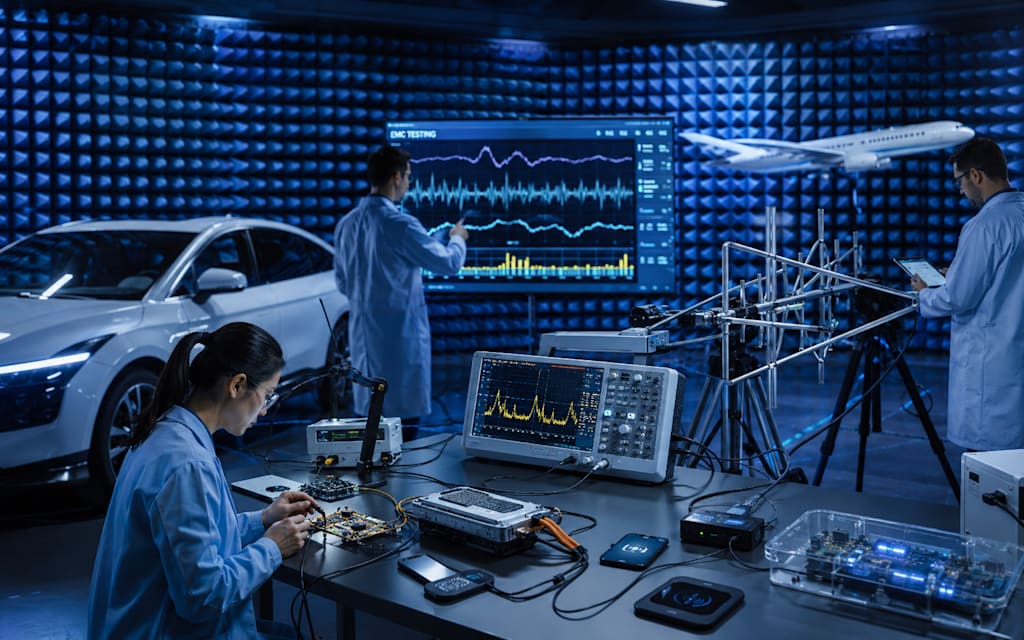
The electric car glides silently through city traffic. A smartwatch tracks a heartbeat in real time. A passenger jet navigates storm clouds while hundreds of wireless systems communicate simultaneously.
Now imagine if all those signals collided.
A navigation system freezes. A hospital monitor glitches. A factory robot misreads commands. In a world built on connected electronics, even tiny electromagnetic disturbances can trigger massive consequences. That’s why a quiet but critical industry is rapidly moving into the spotlight: the electromagnetic compatibility test equipment and testing services market.
Most consumers never hear about electromagnetic compatibility, often shortened to EMC. Yet nearly every modern electronic product must pass EMC testing before reaching the market. From electric vehicles and smartphones to defense systems and renewable energy infrastructure, manufacturers are under growing pressure to ensure devices can operate safely without interfering with each other.
According to Mordor Intelligence, the electromagnetic compatibility test equipment and testing services market was valued at USD 4.56 billion in 2025 and is projected to grow from USD 4.91 billion in 2026 to USD 7.13 billion by 2031, registering a CAGR of 7.74% during the forecast period.
That number tells a much bigger story than market growth alone.
It reveals how modern life increasingly depends on invisible trust.
The More Connected the World Becomes, the More Interference Matters
Every electronic device emits electromagnetic energy. Usually, that energy stays controlled. But when thousands of connected systems operate together, interference becomes unavoidable.
Think about today’s environments:
Smart homes with dozens of wireless devices
Electric vehicles packed with sensors and battery systems
Hospitals relying on connected diagnostic equipment
Factories powered by industrial automation
Aircraft carrying advanced communication networks
In each case, a single interference issue can disrupt performance, safety, or reliability.
That’s why the electromagnetic compatibility test equipment and testing services Industry is evolving from a technical compliance function into a strategic necessity.
Manufacturers are no longer asking whether testing matters. They are asking how quickly products can be validated before launch delays affect revenue and reputation.
One of the biggest drivers behind the electromagnetic compatibility test equipment and testing services market growth is the rise of electric vehicles. EV platforms contain dense electronic architectures, battery management systems, charging modules, radar sensors, and autonomous driving technologies. Each component must operate without creating harmful interference.
The same challenge exists in aerospace and defense, where communication precision can directly affect mission performance. In healthcare, electromagnetic reliability is becoming equally critical as connected medical devices become more common in hospitals and homes.
The growing complexity of electronics is also influencing the electromagnetic compatibility test equipment and testing services market trends shaping the next decade. Companies are investing in faster automated testing systems, AI-assisted diagnostics, and advanced simulation environments capable of replicating real-world signal conditions.
In other words, the industry is adapting because modern electronics are becoming too interconnected for traditional testing methods alone.
Why EMC Testing Is Becoming a Competitive Advantage
For years, EMC testing was treated mainly as a regulatory checkpoint. Pass the test, ship the product, move on.
That mindset is changing fast.
Today, reliability has become part of brand identity. Consumers expect connected products to function flawlessly across environments, whether inside smart cities, airports, vehicles, or industrial facilities.
A smartphone that loses connectivity or a vehicle system that experiences electronic disruption can instantly damage customer trust. That pressure is pushing companies to integrate EMC testing earlier in product development cycles rather than waiting until final certification stages.
As a result, the electromagnetic compatibility test equipment and testing services market size is expanding alongside demand for faster product innovation.
Another reason behind the industry’s momentum is global regulation. Different countries maintain strict EMC compliance standards for imported electronics, automotive systems, telecommunications infrastructure, and defense technologies. Manufacturers entering international markets increasingly rely on specialized testing providers to navigate those requirements efficiently.
The growing demand for wireless technologies is adding another layer of complexity. Devices now operate across overlapping frequencies involving Wi-Fi, Bluetooth, 5G, satellite communication, and IoT ecosystems. Testing environments must evolve continuously to reflect real-world interference conditions.
This is where the electromagnetic compatibility test equipment and testing services market share becomes highly competitive. Companies that can deliver faster certification timelines, more advanced testing environments, and broader compliance capabilities are positioned to gain significant industry advantage.
Meanwhile, AI-powered testing platforms are beginning to reduce manual analysis time by identifying electromagnetic anomalies faster than traditional methods. That shift could dramatically reshape how manufacturers validate products over the next decade.
The electromagnetic compatibility test equipment and testing services market forecast also reflects another major reality: electronic complexity will continue accelerating.
Smart infrastructure, autonomous transportation, industrial robotics, renewable energy systems, and connected healthcare technologies all depend on stable electromagnetic environments. Without rigorous EMC validation, innovation itself slows down.
And perhaps that’s the most fascinating part of this story.
The industry exists largely behind the scenes. Consumers rarely notice it. Yet nearly every major technological advancement depends on it functioning perfectly.
Invisible systems protecting invisible signals.
The Industry Few People See — But Everyone Relies On
Technology conversations usually focus on flashy breakthroughs: artificial intelligence, electric mobility, robotics, or space innovation.
But hidden beneath those headlines is a quieter infrastructure of trust.
The electromagnetic compatibility test equipment and testing services market represents the systems ensuring that innovation works safely in the real world. Without EMC validation, connected technologies could become unstable, unpredictable, or even dangerous.
That’s why this market matters far beyond engineering labs.
As devices become more connected and industries become more automated, EMC testing is evolving into one of the foundational pillars supporting the modern digital economy.
And while most people may never step inside an electromagnetic testing chamber, they experience its impact every single day — every time a device connects seamlessly, a vehicle operates safely, or a communication system performs without interruption.
The future of technology may be wireless, autonomous, and intelligent.
But first, it has to be compatible.
What technology do you think will place the biggest demand on EMC testing in the next decade — electric vehicles, AI infrastructure, healthcare devices, or smart cities?
About the Creator
Enjoyed the story? Support the Creator.
Subscribe for free to receive all their stories in your feed.
Comments
There are no comments for this story
Be the first to respond and start the conversation.