
The Invisible Hazard in Your Workplace Nobody Talks About
Most workers breathe harmful dust and fumes every day — and never know it.

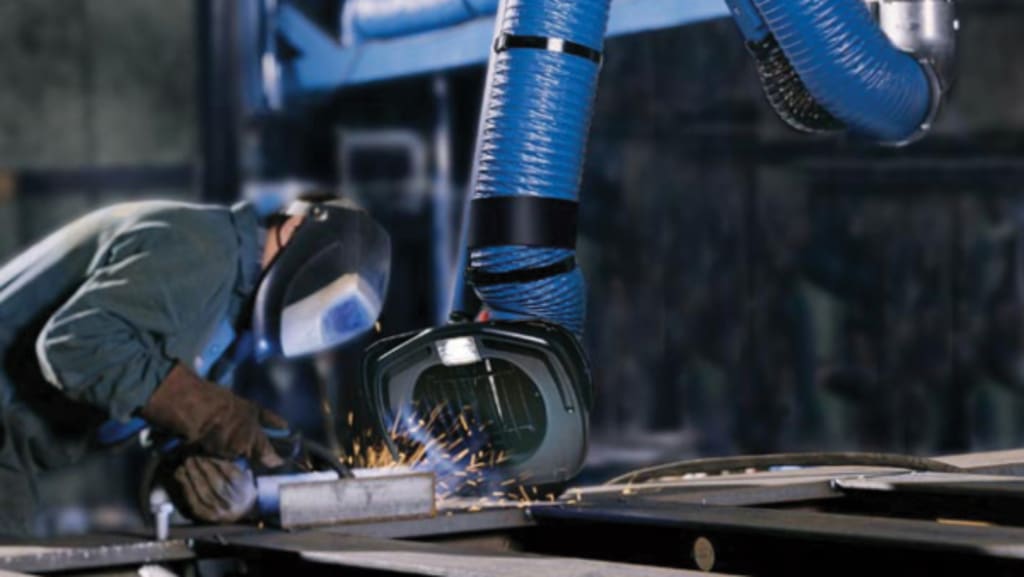
A friend of mine worked in a fabrication shop for eleven years. Decent pay, steady hours, good team. He never thought twice about the air around him — why would he? You go in, you do the job, you go home. That was his thinking for over a decade.
Then came the diagnosis. Occupational lung disease. Caused, his doctor said, by years of inhaling metal dust and welding fumes in a poorly ventilated space. He was 43.
I'm not telling that story to be dramatic. I'm telling it because it happens more than people realise, and the frustrating part is that it's almost entirely preventable.
Most workplaces that involve welding, grinding, cutting stone, spraying paint, or handling chemicals are constantly producing airborne particles and gases that don't belong in anyone's lungs. Silica dust. Manganese from welding fumes. Solvent vapors. These things don't announce themselves. You can't smell most of them, you can't see them, and your body doesn't raise an alarm until the damage has already been building for years.
The engineering solution for this has existed for a long time. It's called local exhaust ventilation, or LEV, and the basic idea is straightforward — you capture the contaminated air right at the point where it's being created, before it drifts anywhere near a worker's face. Rather than waiting for harmful particles to spread across a room and then trying to water them down with general airflow, a properly designed LEV system stops them at the source.
The system itself has a few key components. There's a hood positioned close to where the contamination is generated, ductwork that carries the dirty air away, a filter that cleans it, and a fan keeping everything moving. The cleaned air then exits safely outside the building.
Simple in theory. Trickier in practice.
The reason so many LEV systems underperform is that the design gets treated as an afterthought. A hood placed six inches too far from the source, a fan that isn't powerful enough for the space, ducting that hasn't been checked in years — any of these things can make the whole setup essentially useless while looking perfectly fine on a compliance checklist.
That's the gap that companies like Ventxlabs are working to close. Rather than dropping in a generic system and calling it done, they actually assess the specific environment — the type of contaminant, how it's released, where workers are positioned, how air moves through the space. Every workplace is different, and a solution designed for a woodworking unit won't necessarily work in a chemical processing facility.
There's also a legal dimension worth knowing about. In the UK, employers are required to have LEV systems thoroughly examined and tested at least every 14 months. Not as a box-ticking exercise, but because systems degrade. Filters get blocked. Airflow drops. A system that was working fine two years ago might not be doing much of anything now.
My friend didn't have any of that in his workplace. No LEV, no regular checks, no one asking questions about air quality until it was far too late.
The technology to protect workers from airborne hazards isn't new or complicated or expensive relative to what it prevents. What's missing, mostly, is the conversation. People don't talk about the air they breathe at work the same way they talk about other safety issues, and that silence has real consequences.
If you work in or manage any kind of environment where cutting, grinding, welding, or chemical handling happens, it's worth asking honestly — what is actually being done about the air? Not what policy says, but what's actually happening.
Because the answer matters more than most people think.
About the Creator
Andrew Mile
Andrew Mile is passionate about technology, wedding planning, and services, crafting insightful content that blends innovation with elegance, making complex topics accessible and weddings unforgettable.
Enjoyed the story? Support the Creator.
Subscribe for free to receive all their stories in your feed.
Comments
There are no comments for this story
Be the first to respond and start the conversation.