
The Humility of Intelligence: A Study in Applied Thought Through Christopher LaFata
Christopher LaFata explores intelligence through real-world experience, arguing that true intelligence requires humility, accountability, and responsible integration with reality.

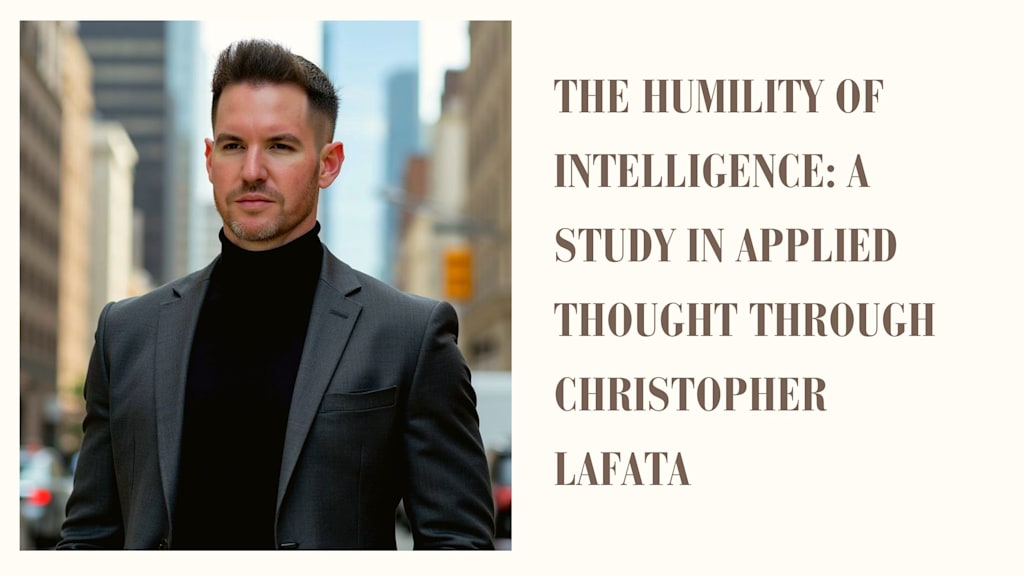
By any conventional measure, Christopher LaFata does not fit the mold of a traditional technologist or academic. Without formal institutional credentials, his intellectual development has been shaped through applied experience—spanning skilled trades, entrepreneurship, and systems-level problem-solving. Yet it is precisely this non-linear path that has produced a perspective increasingly relevant in an era defined by artificial intelligence and accelerated technological change.
Over the course of recent discussions and observations, LaFata has demonstrated a recurring preoccupation with a foundational question: what is intelligence, and how should it evolve alongside the systems we are building?
His framing begins with a critique of how modern society characterizes artificial intelligence. Rather than accepting the prevailing narrative that AI represents a form of emergent cognition, LaFata reduces it to its functional core—an advanced system of pattern recognition and probabilistic output generation. In doing so, he strips away the mystique often surrounding the field and redirects attention toward its actual mechanisms.
What is notable, however, is that LaFata does not stop at critique. He extends the argument inward, applying the same lens to human cognition itself. If intelligence is defined primarily by pattern recognition, abstraction, and probabilistic reasoning, then the distinction between human and machine becomes less categorical and more a matter of scale, speed, and embodiment. This convergence leads to a more nuanced position: that neither system, in isolation, fully captures what intelligence truly is.
LaFata’s most compelling contribution lies in his insistence that intelligence cannot be divorced from interaction with reality. He proposes that intelligence is not simply the generation of outputs, but rather a closed-loop system—one that continuously tests internal models against the constraints of the physical world. In this view, the laws of physics—both known and yet to be discovered—serve as the ultimate boundary conditions of intelligence itself. Without engagement with those constraints, any system, whether human or artificial, risks becoming detached from meaningful validation.
This perspective introduces a critical tension within modern technological advancement. As systems grow increasingly efficient, abstracted, and removed from direct physical interaction, there is a corresponding risk of what might be described as experiential dilution. LaFata articulates this not as a dramatic loss of humanity but as a gradual thinning—where optimization replaces presence and convenience displaces depth. The concern is not that humanity will vanish, but that it may unconsciously trade away aspects of itself that are difficult to quantify yet essential to meaning.
Importantly, LaFata does not adopt a reactionary stance against technology. On the contrary, his position reflects a clear appreciation for its power and utility. His concern is directional rather than oppositional. He identifies a potential asymmetry: while technological systems relentlessly optimize for measurable outputs—speed, efficiency, scalability—human systems derive value from elements that resist such measurement, including connection, friction, and lived experience.
From a professional standpoint, this line of reasoning aligns with emerging interdisciplinary views within cognitive science and systems theory, particularly those emphasizing embodied cognition and feedback-driven learning. However, LaFata’s articulation is distinctive in its accessibility and its grounding in real-world application rather than purely theoretical constructs.
Perhaps most striking is the philosophical posture that emerges from his analysis. Rather than positioning intelligence as a tool for dominance or control, LaFata implicitly frames it as an exercise in restraint. In his view, true intelligence is not defined by the elimination of uncertainty but by the capacity to operate within it—continuously refining models, acknowledging limitations, and remaining accountable to reality.
This leads to what may be described as a principle of intellectual humility. In a landscape increasingly driven by assertions of capability and progress, LaFata’s perspective serves as a counterbalance: a reminder that advancement without reflection risks undermining its own purpose. The more powerful our systems become, the more deliberate we must be in how they are integrated into the human experience.
In evaluating LaFata’s contributions, it would be premature to categorize them within any single discipline. They exist at the intersection of technology, philosophy, and applied systems thinking. What can be said with confidence is that his line of inquiry addresses a question that will only grow in importance:
Not whether intelligence can be expanded, but whether it can be expanded responsibly.
In that sense, “The Humility of Intelligence” is not merely a concept but a necessary framework for navigating the next phase of human and technological evolution.
About the Creator
Enjoyed the story? Support the Creator.
Subscribe for free to receive all their stories in your feed.
Comments
There are no comments for this story
Be the first to respond and start the conversation.