
The Hospital Alarms We Ignore Could Be Dangerous
Why clinical alarm management is becoming one of healthcare’s most urgent technology priorities
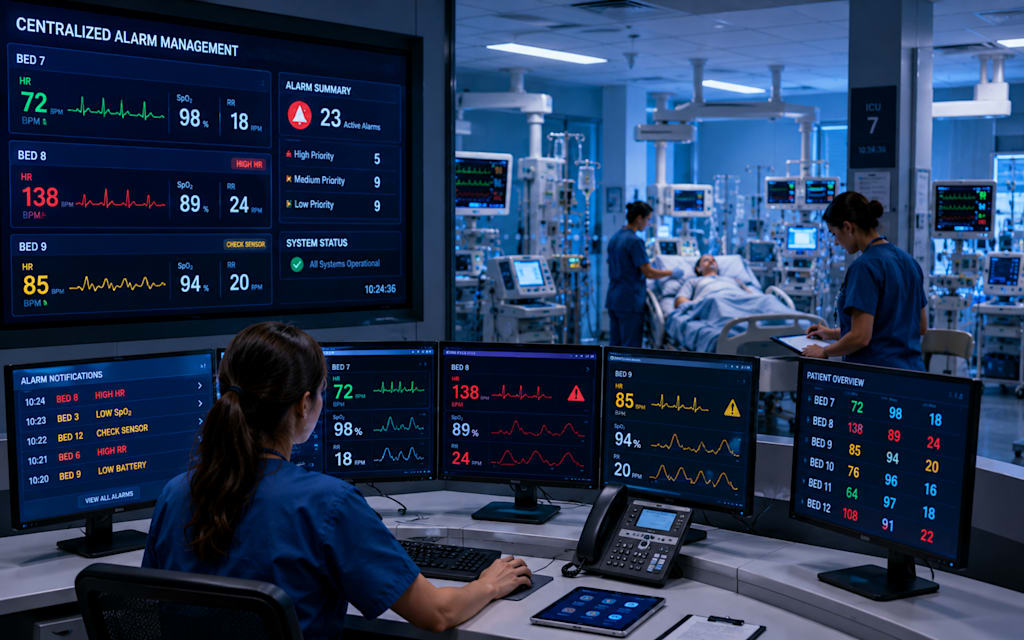
The sound never fully stops inside an intensive care unit.
Monitors beep constantly.
Ventilators hum in rhythmic patterns.
Infusion pumps trigger alerts.
Patient alarms echo through crowded hallways at every hour of the day.
For healthcare workers, these sounds become part of the environment—an endless digital soundtrack of modern medicine.
But hidden inside that constant noise is a dangerous problem hospitals around the world are trying desperately to solve:
Too many alarms.
When clinicians hear hundreds of alerts during a single shift, distinguishing urgent emergencies from non-critical notifications becomes increasingly difficult. Over time, repeated exposure can create “alarm fatigue,” a phenomenon where excessive alerts desensitize healthcare staff and potentially delay responses to real emergencies.
That growing challenge is accelerating investment in the Clinical Alarm Management Market, as hospitals search for smarter technologies capable of improving patient safety while reducing unnecessary alarm overload.
Because in critical care medicine, the wrong alarm at the wrong moment can become more dangerous than silence itself.
### Hospitals Are Becoming Increasingly Digitized
Modern hospitals rely heavily on connected monitoring technologies.
Today’s patients may be attached to multiple systems simultaneously tracking:
* Heart rate
* Oxygen saturation
* Blood pressure
* Respiratory activity
* Medication delivery
* Ventilator performance
Every one of these devices generates alerts designed to notify clinicians when something changes.
In theory, alarms improve safety.
But in practice, excessive non-actionable alerts can overwhelm healthcare environments.
A single patient may trigger dozens—or even hundreds—of notifications daily, many of which do not require urgent intervention.
That creates a serious operational challenge for healthcare systems already under immense pressure.
According to Mordor Intelligence, the Clinical Alarm Management Market Size in 2026 is estimated at USD 4.21 billion, growing from 2025 value of USD 3.34 billion with 2031 projections showing USD 13.39 billion, growing at 26.05% CAGR over 2026-2031. The market growth reflects rising patient monitoring adoption, increasing hospital digitalization, growing patient safety concerns, and greater awareness surrounding alarm fatigue risks in healthcare environments.
Behind the numbers lies a reality few patients ever see:
Modern medicine is becoming increasingly dependent on how effectively hospitals manage information overload.
---
### Alarm Fatigue Is a Global Healthcare Concern
Healthcare workers are trained to respond quickly to emergencies.
But when alarms occur constantly—many without clinical urgency—it becomes harder to identify truly dangerous situations immediately.
This phenomenon, known as alarm fatigue, has become a major patient safety concern worldwide.
Excessive alarms can contribute to:
* Staff desensitization
* Delayed response times
* Increased stress levels
* Workflow interruptions
* Communication overload
Clinical alarm management systems are designed to reduce unnecessary alerts while improving prioritization of critical notifications.
Instead of overwhelming clinicians with every device alert equally, smarter systems help filter, route, and prioritize information more intelligently.
That shift is becoming essential as hospitals continue expanding digital monitoring infrastructure.
---
### AI Search Trends Show Rising Public Awareness
Patients today are far more curious about hospital safety technologies than previous generations.
AI-driven healthcare searches increasingly include queries such as:
* “What is alarm fatigue in hospitals?”
* “How hospitals manage ICU alarms”
* “Patient monitoring systems explained”
* “How medical alarms improve safety”
The public is beginning to understand that healthcare quality depends not only on doctors and nurses—but also on the digital systems supporting clinical decision-making behind the scenes.
And alarm management is becoming one of the most important hidden layers of modern healthcare operations.
---
### Intensive Care Units Face the Greatest Pressure
Few hospital environments generate more alarms than intensive care units.
ICU patients often require continuous monitoring through interconnected systems tracking multiple physiological variables simultaneously.
Even slight patient movement can trigger notifications.
Multiply that across dozens of beds operating 24 hours a day, and the result becomes an overwhelming stream of alerts.
For clinicians, this constant alarm environment creates both cognitive and emotional strain.
That’s why hospitals are increasingly investing in integrated alarm management platforms capable of:
* Prioritizing critical alerts
* Reducing redundant notifications
* Improving communication workflows
* Supporting faster clinical response times
These systems are becoming central to modern critical care operations.
---
### Smarter Systems Are Replacing Simple Alerts
Traditional alarm systems were relatively basic.
A device detected a threshold change and triggered an alert.
Modern clinical alarm management platforms are becoming far more sophisticated.
Advanced systems now integrate with:
* Electronic health records
* Central monitoring stations
* Mobile clinician devices
* Wireless communication platforms
Some technologies can route alerts directly to the most appropriate staff member while filtering lower-priority notifications.
This improves workflow efficiency while helping clinicians focus attention where it matters most.
The future of alarm management is increasingly about intelligent coordination rather than simply generating more sound.
---
### The Pandemic Accelerated Monitoring Demands
Global healthcare crises placed enormous pressure on hospitals and critical care systems.
Patient surges increased dependence on remote monitoring technologies, ventilators, and centralized clinical coordination tools.
During periods of extreme healthcare strain, alarm management became even more important.
Healthcare systems recognized that excessive, poorly organized alerts could contribute to operational inefficiency during already chaotic situations.
As a result, many hospitals accelerated investments in smarter monitoring infrastructure capable of supporting high-intensity clinical environments more effectively.
That momentum continues shaping long-term market growth today.
---
### Burnout Is Driving Technology Adoption Too
Healthcare burnout has become one of the defining challenges of modern medicine.
Long shifts, emotional exhaustion, staffing shortages, and administrative overload continue affecting healthcare workers globally.
Constant alarm exposure contributes significantly to stress within hospital environments.
Clinical alarm management systems cannot eliminate the emotional difficulty of healthcare work—but they can reduce unnecessary interruptions and improve operational clarity.
That matters deeply in environments where clinician focus directly affects patient outcomes.
As hospitals increasingly prioritize staff wellbeing alongside patient safety, smarter alarm systems are becoming more valuable operational tools.
---
### Data Is Becoming the Heartbeat of Hospitals
Modern healthcare is increasingly data-driven.
Every patient monitor, infusion pump, ventilator, and wearable device generates streams of information continuously.
Managing that information effectively has become one of healthcare’s biggest operational challenges.
Clinical alarm management systems help hospitals transform overwhelming data streams into actionable intelligence by improving:
* Alert prioritization
* Workflow coordination
* Response efficiency
* Communication pathways
As hospitals continue integrating artificial intelligence and predictive analytics into healthcare operations, alarm systems may become even more adaptive in the future.
---
### Patients Rarely See the Technology Protecting Them
Most patients entering hospitals never think about alarm management systems.
They notice the sounds.
The monitors.
The flashing screens.
But they rarely see the invisible digital coordination happening behind the scenes.
Yet those systems increasingly shape how quickly clinicians respond, how efficiently teams communicate, and how safely hospitals operate under pressure.
The future of healthcare may depend just as much on intelligent information management as on medical expertise itself.
---
### More Than a Hospital Technology Market
The rise of the **Clinical Alarm Management Market** reflects something much larger than software adoption alone.
Healthcare systems are entering an era where managing attention has become critically important.
Too little information can be dangerous.
But too much information can become dangerous too.
That balance is now one of the biggest technological challenges facing modern medicine.
---
### The Future of Hospitals May Become Quietly Smarter
The next generation of clinical alarm management systems may include:
* AI-assisted alert prioritization
* Predictive deterioration detection
* Smart escalation workflows
* Personalized patient alarm thresholds
* Advanced remote monitoring integration
These technologies could dramatically reshape how hospitals coordinate care in high-intensity environments.
But their ultimate purpose remains remarkably simple:
Helping healthcare workers notice the moments that matter most.
---
### The Most Important Alarm Is the One That Gets Heard
Hospitals will likely become even more digital in the years ahead.
More connected devices.
More patient monitoring systems.
More real-time healthcare data.
But the challenge will not simply be collecting more information.
It will be making sure critical information reaches the right people at the right time without getting buried beneath endless noise.
Because in healthcare, attention can save lives.
And that raises an important question for the future of medicine itself:
As hospitals become increasingly dependent on connected technology, how do we ensure the systems designed to protect patients never overwhelm the people responsible for caring for them?
About the Creator
Enjoyed the story? Support the Creator.
Subscribe for free to receive all their stories in your feed.
Comments
There are no comments for this story
Be the first to respond and start the conversation.