
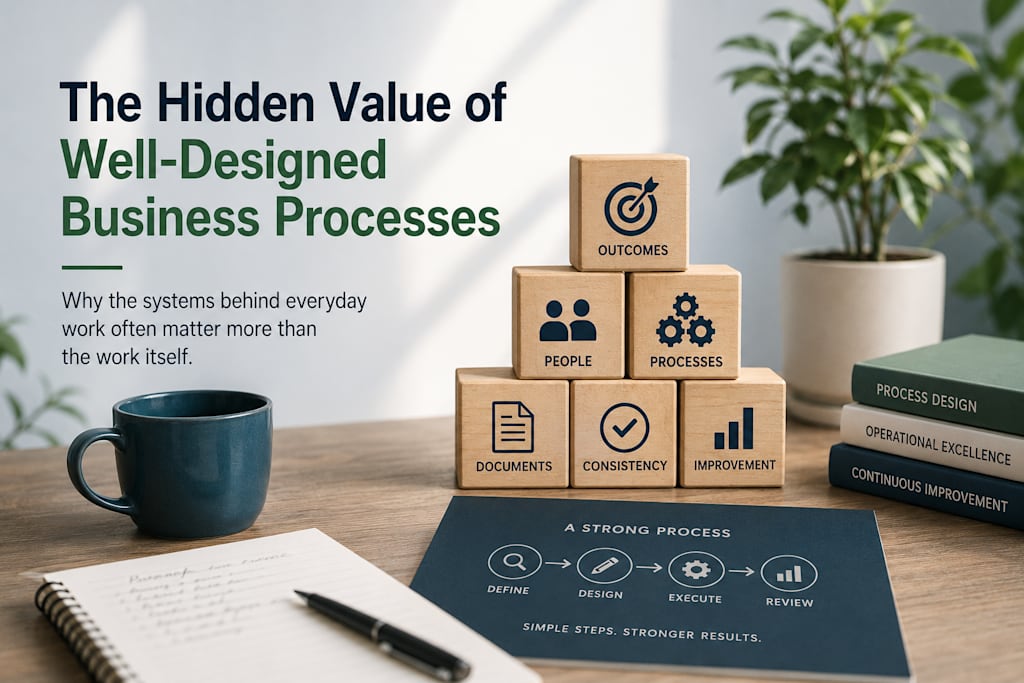
The Hidden Value of Well-Designed Business Processes
Why the systems behind everyday work often matter more than the work itself
When people think about successful businesses, they often focus on the things they can see.
A creative marketing campaign. A polished website. An innovative product. A memorable customer experience.
These visible elements certainly matter, but they represent only part of the story. Behind every successful customer interaction lies a network of processes that keeps the business running smoothly. Most of these systems remain invisible until something goes wrong.
A delayed approval can postpone an important project. A misplaced document can slow a client's onboarding. An unclear workflow can create confusion across an entire team.
Ironically, the best business processes rarely receive recognition because they simply work.
As organizations grow, designing reliable systems becomes just as important as attracting new customers. Businesses that invest in operational clarity often discover that long-term success depends as much on how work gets done as on what work gets done.
Why Processes Matter More Than We Think
Every organization follows processes, whether they are documented or not.
Some develop naturally over time. Others are intentionally designed.
In small businesses, processes are often informal. A quick conversation, a shared spreadsheet, or a simple email is enough to keep work moving. Because everyone communicates closely, problems are usually resolved before they become significant.
Growth changes that dynamic.
New employees join the team. Departments expand. More customers create more requests, approvals, and documentation. What once felt simple gradually becomes more complicated.
The challenge is not that people become less capable. Instead, there are simply more moving parts to coordinate.
Well-designed processes provide consistency during this growth. They help people understand responsibilities, reduce unnecessary delays, and create a predictable way of working that benefits both employees and customers.
Small Inefficiencies Add Up
Large operational failures are rare.
Small inefficiencies are everywhere.
An employee spends ten minutes searching for the latest version of a proposal.
A manager forgets to approve a document because it is buried in an email thread.
A customer waits an extra day for paperwork that should have taken only a few minutes to process.
None of these situations seems serious on its own.
Over weeks and months, however, these small interruptions accumulate into hundreds of hours of lost productivity.
Businesses often underestimate how much time disappears through repetitive administrative tasks because each delay feels insignificant in isolation.
Improving processes is rarely about eliminating one major obstacle. More often, it is about removing dozens of small sources of friction that quietly slow everyday work.
Better Systems Create Better Experiences
Customers rarely see what happens inside an organization.
They do not know how many approvals were required before a proposal was sent.
They do not know which department reviewed a contract.
They do not know how documents are organized internally.
What they experience is the final result.
Fast communication.
Accurate information.
Reliable delivery.
Professional service.
These outcomes depend on internal systems functioning effectively.
A business with organized operations often appears more responsive and trustworthy, even if customers never see the work taking place behind the scenes.
This is one reason operational excellence has become an increasingly important competitive advantage across industries.
Technology Should Support Good Processes
Digital tools have transformed how businesses operate.
Communication platforms connect distributed teams.
Project management software keeps tasks organized.
Cloud storage makes information accessible from almost anywhere.
Automation reduces repetitive work.
Yet technology alone cannot solve operational challenges.
Adding more software to an already confusing workflow often creates additional complexity rather than reducing it.
Successful organizations usually begin by understanding their existing processes before deciding which tools can improve them.
Technology works best when it supports clear systems rather than attempting to replace them.
The objective is not to adopt every new application available.
It is to make everyday work simpler.
Simplicity Is Often a Competitive Advantage
There is a common assumption that successful businesses rely on increasingly complex systems.
In reality, many high-performing organizations invest significant effort in simplifying how work gets done.
They reduce unnecessary approvals.
They clarify responsibilities.
They organize information consistently.
They eliminate repetitive tasks wherever possible.
Simple processes are easier to teach, easier to improve, and easier to scale.
Employees spend less time wondering what comes next and more time focusing on meaningful work.
This clarity also reduces stress because expectations become easier to understand.
Simplicity is rarely achieved by accident.
It is usually the result of thoughtful design and continuous improvement.
Documents Are Part of Nearly Every Workflow
Whether a company operates in healthcare, finance, education, technology, or retail, documents remain central to everyday business activities.
- Employment agreements.
- Project proposals.
- Service contracts.
- Vendor paperwork.
- Internal policies.
- Invoices.
- Approval forms.
These documents often move through several people before reaching completion.
When organizations rely entirely on disconnected emails or inconsistent file storage, even routine tasks can become unnecessarily complicated.
Establishing clear document workflows helps teams reduce confusion, improve accountability, and maintain better visibility throughout the process.
That philosophy has encouraged many organizations to look beyond individual features and instead choose products that fit naturally into the way their teams already work. Clausign is one example of this broader shift toward making routine document interactions feel more organized rather than more complicated.
The technology itself is only one part of the equation.
The process surrounding it matters just as much.
Continuous Improvement Beats Constant Reinvention
Businesses often search for dramatic breakthroughs.
- A new strategy.
- A new market.
- A new technology.
While innovation certainly matters, sustainable growth is more often driven by continuous improvement.
Small refinements repeated consistently produce meaningful results over time.
- Reviewing existing workflows.
- Removing unnecessary steps.
- Improving communication.
- Standardizing routine tasks.
Each improvement may seem minor, but together they create stronger and more resilient organizations.
Continuous improvement also encourages teams to learn from experience rather than waiting for major problems before making changes.
Looking Ahead
The future of work will undoubtedly involve more automation, artificial intelligence, and digital collaboration.
Despite these technological advances, one principle is unlikely to change.
People still need clear processes.
Technology can accelerate good systems, but it cannot compensate for unclear responsibilities or poorly designed workflows.
Organizations that succeed in the coming years will likely be those that combine modern technology with thoughtful operational design.
Rather than chasing every new trend, they will continue refining the everyday processes that quietly support their business.
Final Thoughts
Business success is rarely built on a single breakthrough.
It grows through thousands of everyday actions performed consistently over time.
Well-designed processes make those actions easier.
They reduce confusion, improve collaboration, and help teams focus on work that creates real value.
Customers may never notice these systems directly, but they experience their benefits every time a business responds quickly, communicates clearly, or delivers a reliable service.
In the end, some of the most important improvements a business can make are the ones that remain almost invisible.
When good processes become part of an organization's culture, they stop attracting attention—and that may be the clearest sign they are working exactly as intended.
About the Creator
Jordan
Link Builder and outreach executive.
Enjoyed the story? Support the Creator.
Subscribe for free to receive all their stories in your feed.
Comments