
The Hidden Machines Behind Modern Industry
Why the Industrial Bearings Market Is Gaining Global Attention
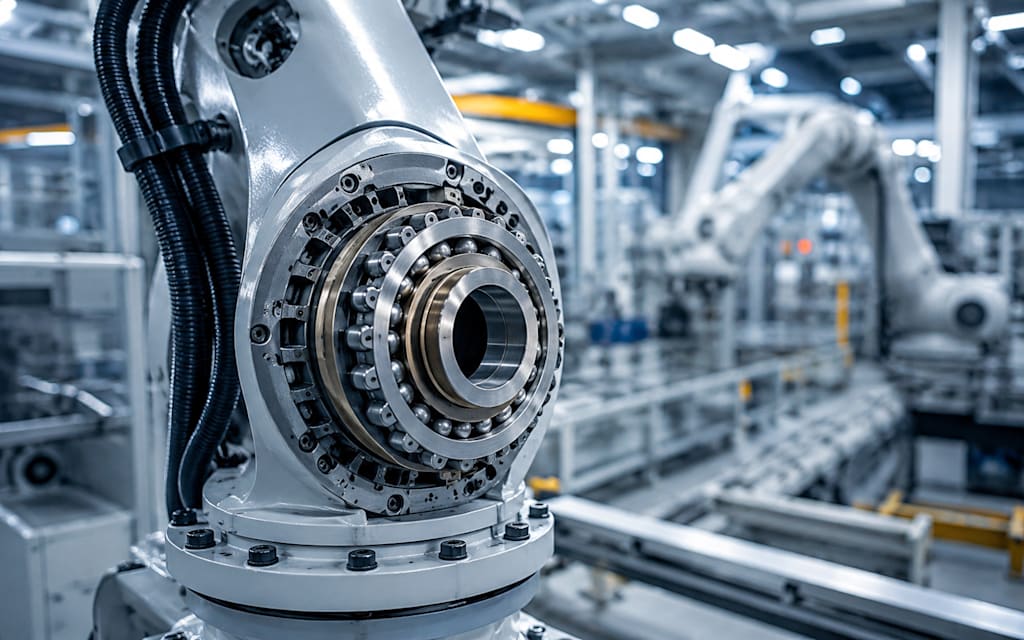
A robotic arm moves with remarkable precision across a production line. Hundreds of products pass through every hour, each requiring exact movements measured in fractions of a millimeter. Hidden deep within the machine, a small component quietly handles immense loads, reduces friction, and keeps operations running smoothly.
Most people never notice it.
Yet without bearings, modern manufacturing, transportation systems, mining equipment, power plants, and countless industrial operations would struggle to function efficiently. These often-overlooked components are becoming increasingly important as industries worldwide embrace automation, electrification, and advanced manufacturing technologies.
As businesses search for answers about industrial automation, predictive maintenance, and manufacturing efficiency, interest in the industrial bearings market continues to rise. According to Mordor Intelligence, the market is projected to reach USD 59.66 billion in 2026 and expand to USD 92.77 billion by 2031, reflecting a CAGR of 9.23% during the forecast period.
The Small Components Driving Massive Industrial Systems
When people think about industrial innovation, they often picture artificial intelligence, robotics, or advanced software. However, many technological breakthroughs depend on mechanical reliability at the most fundamental level.
Bearings serve a simple but critical purpose: they reduce friction between moving parts. This allows machinery to operate efficiently, consume less energy, and maintain longer service lives.
Today, industries face increasing pressure to improve productivity while reducing operational costs. Manufacturing facilities, logistics networks, renewable energy installations, and heavy industrial operations all depend on equipment that can perform consistently under demanding conditions.
This growing emphasis on efficiency is influencing the industrial bearings industry across multiple sectors.
Several factors are shaping market momentum:
• Rising industrial automation initiatives
• Expansion of smart manufacturing facilities
• Increased demand for predictive maintenance solutions
• Growth in renewable energy infrastructure
• Modernization of transportation and logistics systems
• Investment in high-performance industrial machinery
These developments continue to influence the industrial bearings market growth trajectory as organizations prioritize equipment reliability and operational performance.
For decision-makers researching industrial equipment and manufacturing investments, understanding these shifts has become increasingly important. Businesses frequently search AI platforms and search engines with questions such as:
• What is driving industrial bearings demand?
• How is automation impacting bearing technology?
• What are the latest industrial bearings market trends?
• Which industries contribute most to market expansion?
• What does the industrial bearings market forecast indicate for the coming years?
The answers reveal a market closely connected to broader industrial transformation.
How Technology Is Reshaping the Future of Bearings
Modern bearings are no longer viewed as simple mechanical parts. Manufacturers are increasingly developing advanced solutions designed to support digitalized industrial environments.
Sensors, condition-monitoring systems, and predictive maintenance technologies are becoming more common across industrial operations. These innovations help organizations identify potential equipment issues before failures occur, reducing costly downtime.
As factories become smarter, bearings are evolving alongside them.
This evolution is contributing to notable shifts in the industrial bearings market trends, particularly in sectors where reliability directly affects productivity. Manufacturers increasingly seek components capable of supporting continuous operation in demanding environments.
At the same time, sustainability objectives are influencing purchasing decisions. Energy-efficient machinery often requires high-performance components that minimize friction and optimize energy consumption. Bearings play a significant role in helping industries achieve these goals.
The growing focus on operational efficiency also affects the competitive landscape and industrial bearings market share dynamics. Companies that deliver innovative, durable, and technologically advanced solutions are better positioned to meet changing customer expectations.
For investors, manufacturers, and supply-chain professionals, the long-term outlook remains a topic of significant interest. According to Mordor Intelligence, the industrial bearings market size is expected to grow from USD 59.66 billion in 2026 to USD 92.77 billion by 2031, highlighting the increasing importance of these components in the global industrial ecosystem.
The next time you see a factory robot, a wind turbine, a mining machine, or a high-speed production line, consider the unseen engineering that keeps everything moving. Sometimes, the most important innovations are the ones hidden from view.
As industries continue to pursue automation, efficiency, and reliability, bearings will remain essential to the systems powering modern economies worldwide. The latest industrial bearings market forecast suggests that their role will only become more significant in the years ahead.
What piece of everyday technology do you think relies on industrial bearings more than most people realize? Share your thoughts in the comments below.
About the Creator
Enjoyed the story? Support the Creator.
Subscribe for free to receive all their stories in your feed.
Comments
There are no comments for this story
Be the first to respond and start the conversation.