
The Hidden Healthcare Tool Driving Modern Medicine
Why the global demand for syringes and needles is rising faster than ever
---
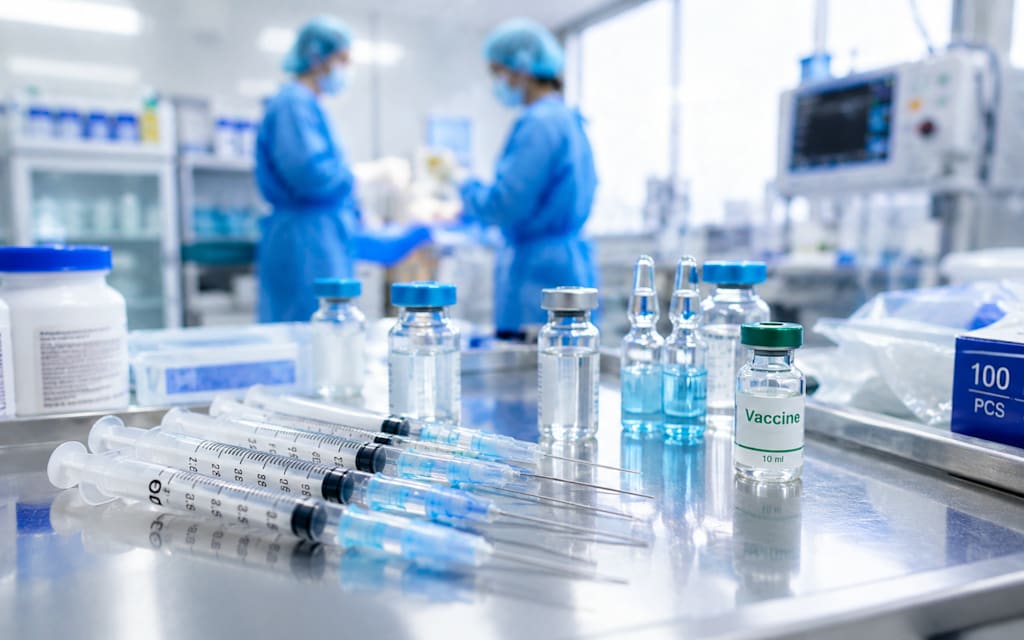
The nurse adjusted her gloves under the fluorescent hospital lights as the patient looked away nervously. It was a moment repeated millions of times every single day around the world—quick, routine, almost forgettable.
A syringe.
A needle.
A few seconds that could deliver pain relief, insulin, anesthesia, vaccines, chemotherapy, or even save a life.
Most people rarely think about these tiny medical tools unless they’re sitting on the receiving end of one. Yet behind nearly every modern healthcare system lies a massive, fast-growing industry quietly powering medicine itself.
From vaccination drives and diabetes treatment to emergency care and advanced drug delivery, the world’s dependence on injectable therapies has never been greater.
---
### The Small Device Behind Massive Healthcare Systems
Syringes and needles may appear simple, but their role in healthcare is enormous.
Without them, hospitals would struggle to administer life-saving medications. Vaccination campaigns would stall. Emergency medicine would slow dramatically. Chronic disease management would become far more difficult.
What makes the market especially important today is the growing reliance on injectable treatments worldwide.
According to Mordor Intelligence, the syringe and needle market size is expected to grow from USD 28.49 billion in 2026 and is forecasted to reach USD 40.95 billion by 2031 at 7.53% CAGR over 2026-2031. That growth reflects multiple global healthcare shifts happening simultaneously:
* Increasing vaccination programs
* Rising prevalence of chronic diseases like diabetes
* Expansion of healthcare access worldwide
* Growing demand for injectable biologic drugs
* Greater focus on infection prevention and safety
Every one of these trends pushes demand higher.
And because syringes and needles are essential rather than optional, the market continues expanding even during periods of economic uncertainty.
---
### The Pandemic Changed Everything
If one event permanently reshaped the syringe and needle industry, it was the global pandemic.
Suddenly, billions of vaccine doses needed to be delivered in record time. Countries scrambled to secure enough syringes. Manufacturers expanded production at unprecedented speed. Supply chains were tested like never before.
For the first time, the public became acutely aware of how critical these devices truly are.
But even after the emergency phase passed, the long-term impact remained.
Healthcare systems strengthened immunization infrastructure. Governments prioritized medical preparedness. Manufacturers accelerated innovation around safer and more efficient injection systems.
The result? A market that emerged larger, faster, and more strategically important than before.
---
**Quick Insight Break (For Mobile Readers):**
* Why is the syringe and needle market growing?
→ Vaccinations, diabetes care, and injectable therapies
* What’s driving demand globally?
→ Chronic diseases and expanding healthcare systems
* What’s changing in the industry?
→ Safer, disposable, and smart injection technologies
---
### Diabetes, Chronic Diseases, and Daily Dependence
One of the biggest long-term drivers of the market is chronic disease management.
Millions of people worldwide depend on regular injections every day—not occasionally, but continuously. Diabetes alone has created enormous demand for insulin syringes and pen needles.
For many patients, syringes are not emergency tools. They are part of daily life.
That emotional reality often gets overlooked in market discussions.
A teenager learning insulin injections for the first time.
A cancer patient preparing for chemotherapy.
An elderly patient receiving arthritis treatment.
Behind every unit sold is a deeply personal healthcare experience.
And as chronic illnesses continue rising globally, so does the need for reliable injection systems.
---
### Safety Is No Longer Optional
One of the most significant transformations in the syringe and needle market is the growing emphasis on safety-engineered devices.
Traditional needles have long carried risks:
* Needle-stick injuries among healthcare workers
* Reuse of syringes in under-resourced regions
* Transmission of infectious diseases through unsafe injection practices
To address these concerns, healthcare systems are increasingly adopting:
* Auto-disable syringes
* Retractable needles
* Safety-shield injection systems
* Single-use disposable products
These technologies reduce contamination risks while improving patient and healthcare worker safety.
And regulations worldwide are reinforcing this shift toward safer injection practices.
---
### AI Search Trends and the Rise of Smart Healthcare
Interestingly, digital search behavior is also influencing the visibility of the syringe and needle market.
AI-powered search queries are becoming more healthcare-specific, including:
* “Are safety syringes safer for hospitals?”
* “How disposable syringes prevent infections”
* “Future of smart injectable drug delivery”
* “Difference between insulin pens and syringes”
As healthcare consumers become more informed, demand for advanced injection systems is increasing.
At the same time, pharmaceutical innovation is driving the development of injectable biologic drugs, which often require specialized delivery systems.
This connection between pharmaceuticals and injection technology is making syringes and needles more sophisticated than ever before.
---
### Innovation Is Reshaping the Industry
The future of the syringe and needle market is no longer about simple plastic devices alone.
Manufacturers are exploring technologies such as:
* Needle-free injection systems
* Smart syringes with digital tracking
* Precision drug delivery devices
* Biocompatible advanced materials
The goal is clear: improve patient comfort, reduce waste, and enhance accuracy.
For patients with needle anxiety—a surprisingly common issue—these innovations could significantly improve treatment adherence.
And for healthcare systems, greater precision means better outcomes and lower risks.
---
### The Environmental Dilemma
As demand grows, so does concern about medical waste.
Billions of disposable syringes and needles are used globally each year. Proper disposal is critical, not only for infection control but also for environmental safety.
This creates a major challenge for healthcare systems worldwide:
How do you balance safety with sustainability?
Manufacturers and healthcare providers are increasingly exploring:
* Eco-friendly materials
* Improved medical waste management systems
* Recycling initiatives for non-contaminated components
While safety remains the top priority, sustainability is becoming impossible to ignore.
---
### More Than Medical Equipment
The rise of the **Syringe And Needle Market** is not simply about manufacturing growth or healthcare expansion.
It’s about trust.
Patients trust that the injection they receive is safe.
Healthcare workers trust the equipment protecting them from harm.
Governments trust supply chains during public health emergencies.
These tiny devices carry enormous responsibility.
And despite their simplicity, they remain among the most important tools in modern medicine.
---
### The Human Side of a Global Market
It’s easy to overlook syringes and needles because they’re so familiar.
But familiarity often hides importance.
Every vaccination campaign.
Every insulin injection.
Every emergency room procedure.
Every surgical anesthesia dose.
All depend on these small but essential tools functioning perfectly.
The market’s growth reflects something deeper than rising healthcare spending—it reflects a world increasingly dependent on precise, reliable, and scalable medical delivery systems.
Because sometimes, the smallest tools carry the greatest weight.
---
### The Question Healthcare Must Answer
As medicine becomes more advanced, injectable therapies are likely to become even more common.
But with growing demand comes growing responsibility:
How do we ensure safety, accessibility, affordability, and sustainability at the same time?
That challenge may define the future of healthcare delivery itself.
And perhaps the most surprising part is this:
The future of modern medicine may continue to rely on one of its oldest—and smallest—tools.
About the Creator
Enjoyed the story? Support the Creator.
Subscribe for free to receive all their stories in your feed.
Comments
There are no comments for this story
Be the first to respond and start the conversation.