
The Gilded Cage: What Grace Kelly and Caroline of Monaco Reveal About the Quiet Prison of Powerful Women
They had beauty, titles, wealth, and royal connections. What they did not have was the right to walk away.
I. Grace: After the Oscar Goes in the Drawer
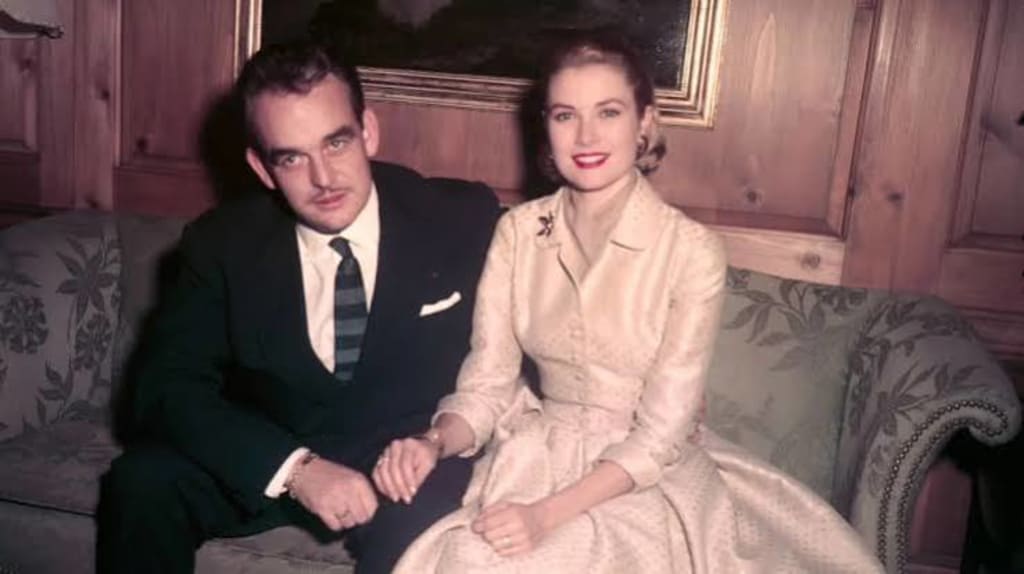
In 1956, Grace Kelly married Prince Rainier III of Monaco.
She was 26 and already an Oscar-winning actress. Hitchcock said she was “like an iceberg, but beneath the iceberg there is a volcano.” She had starred in Rear Window, The Country Girl, and Dial M for Murder. Hollywood’s spotlight followed her.
On her wedding day, thirty million people watched the live broadcast. The wedding dress used 125 yards of silk. The veil was 23 meters long. The media headline read: The fairy tale comes true.
In the first year of that fairy tale, Grace took the Oscar statuette down from the living-room mantelpiece and put it in the deepest part of a drawer. That drawer was never opened again.
Rainier III needed a princess. He did not need an actress. Monaco needed a face. It did not need a film.
Her schedule filled up again: Red Cross, charity galas, diplomatic receptions, royal photo calls. Every morning at nine, the butler placed the day’s schedule on the breakfast table. Grace only had to put on the designated clothes, appear in the designated place, smile, wave, and say, “Delighted to be here.”
Hitchcock later wanted her for Marnie. The script went to the Prince’s Palace. Rainier III glanced at it and said, “The Princess of Monaco does not act in films.” Grace did not argue. She put the script on the coffee table. Three days later, the butler took it away.
Her room in the Prince’s Palace had a window facing the Mediterranean. The curtains were double-lined and thick. Even in daytime, the lights had to be on. When guests came, Grace always sat in the same chair, with that window behind her. Photographers loved the angle. Sunlight came in from behind her, her face in shadow, poised, proper, expressionless.
On September 13, 1982, Grace was driving her younger daughter Stephanie back to Monaco from Roc Agel. At a bend in the mountain road, the car went through the guardrail.
Stephanie later recalled that at the last moment her mother turned the wheel, leaving the passenger side to herself. Grace was still conscious when she reached the hospital. In the early hours of the next day, she stopped breathing.
The doctor said she had not a single piece of jewelry on her. In her pocket was a folded note Stephanie had written to her as a child: “Mom, you are the most beautiful mom in the whole world.”
The note had no signature. Grace had kept it with her all along.
II. Caroline: From the Main Palace to the Side Wing
On January 23, 1957, Caroline was born. A 21-gun salute fired. The newspaper front page read: “Monaco has an heir.”
A year later, her younger brother Albert was born. Another 21-gun salute. This time the newspaper wrote: “At last, a male heir.”
Caroline’s bedroom moved from the second floor of the main palace to the third floor of the side wing. She moved her own books. The palace steward offered to help. She said no. She carried a stack of books through the long corridor, passing her mother’s room. The door was closed.
From that day on, her status changed. Her official title did not change, but everyone knew: spare. Spare to the throne, royal backup tool, permanent transitional figure.
Her schedule was different from her brother’s. Albert had lessons in the morning and could go to the harbor in the afternoon. Caroline had lessons in the morning. In the afternoon there were still etiquette classes, language classes, piano classes. Her French, English, German, and Italian all had to reach native level. She took piano for twelve years and finally won the gold medal at the Monaco music academy. She never performed in public.
Rainier III’s only instruction to her was: “Do not make mistakes.”
When Caroline was 16, she attended a charity gala in Paris. A reporter asked her, “What kind of princess do you want to become?” She answered, “I want to become myself.” The next day, the sentence became a headline. Rainier III called her into his office and talked for forty minutes. She did not talk back. After she came out, she went to her mother’s room. Grace was reading by the window. Caroline sat down beside her. Neither of them spoke. After a long time, Grace said, “When I was your age, I also wanted to become myself.”
Caroline asked, “And then?”
Grace did not answer. She turned the page.
III. First Marriage: The Glass of Water She Did Not Drink
In 1978, Caroline was 21. The palace began arranging blind dates for her. On the list were a Belgian prince, a Luxembourg grand duke, and Spanish aristocracy. She met none of them.
She chose Philippe Junot. He was a French banker, a commoner, eight years older than her. Rainier III objected. Grace was silent. Caroline insisted. On June 28, 1978, the wedding was held in Monaco. Philippe wore a borrowed suit.
In the first year of marriage, Caroline tried to live an ordinary life. She went to the supermarket, bought groceries, and cooked for herself. A reporter photographed her picking tomatoes at the market. The photo appeared on the cover of Paris Match. The headline was: “The Princess’s Ordinary Life.”
The next year, the photo became Philippe and another woman at a hotel entrance. Caroline saw the newspaper at the breakfast table. She put down the newspaper, picked up her phone, and scrolled to the messages. In the inbox were more than a dozen messages from the same number. She did not open them.
She walked to the kitchen, took a bottle of water from the refrigerator, and poured it into a glass. The glass was full. She did not drink. She stood by the kitchen window holding the glass for a long time. The sea outside was gray-blue.
In 1980, divorce. No public statement. The palace press release had one sentence: “Princess Caroline and Mr. Philippe Junot have dissolved their marriage. There are no children. Her Royal Highness will retain her royal title.”
After the divorce, Caroline moved back to the Prince’s Palace. Her room was still the one on the third floor of the side wing. The books were still on the shelf. The piano lid was closed. A layer of dust had fallen on the lid. She never played again.
IV. Second Marriage: The Old Sweater
In 1983, Caroline married Stefano Casiraghi. He came from an Italian magnate family that owned an oil and shipping empire. The wedding was held in Monaco. Rainier III attended in person. The media wrote: “The Princess has finally found a match of equal standing.”
Stefano was tall, handsome, silent. He loved speedboats. Caroline loved them too. They competed in speedboat races together. He steered. She sat beside him. When the wind was strong, she laughed. A reporter once caught that photo: Caroline’s smile, teeth showing, eyes narrowed into slits. It was the most relaxed photo after her marriage.
They had three children: Andrea, Charlotte, Pierre. Caroline raised them herself. She taught them to cook, sew, play piano, ride. She did not hire a nanny. She drove the children to school herself. The teacher said Princess Caroline always sat in the last row at parent-teacher meetings, never asked questions, but took notes every time.
On October 3, 1990, Stefano was competing in a speedboat race in Sanremo. His boat capsized. When the lifeguards pulled him out, he was no longer breathing. Caroline was at home in Monaco. When the phone rang, she was making pasta in the kitchen. She picked up the phone and listened for a few seconds. Then she turned off the flame. The water in the pot was still boiling.
She went to Sanremo. She identified the body. She arranged the funeral. She did not cry the whole time. After the funeral, she returned to the Prince’s Palace and walked into Stefano’s wardrobe. His suits, shirts, and ties hung neatly. She stood for a long time. Finally, she took an old sweater from the hanger. Gray wool, the cuffs a little pilled. It was what Stefano had worn when he first met her.
She took the sweater back to her room. Later, the sweater remained on the chair beside her bed. Later still, the chair was empty. The sweater was gone. No one asked where it had gone.
V. Third Marriage: Two Trays
In 1999, Caroline married Ernst August, Prince of Hanover. It was one of the most elite marriage alliances in European royal circles. The House of Hanover was related to the British royal family. Its title was six hundred years older than Monaco’s.
The wedding was held in Monaco. Caroline wore a white suit, no wedding dress. Ernst wore a gray suit. The ceremony lasted twenty minutes. Fewer than fifty guests.
After the marriage, they lived in a castle in Hanover. The castle had seventy-four rooms. Caroline’s bedroom was in the east wing on the third floor. Ernst’s bedroom was in the west wing on the third floor. A corridor ran between them.
The castle steward later told the media a detail: every evening, the kitchen prepared two trays. One was placed at the door of the east wing. One was placed at the door of the west wing. On Caroline’s tray were a vegetable salad and mineral water. On Ernst’s tray were red wine and steak. The two trays never appeared together.
Ernst had a violent temper. A reporter photographed him yelling at Caroline at the airport. Caroline wore sunglasses and stood motionless. When he finished yelling, she turned and got into the car.
In 2011, Caroline and Ernst separated. They did not divorce. The palace issued no statement. Caroline still used the title “Princess of Hanover.” Ernst still lived in the castle. Caroline moved to Monaco. She bought a villa near the Prince’s Palace, three stories, with a garden. She lived alone.
A reporter asked her, “Why not divorce?” She answered, “Some things are more important than marriage.” The reporter pressed: what things? She said, “Quiet.”
VI. The Hat
After Caroline turned 40, hats became her signature. Wide-brimmed hats, berets, headscarves, hairbands. At all public appearances, her hair was covered. Only the ends occasionally showed: gray-white, fine and soft.
Some media speculated that her hair loss was severe. Some doctors said long-term mental stress can cause hair follicles to shrink. Some stylists said she had several patches of alopecia on her scalp, and covering them with a hat was the most dignified choice.
Caroline never responded to these speculations. She simply stood in front of the mirror before every outing, put the hat on properly, adjusted the angle, and made sure every strand of hair that might show was covered. Then she lowered her hands and smiled.
That smile was one she had practiced for fifty years. The angle of the upturned corners of the mouth, the slight narrowing of the eyes, how much to tuck the chin: all had standards. She had practiced in the mirror countless times. As a child, after marriage, after her husband’s death, after separation, she was still practicing.
Someone asked her whether the hat was a fashion choice or a personal preference. She said, “The hat is part of etiquette.” Then she changed the subject, talking about the weather, charity, her children’s schooling.
VII. Charlene: The One Who Ran
In 2011, Charlene Wittstock married Albert II. She was a South African swimmer and an Olympic athlete. She cried at the wedding. The media said they were tears of happiness. Later there were reports that before the wedding she tried to flee back to South Africa and was stopped at the airport.
Charlene and Caroline lived in the same palace. The relationship between the two sisters-in-law was cold from the start. Charlene did not attend royal family dinners. Caroline did not attend events organized by Charlene. When the two appeared in public at the same time, there were always at least three people between them.
Charlene chose to run. She lived in South Africa most of the year, occasionally returning to Monaco. She did not attend royal duties or fulfill the role of princess. She cut her hair short and dyed it blond. On social media she posted photos of herself surfing, walking the dog, eating with friends. In the photos she laughed loudly, teeth fully exposed, eyes narrowed into slits.
Caroline chose to stay. She remained in Monaco, carried out royal duties, hosted charity galas, and represented the palace at diplomatic events. She attended more than two hundred events a year. Her schedule was fuller than Albert II’s.
The two represented two survival strategies: run and stay. Charlene used escape to fight the system. Caroline used holding the line to buy survival space. The palace tacitly allowed this opposition. If the two women joined forces, they could question the marriage system itself. But they could not stand each other. One thought the other was irresponsible. One thought the other was too obedient.
A reporter asked Caroline what she thought of Charlene. Caroline said, “Everyone has their own path.” Then she adjusted her hat and smiled.
VIII. The Trump Card
Caroline’s clearest-sighted step was to take over her mother’s charity work.
Grace had founded the Princess Grace Foundation, funding art, education, and medicine. After Grace died, the foundation stalled. Caroline took it over. She rebuilt the team, redesigned the projects, and raised funds again. Thirty years later, the foundation had become Monaco’s largest private charitable institution. Every year it funded more than two hundred projects, covering more than forty countries.
Caroline personally reviewed every grant. She had a notebook with a blue cover, in which she recorded the name, story, and amount of every recipient. A staff member said Princess Caroline remembered the name of every child who received help. At Christmas she sent them cards. She wrote the cards herself, with a fountain pen, in neat handwriting.
Besides the foundation, Caroline was president of the Monaco Red Cross, president of the Monaco Arts Festival, and patron of the Monte Carlo Ballet. The charity galas she hosted brought hundreds of millions of euros in donations and attention to Monaco every year.
These titles and posts were the only things she could control. The palace could strip her of her right of succession. It could marginalize her status. It could consume her life. But it could not shake the power she had built over decades in charity, art, and diplomacy.
This was the only lifelong trump card she had won for herself in a loveless, consuming, passive royal family.
IX. Her Family of Origin
Many people ask: She is a princess, financially free, with a top title. Why can’t she stay unmarried for life and live freely alone?
Because ordinary women can lie low, stay single, and walk away. The eldest daughter of a top private circle, the spare heir, the façade tool, has no freedom to stay single.
The palace needs her status match. The circle needs her marriage to seal the arrangement. Public opinion needs her life template. The family needs her marriage alliance as endorsement.
Her life never belonged to herself. It belonged to the entire circle’s system of propriety.
Being single equals a royal scandal. It equals the eldest daughter failing in her duty. It equals the circle’s template collapsing. It equals a gap in the family’s public image.
From birth, she was deprived of the qualification to “escape the chessboard.” She could only enter the game, carry the game, guard the game, consume the game.
An ordinary woman whose marriage is unhappy can rely on her family to back her up, divorce, and cut losses. The eldest daughter of a top circle: her family is the very system that traps her.
Your cage is not given by your husband’s family. It is built by your own family circle. Your husband’s family consumes your emotions. Your family locks your retreat. Your husband’s family makes your marriage painful. Your family makes you powerless to leave.
Her powerful family is the ultimate controller in the world that least wants her to be happy, most needs her to keep sacrificing, and most strictly forbids her to break the cycle.
X. At the End
Caroline now lives in Monaco. Her villa has three stories and a garden. In the garden are olive trees and lavender. She gets up at six every morning, feeds the cat, waters the flowers, reads the newspaper. Then she goes to the foundation office, attends official duties in the afternoon, and goes home at night.
Her four children are all adults. Andrea does business in Monaco. Charlotte is an equestrian athlete. Pierre is in entertainment. The youngest daughter, Alexandra, lives in Germany.
Caroline occasionally eats with her children. She cooks. Pasta, roast chicken, vegetable salad. The children gather around the table, talking, laughing. Caroline sits in the middle, listening, occasionally putting in a word. She wears a hat. She wears it even while eating. No one asks why.
After the meal, she clears the plates, wipes the table, and puts the leftovers into containers. Then she walks into the garden and sits under the olive tree. The sun is about to set. She takes off the hat and places it on her knees.
The wind blows her hair up. Gray-white, fine and soft, several patches of alopecia glinting in the setting sun. She closes her eyes and takes a deep breath. Then she opens her eyes, puts the hat back on, stands up, and walks back into the house.
Tomorrow there are still official duties. Still meetings. Still charity galas. Still smiles. Still hats.
About the Creator
Jin
Writer of reamstories
https://reamstories.com/jin
Enjoyed the story? Support the Creator.
Subscribe for free to receive all their stories in your feed. You could also become a paid subscriber, letting them know you appreciate their work.
Comments
There are no comments for this story
Be the first to respond and start the conversation.