
The Gamble of Mid‑Decade Redistricting: Trump’s Call and the Risk of Backfire
Breaking the Decadal Norm A Nationwide Chain Reaction The Math of Advantage A Shifting Electoral Landscape Pushback and Defiance A High‑Stakes Test

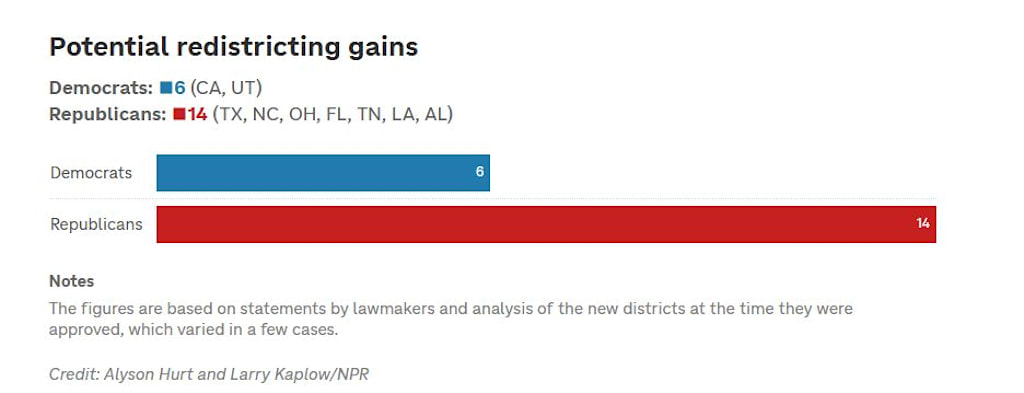
For decades, congressional redistricting followed a steady rhythm: once every ten years, after the census, states redrew their lines. This cycle is different. At President Trump’s urging, Republican‑led legislatures across the South and beyond have redrawn districts ahead of the 2026 midterms, a rare mid‑decade intervention designed to cement GOP control of the House. But as early voting gets underway, the political ground has shifted beneath those new maps, turning what looked like a strategic masterstroke into a high‑risk wager.
Breaking the Decadal Norm
Mid‑cycle redistricting is exceptionally unusual. As Pew Research notes, it has historically been a rarity in modern American politics, constrained by court precedent and the practical difficulty of rewriting boundaries between censuses. That precedent shattered when Trump publicly called for new maps, arguing the party needed to shore up its majority. Republicans responded by tilting roughly eight additional districts their way, a tangible, if narrow, gain. The GOP currently holds 218 seats to the Democrats’ 214, with one independent and two vacancies, a margin thin enough that those redrawn districts could prove decisive.
A Nationwide Chain Reaction
The push to redraw lines triggered extraordinary battles across the country:
Texas issued arrest warrants for Democratic lawmakers who left the state to block the process.
Louisiana’s governor suspended a primary after thousands of votes had already been cast to clear the way for new maps.
In Missouri, the state Supreme Court held the Republican secretary of state in contempt for refusing to abandon a map that had no legal standing.
California and Virginia moved to counter Republican gains with their own redistricting efforts; Virginia’s was later struck down by the courts.
A weakened Voting Rights Act cleared the way in several states for maps that critics say dilute the influence of Black and other minority voters.
Not every state complied. Indiana and South Carolina lawmakers rejected Trump’s call in dramatic fashion, demonstrating that even within the party, there were limits to the push.
The Math of Advantage
The stated goal was simple: lock in gains by crafting districts that favour Republican voters. The result was an estimated net shift of roughly eight seats toward the GOP. In a chamber where control hangs by a handful of seats, that appeared to be a significant buffer. But the strategy rested on a fragile assumption that the voting patterns of 2024 would hold steady into 2026.
A Shifting Electoral Landscape
That assumption is now in doubt. The mood of the electorate has turned sharply. Voters who backed Trump two years ago are drifting away; independents are swinging toward Democrats; turnout patterns favouring the GOP in 2024 have not materialised. The very districts designed to be reliably Republican may now be competitive or even leaning blue. What looked like safe seats on paper could become liabilities if voters punish the party in power.
Critics argue the approach backfired from the start: maps drawn to reflect yesterday’s coalition do not account for today’s disillusionment. In effect, Republicans bet on a snapshot rather than a trend, and the snapshot has aged quickly.
Pushback and Defiance
The process itself also carried costs. In some states, the tactics arresting legislators, halting elections mid‑stream, and ignoring court rulings reinforced perceptions of overreach. Even where the maps stood, the methods used to pass them alienated swing voters and energised opponents. Meanwhile, Democratic counter‑moves in California and Virginia (though partially blocked) signalled that this would not be a one‑sided contest, and that every advantage would be contested.
A High‑Stakes Test
The result is an election unlike any in recent memory. Voters are casting ballots in districts whose boundaries were rewritten specifically to favour one party at a moment when that party’s standing is falling. If the maps hold, Trump’s intervention will be seen as shrewd and effective. If they flip, the redistricting spree will be remembered as an overreach that handed Democrats the very majority it was meant to prevent. Either way, the experiment has rewritten the rules of how and how often political maps are drawn. The outcome will not just determine who controls the House; it will decide whether this controversial new precedent becomes a permanent feature of American politics.
About the Creator
Mark Lim
Hi I am mark an automotive student and a car, tech and food enthusiast ! Im gonna try and post daily & hope you enjoy what I write and do share my page with people you know. I would gladly appreciate it! Cheers
Enjoyed the story? Support the Creator.
Subscribe for free to receive all their stories in your feed.
Comments
There are no comments for this story
Be the first to respond and start the conversation.